 HYGO News
 John Kennedy's opening statement in Barrett Supreme Court confirmation hearing
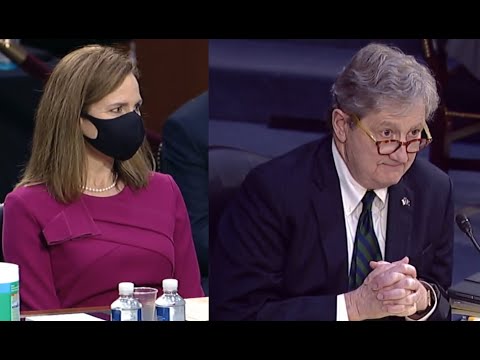
John Kennedy’s Opening Statement in Barrett Supreme Court Confirmation Hearing
On October 12, 2020, Senator John Kennedy (R-LA) delivered a wide-ranging opening statement at Judge Amy Coney Barrett’s Supreme Court confirmation hearing that combined his characteristic folksy humor with a substantive argument against judicial overreach. Kennedy warned that the hearing could “turn sour real fast,” compared the Kavanaugh confirmation hearings to “the cantina bar scene out of Star Wars,” and laid out what he described as the proper constitutional role of the federal judiciary. He defended Barrett against anticipated attacks on her religious faith and her stance on healthcare, while arguing that Congress had abdicated too much of its power to both the administrative state and the federal courts.
A Personal Welcome and a Warning
Kennedy opened on a personal note, claiming Barrett for his home state of Louisiana. “We’re proud of the fact in Louisiana that you were born in Metairie, a suburb of New Orleans, and we’re proud of the fact that you got a solid education at St. Mary’s Dominican High School. Come back and visit us,” he said.
He then set a serious tone by noting the gravity of the position. “I can’t think of another position, at least not a position that is for life, not a position in which the occupant is not elected by the people, that is more powerful, at least not in the Western world, than an associate justice of the Supreme Court,” Kennedy said.
But he quickly pivoted to warning Barrett about what might come. “This thing can turn sour real fast,” he said. “We all watched the hearings for Justice Kavanaugh. It was a freak show. It looked like the cantina bar scene out of Star Wars.”
Defending Barrett Against Anticipated Attacks
Kennedy pre-emptively addressed the attacks he expected Barrett to face, ticking through them one by one: “I know, for someone unaccustomed to it, that it hurts to be called a racist. I think it’s one of the worst things you can call an American. I know that it hurts to be called a white colonialist. And I know it must hurt for someone of deep Christian faith like yourself to be called a religious bigot, and to have it implied that because you are a devout Christian, that you’re somehow unfit for public service.”
He added with dry humor: “Before it’s over with, they may call you Rosemary’s baby for all I know. I hope not.”
Kennedy was especially pointed about the healthcare argument, which Democrats had been framing as a central concern. He said it was “unfair for my colleagues to suggest, some overtly, some more indirectly, that if you’re put on the United States Supreme Court, you will be on a mission from God to deny healthcare coverage for pre-existing conditions for every American. I know that seems preposterous to you, and it seems that way because it is.”
He offered Barrett some reassurance: “Take comfort in the fact that the American people are not morons. They can see drivel when they see it, and they can appreciate it when they see it for being what it is.”
The Role of the Federal Judiciary
The substance of Kennedy’s remarks centered on what he described as the proper constitutional role of the courts. He argued that Americans “don’t have a pure democracy” and that social and economic policy decisions belong to elected representatives who are accountable to voters.
Kennedy identified two institutions that he said had improperly accumulated congressional power. The first was the administrative state: “This giant rogue beast that enjoys power now that only kings once enjoyed. Members of the administrative state write their own laws, they interpret their own laws, they litigate their own laws in their own courts before judges that they oppose, and Congress has allowed that to happen.”
The second was the federal judiciary itself. Kennedy acknowledged that “federal judges don’t make law — of course they make law” through judicial precedent, but argued the founders intended judges to “exercise judicial restraint and to understand the special role, scope, and mission of the federal judiciary vis-a-vis the United States Congress.”
He used Chief Justice John Roberts’s famous analogy with an important addition: “I think our founders intended federal judges to call balls and strikes. I don’t think our founders intended for federal judges to be able to redraw the strike zone.”
Against Judges as Politicians in Robes
Kennedy built his argument against judicial activism with escalating force. “I don’t think our founders intended judges to be politicians in robes,” he said. “Politicians get to vote their preferences under our democracy. Judges do not.”
He went further: “I don’t think our founders intended the United States Supreme Court to become a mini-Congress. I don’t think our founders intended members of the United States Supreme Court to try to rewrite our statutes or the United States Constitution every other Thursday to prosecute a social or an economic agenda that they can’t get past the voters.”
Kennedy pointed to the modern practice of nationwide injunctions as evidence of judicial overreach: “We’ve reached the point where one single solitary judge, in a limited venue, can enjoin a federal statute or an executive order of the president of the United States for the entire country. Our founders never intended that.”
Historical Quotations
Kennedy closed with two quotations that encapsulated his argument. The first was from Justice Benjamin Curtis’s 1857 dissent in the Dred Scott case: “When a strict interpretation of the Constitution, according to the fixed rules which govern the interpretation of laws, is abandoned, and the theoretical opinions of individuals are allowed to control its meaning, we have no longer a constitution. We are under the government of individual men, who for the time being, have power to declare what the Constitution is, according to their own views of what it ought to mean.”
The second came from Justice Antonin Scalia, Barrett’s mentor: “The American people love democracy, and the American people are not fools. The American people know their value judgments are quite as good as those taught in any law school, maybe better. Value judgments, after all, should be voted on, not dictated.”
Key Takeaways
- Senator Kennedy warned Barrett that the hearing could devolve into a “freak show” like the Kavanaugh confirmation, and pre-emptively defended her against anticipated attacks on her religious faith and her supposed intentions to eliminate healthcare protections for pre-existing conditions.
- He argued that both the administrative state and the federal judiciary had accumulated power that properly belongs to Congress, criticizing nationwide injunctions by single judges and the treatment of the Supreme Court as “a mini-Congress.”
- Kennedy framed the proper judicial role through the lens of restraint and originalism, quoting Justice Curtis’s Dred Scott dissent and Justice Scalia’s defense of democratic value judgments to argue that judges should “call balls and strikes” rather than “redraw the strike zone.”