 HYGO News
 Jeffries Elmo Doll to Protest Cuts to PBS; Tim Walz & Pritzker still Woke; Boebert: peaceful protest
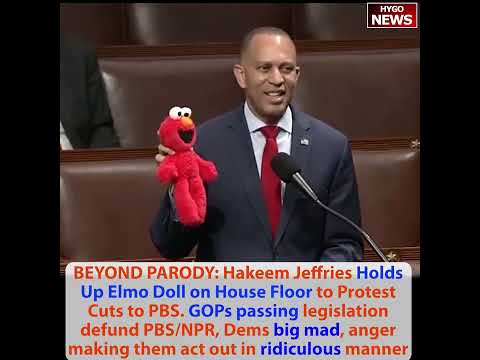
Jeffries Elmo Doll to Protest Cuts to PBS; Tim Walz & Pritzker still Woke; Boebert: peaceful protest
The House hearing with three Democratic governors — Tim Walz, JB Pritzker, and Kathy Hochul — was designed to produce footage. It did. Representative Lauren Boebert, questioning the governors, asked four straightforward questions that exposed the rhetorical architecture of the current Democratic posture on protest, riots, and gender policy. Walz and Pritzker could not answer a yes-or-no question about biological men using women’s restrooms. Pritzker pivoted to attacking January 6 when Boebert asked him whether destroying property counts as peaceful protest. Hochul, to her credit, answered more directly than her colleagues. And House Democratic Leader Hakeem Jeffries stood on the House floor with an Elmo doll to object to the rescissions package that would cut taxpayer funding for Sesame Street programming abroad. Each moment illuminated a different facet of the Democratic Party’s current messaging trouble.
”Republicans Are Attacking Elmo”
The opening line of the transcript — “Republicans are attacking Elmo” — captures the absurdist peak of the Democratic objection to the rescissions package. The image of the House Minority Leader brandishing an Elmo doll on the floor to protest cuts to PBS is the kind of political theater that plays to some constituencies and bewilders others.
The administration’s counter-framing is direct. The rescissions bill does not “attack Elmo.” Elmo is a character in a television program produced by an independent production company. The rescissions package cuts federal funding for specific overseas Sesame Street localizations — a distinct matter from the character’s existence. Jeffries’s theatrical framing conflates federal program funding with the beloved character in a way that the administration believes voters will see through.
”What Is A Woman?”
The hearing then turned to the “What is a woman?” line of questioning that has become a staple of House oversight hearings involving Democratic officials. “What is a woman? What is a woman? Is the question?”
Minnesota Governor Tim Walz’s response: “I’m not sure I understand the question here.”
That response — “I’m not sure I understand the question” — is not an answer. It is a deflection. The question is simple. It has a biological answer. The fact that a sitting governor finds it difficult to answer the question is itself an artifact of current political dynamics on the Democratic side.
The Bathroom Question
Boebert pressed further on the specific policy question behind the definitional question. “Do you think the biological men should be able to use women’s restrooms?”
Walz: “I’m not sure how this has to do with immigration.”
Boebert’s response: “It’s just a yes or no question.”
The deflection — that the question has nothing to do with immigration — is curious given that the hearing was examining multiple policy areas and that Walz had not objected to other non-immigration questions on those grounds. What the response actually signals is that Walz does not have a yes-or-no answer he is willing to give on the record.
”Why Are You Politicizing This?”
Boebert: “Do you think that men should be using women’s restrooms?”
Walz: “Why are you politicizing this?”
The move — claiming the question is political — is the characteristic Democratic move when asked to state a policy position that has become uncomfortable within the party’s coalition. Walz has been, throughout his career, a politician willing to take public positions. His reluctance to take one on a simple question about bathroom access indicates the degree to which the issue has become a minefield.
”Have You Ever Used The Women’s Restroom?”
Boebert then raised what she said was a tweet Walz had sent during the Trump administration’s first term. “You tweeted that as a protest against President Trump, everyone should use the other genders bathroom today. Have you ever used the women’s restroom?”
Walz: “Not that I can recall ever.”
Boebert: “You wanted everybody else to do it, but you didn’t.”
The exchange captures one of the more awkward moments of the hearing. Walz was being asked about a specific prior position — that using opposite-gender bathrooms was a valid form of protest against Trump — and was being asked whether he himself had ever acted on that position. His admission that he had not is the kind of concession that reinforces the charge of hypocrisy.
The Pivot To 2020 And “Mostly Peaceful”
Boebert then pivoted to the protest framing that had animated 2020 and was now animating 2025. “So now we’re seeing these riots everywhere. We’ve heard in 2020 that everything was mostly peaceful. As cities burned down, as people lost their lives, as law enforcement officers lost their lives.”
The “mostly peaceful” phrase had become the cultural shorthand for what Americans across the political spectrum saw as an inaccurate media framing of the 2020 George Floyd protests, many of which escalated into destruction of property, arson, and violence. Boebert was invoking that phrase as a shorthand for the pattern Democrats were now repeating.
The Peaceful Protest Question
Boebert’s core question: “So I just want to ask you three governors. Yes or no is the destruction of private and governmental property. Is that something that fits under your definition of a peaceful protest?”
Walz: “No, it does not.”
That answer, at least, is unambiguous. Walz is willing to say that destruction of property is not peaceful protest.
Pritzker’s January 6 Deflection
Pritzker, asked the same question, chose to deflect rather than answer. “I find it hard to believe that you’re lecturing us about peaceful protest. Look at what happened January 6th. Here at the Capitol, it’s actually on our democracy. That is an insurrection. This is an absolute insurrection. You don’t understand what insurrection is when people are trying to overturn an election here at the Congress.”
The move is the classic Democratic pivot to January 6. Whenever Democrats are asked to answer a specific question about protest violence on their political side of the aisle, the reflexive response has become to invoke January 6 as a counter-example that relieves them of the need to answer.
Why The Deflection Matters
The problem with the deflection is structural. Boebert’s question was whether destruction of property counts as peaceful protest. That question has a yes-or-no answer that is independent of whether January 6 was or was not an insurrection. The answer is no — destruction of property is not peaceful protest, regardless of whose side is doing the destruction. Pritzker could have said that and then argued his separate January 6 point. He chose not to, because the yes-or-no answer would have implicated the conduct of protesters on his side.
Boebert’s Response
Boebert pressed the point. “I started this off showing you before. They were attacking you, by the way. I would expect the same. I’m answering your question. It is outrageous that you are asking us people. Is it peaceful when you’re the one condoning, to destroy private and governmental property? Right here at our Capitol.”
The transcription is choppy, but the argument is clear. Boebert is saying that she has already stated her position on January 6 — it was not peaceful — and she is asking Democrats to state the same position on current property destruction.
Hochul’s Cleaner Answer
New York Governor Kathy Hochul was the third governor asked. “Governor Hochul, does that fit under your definition of a peaceful protest? The destruction of private and governmental property?”
Hochul: “No, and we feel for the business owners and the community for what’s going on there.”
Hochul’s answer is the cleanest of the three. She said no, she said it without pivoting, and she added a note of sympathy for those affected. It is the answer Pritzker should have given and did not. The contrast is revealing.
”Would Lighting These Cars On Fire Fit Under The Definition”
Boebert continued with increasing specificity. “Yes or no? Would lighting these cars on fire fit under the definition of a peaceful protest?”
The answer came back: “No, we reject that.”
The specificity of the question — lighting cars on fire — was designed to make evasion impossible. The answer finally arrived in unambiguous form.
The National Guard Hypocrisy Charge
Boebert then pivoted to a policy contrast. “Governor Pritzker, have you or have you not called for mass protests and mobilization and disruption? Indeed, microphones, megaphone, and going to the ballot box. This was this one. Well, they’re responding in a much different way. Are they not? President Trump also asked for people to peacefully make their voices heard. So it’s okay for you to say that and hold that standard. I just think that this is all hypocritical.”
The hypocrisy charge: Pritzker has called for mass protests and mobilization. Trump has called for peaceful protest. Pritzker has held up the National Guard as a threat to democracy when Trump has called it out. Pritzker has himself called in his own National Guard when circumstances in Illinois warranted. The mismatch between Pritzker’s framing of Trump’s actions and Pritzker’s own conduct in parallel situations is what Boebert is flagging.
”Your Destructive Policies Are Harming American Citizens”
Boebert’s closing argument tied the protest debate to the underlying immigration enforcement debate. “You’ve called in your National Guard. You don’t want President Trump to come in and enforce the rule of law to keep communities safe. And your destructive policies are harming American citizens. We should not have to wait until violence is committed to find out their legal status.”
The argument is that the Democratic governors’ position is internally inconsistent. They are willing to use their own state Guard forces when they perceive a need. They are unwilling to accept federal Guard deployment when the federal government perceives a need. And their opposition to enforcement is causing, in Boebert’s framing, harm to the American citizens they are elected to serve.
”2 Million Unknown Gotaways”
Boebert closed with a specific data point. “We have 2 million unknown gotaways because of Joe Biden’s administration. And we have got to find them and get them out of America. And I thank President Trump and his administration for doing just that.”
The “2 million unknown gotaways” figure refers to individuals who crossed the border without being apprehended during the Biden administration. The number is large, it is contestable at the margins, and it is the figure the administration has used to justify the aggressive deportation operation now underway. Boebert’s invocation closes the loop from the bathroom questions to the protest questions to the core policy question — what does the country do about 2 million people who entered without authorization and were not processed at the time of entry.
Key Takeaways
- Hakeem Jeffries held an Elmo doll on the House floor to object to rescissions cuts to overseas PBS/Sesame Street funding — “beyond parody” imagery the administration happily amplified.
- Walz and Pritzker could not answer simple yes/no questions about biological men using women’s restrooms: “I’m not sure how this has to do with immigration” and “Why are you politicizing this?”
- Pritzker deflected the peaceful-protest question by pivoting to January 6: “You don’t understand what insurrection is” — rather than answering whether destroying property is peaceful protest.
- Gov. Hochul gave the cleanest answer: “No, and we feel for the business owners and the community for what’s going on there.”
- Boebert’s closing: “We have 2 million unknown gotaways because of Joe Biden’s administration. And we have got to find them and get them out of America.”