 HYGO News
 Expert Witness: McKinsey Report Trained Allstate First, Then Took It 'On the Road' to 'Almost Every Other Insurance Company -- Now Industry Standard'; US Forensic Sued for Katrina, Sandy Fraud
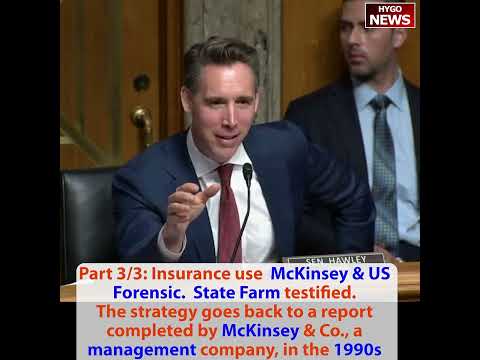
Expert Witness: McKinsey Report Trained Allstate First, Then Took It “On the Road” to “Almost Every Other Insurance Company — Now Industry Standard”; US Forensic Sued for Katrina, Sandy Fraud
Expert testimony at the May 13, 2025 Senate subcommittee hearing exposed that the Allstate claims-manipulation pattern was industry-wide. When asked if the fraud was limited to Allstate, the expert witness was direct: “No, sir. It is pretty much industry-wide. We believe this goes back to the 90s with what’s called the McKinsey Report. Consulting firm trained insurance companies to use their claims department as a profit center. They did it specifically starting out with Allstate and then they took it on the road for almost every other insurance company and it is now basically industry standard.” State Farm’s Michael Keating denied altering reports, but a whistleblower letter read by Hawley stated: “I observed routine and deliberate underpayment of claims, including the consistent removal or alteration of essential line items.” Both Allstate’s Fiato and State Farm’s Keating claimed unfamiliarity with US Forensic — an engineering firm “sued multiple times, found civilly liable for widespread fraud in Katrina and Superstorm Sandy.” Asheville policyholder Jacob Vertel testified his home remained uninhabitable 228 days after Hurricane Helene.
”Industry-Wide, Not Limited to Allstate”
Hawley opened with the industry scope question.
“Can I just ask you, you’ve heard testimony about Allstate and about, frankly, fraud that goes on there. In your view and your professional judgment, is that kind of fraud limited to Allstate?”
The expert witness was clear: “No, sir, it is not, it is pretty much industry-wide.”
Hawley pressed for the mechanism: “Tell us more about that. I mean, it’s industry-wide because why? Tell us what the industry looks like.”
The witness traced the history: “We believe this goes back to the 90s with what’s called the McKinsey Report, consulting firm sort of trained insurance companies to use their claims department as a profit center.”
He described the mechanism: “And they actually trained their staff to come in and short people on claims.”
He explained the spread: “They did it specifically starting out with Allstate and then they took it on the road for almost every other insurance company and it is now basically industry standard.”
The “took it on the road” description was damning. McKinsey had not provided its claims-manipulation strategy to Allstate as an isolated engagement. It had then sold the same approach to other insurance companies, creating what the witness called an “industry standard” of systematic claims underpayment.
The witness described his own experience: “I will say there’s nothing you’re hearing that’s unique. The people that are speaking are unique because they had the courage to do it, but I hear these stories every single day and they are the exact same stories over and over and over and working class families getting taken advantage of by insurance companies without any ability to fight back.”
The “every single day” framing was important. What had been presented as specific Allstate misconduct in the Miguel case was actually the daily experience of claims adjusting work in the American insurance industry. The consistent pattern — policyholders getting low-balled, adjusters being instructed to reduce estimates, legitimate claims being delayed or denied — was not a bug in the system. It was the system.
”Design a Program to Help Rip Off Policyholders”
Hawley summarized the witness’s account.
“So what you’re telling us is these big insurance companies went to a consulting firm, McKinsey, and asked them to design a program to help rip off policyholders?”
The witness confirmed: “That is correct, sir.”
“Has their program been successful in ripping off policyholders?”
“It’s been incredibly successful, sir. It is actually part of the systemic fraud that’s occurring every day now.”
“That’s extraordinary.”
The witness’s characterization — “systemic fraud… occurring every day” — was not hyperbole. It was a factual assessment from someone with professional expertise in claims adjusting. The argument was that the American insurance industry was systematically defrauding policyholders through practices that had been designed as a business strategy by McKinsey in the 1990s and adopted across the industry in the decades since.
The McKinsey role was significant because it implicated one of the world’s most prestigious consulting firms in designing systematic fraud. McKinsey’s role in similar controversies — its work for Purdue Pharma designing opioid sales strategies, its work for authoritarian governments, its work for various corporate clients facing regulatory scrutiny — had become a broader issue by 2025. The insurance claims strategy fit the pattern of McKinsey providing sophisticated advice that enabled ethically questionable corporate conduct.
State Farm’s Different Apology
State Farm’s Michael Keating had taken a different approach than Allstate’s Fiato. Where Fiato had denied and deflected, Keating had apologized to Jacob Vertel during his testimony.
The Senator walked through Vertel’s situation.
“You were a policy holder of State Farm. This is your home after Hurricane Helene. This was taken right after the hurricane, back in September about October, something like that?”
“Right after the storm, yes,” Vertel confirmed.
“And did you say Allstate now has fixed it all up and it’s all good?”
Vertel clarified the company: “State Farm has not. The home sits untouched. Current condition is uninhabitable.”
The Senator asked about the timeline: “So they’ve done nothing in those, you said the number of days, 200 and?”
“228 days of our home being uninhabitable.”
The Senator expanded on Vertel’s personal circumstances: “You have, your wife has since had your second child, is that correct?”
“Two and a half months ago, yes.”
“So you’ve got, okay, so you’ve got a two and a half month old, you’ve got a two year old, nobody gets any sleep in your house, I suspect.”
Vertel’s response captured the human cost: “This keeps us up more at night than they do.”
The 228 days of uninhabitability was the kind of specific number that demonstrated real human consequences. Vertel and his wife, parents of a two-year-old and a newborn, had spent over seven months unable to live in their home after Hurricane Helene. State Farm had provided only “drips of reimbursement” that they had to “fight tooth and nail for.”
The Senator asked about the broader dynamic: “You decided ultimately that you needed to stand up for yourself and actually try to fight State Farm on this. What would have happened though, if you hadn’t have stood up and started to demand your rights?”
Vertel’s answer was the systemic point: “I feel that we were perceived as an easy mark that we needed to be in our home quickly.”
The “easy mark” framing captured the underlying insurance company strategy. Policyholders after disasters were typically desperate, displaced, and financially stressed. They wanted to get back into their homes quickly and had limited resources to fight prolonged legal battles. Insurance companies could exploit this desperation by making low initial offers and counting on most policyholders to accept rather than fight.
The State Farm Whistleblower
Hawley then read from a State Farm whistleblower letter.
“Does State Farm deliberately underpay claims? Do you engage in that behavior?” Hawley asked Keating.
Keating: “No, Senator, we do not.”
Hawley read the whistleblower statement: “I observed routine and deliberate underpayment of claims, including the consistent removal or alteration of essential line items. These were not occasional discrepancies, but part of a broader and consistent pattern of low-balling estimates.”
Keating’s response: “That’s not consistent with the State Farm I know, and I’m certainly not familiar with the individual that’s making those allegations.”
Hawley pressed: “Would you ever alter factual findings from an inspection report like Allstate does?”
Keating: “No, we would not do that, nor do we direct anyone to do that.”
Hawley read more from the whistleblower: “More concerning was the alteration and deletion of factual findings in my reports. In many cases, I documented legitimate damage to vinyl siding that warranted full elevation replacement, only to have the estimate changed to reflect piecemeal spot repairs, contrary to manufacturer specifications and professional standards.”
The “contrary to manufacturer specifications” phrase was technical but important. Building materials have installation specifications that require specific approaches for various types of damage. If an adjuster was forced to recommend “piecemeal spot repairs” when full replacement was required by the manufacturer’s specifications, the result would be repairs that failed prematurely or that violated warranty conditions. The policyholder would end up with substandard work that would need to be redone at additional personal expense.
The Retaliation Pattern
Hawley asked about whistleblower retaliation.
“Do you retaliate against whistleblowers?”
Keating: “No, we do not.”
Hawley read from the whistleblower letter: “It is also my professional concern that whistleblower retaliation is a very real threat within the State Farm System. Others before me have experienced severe consequences for speaking out, and I have reason to believe similar retaliation could result in the end of my ability to work in this industry.”
Keating’s response followed the pattern: “So again, I can’t speak to the specifics because the individual is not here, or I don’t know of those specifics, but it’s inconsistent with the State Farm that I know and that I’ve experienced for 32 years.”
The “State Farm I know” framing was suspicious. Keating was using his personal subjective experience over 32 years to deny the existence of practices that might exist without his personal awareness. A Vice President could easily operate within a company while being unaware of ground-level adjuster pressure practices.
Hawley noted the convenient pattern of executive unfamiliarity: “It’s amazing to me that both of your testimonies are very consistent in one respect, which is that it’s a sudden case of amnesia before this committee. You’ve never heard of any of the stuff that’s happened. You’re unfamiliar with your own company, in your case, Mr. Fiato, before like yesterday. There’s no knowledge whatsoever. I have to say, it’s awfully convenient.”
US Forensic: The Engineering Firm Fraud
The most striking exchange concerned US Forensic, an engineering firm allegedly used by multiple insurance companies.
“Is your testimony that neither of you, you don’t do business with US Forensic?”
Keating: “I’m unaware of that. That firm that you’re referring to.”
Hawley pressed: “You’re not familiar with it, Mr. Fiato?”
Fiato: “Same, I’m unaware.”
Hawley was incredulous: “You’re not familiar with US Forensic?”
Both executives maintained they were not familiar with US Forensic.
Hawley delivered the background: “US Forensic, which has been sued multiple times, was found civilly liable for widespread fraud in Katrina and Superstorm Sandy. Both of your companies have contracted with US Forensic for years, for decades.”
He noted the convenient uncertainty: “Your testimony is today that you’re, what I think you just said, the ranking member, you no longer contract with US Forensic.”
Fiato: “I don’t know if we do.”
Keating: “The same thing, I’m unaware.”
Ranking member Senator Andy Kim summarized: “So in other words, the testimony is, Senator Kim, that maybe they continue to contract the fraudsters, I think. They can’t recall, which is, I think, the theme of today’s testimony.”
The US Forensic pattern was particularly damning because it represented a specific mechanism for the alleged fraud. When homeowners submitted damage claims, insurance companies would have engineering assessments done to determine coverage. If the engineering firm systematically found reasons to attribute damage to pre-existing conditions rather than to the covered event, the claim would be denied or reduced. Hiring an engineering firm known for fraudulent assessments was therefore a way for insurance companies to obtain the outcomes they wanted while maintaining plausible deniability.
The litigation findings against US Forensic made the matter particularly serious. The firm had been found civilly liable for widespread fraud in Hurricane Katrina proceedings. The same pattern had been found in Superstorm Sandy litigation. For senior insurance executives to claim unfamiliarity with a firm that had been subject to major fraud litigation involving their own industry was scarcely credible.
”Executive Amnesia”
Hawley’s characterization of the testimony pattern was trenchant.
“That witness, that sworn testimony, that oath, it’s amazing how often it produces amnesia at these hearings. Sadly, your policyholders don’t have it and they’re suffering because of it.”
The “executive amnesia” pattern was a recurring feature of corporate testimony before Congress. Senior executives, when asked about specific questionable practices, would frequently claim unfamiliarity. This allowed them to avoid direct lying while also avoiding admission of wrongdoing.
The contrast with policyholders’ memories was pointed. Ms. Miguel would remember in detail every day of her 200+ day wait for legitimate claim payment. Vertel would remember every day of his 228 days with an uninhabitable home. Every family that had been denied proper storm damage coverage would remember the specific exchanges, offers, and delays. But the executives responsible for the systems producing these experiences claimed no specific knowledge.
Key Takeaways
- Expert witness: “Industry-wide. McKinsey trained Allstate first, then took it on the road to almost every other insurance company — now industry standard.”
- State Farm’s Keating apologized to Vertel (unlike Allstate’s Fiato); Asheville home uninhabitable 228 days after Helene.
- State Farm whistleblower: “Routine and deliberate underpayment, consistent removal or alteration of essential line items.”
- Both executives claimed no knowledge of US Forensic — engineering firm found civilly liable for Katrina and Sandy fraud.
- Hawley: “Sudden case of amnesia before this committee. Policyholders don’t have it and they’re suffering because of it.”