 HYGO News
 Pelosi in 1996: 'US Tariff 2% vs. China's 35% -- The Biggest and Cruelest Hoax of All'; 'Do Something About This Trade Relationship'
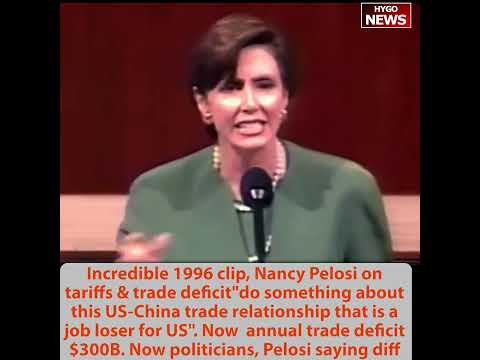
Pelosi in 1996: “US Tariff 2% vs. China’s 35% — The Biggest and Cruelest Hoax of All”; “Do Something About This Trade Relationship”
An extraordinary 1996 House floor speech by Nancy Pelosi resurfaced in April 2025 — and every word she spoke anticipated the Trump administration’s tariff policy by three decades. Pelosi laid out the asymmetry: “The average US tariff on Chinese goods is 2%, whereas the average Chinese tariff on US goods is 35%. Is that reciprocal?” She detailed forced technology transfer, with Boeing moving 737 tail section production from Wichita to China, and called the trade relationship “the biggest and cruelest hoax of all.” Pelosi demanded that Congress “draw the line and say to the President, do something about this US-China trade relationship that is a job loser for the United States.” Thirty years later, the trade deficit had grown from $35 billion to $300 billion — and the politicians who identified the problem, including Pelosi herself, now opposed the president who was finally addressing it.
”Is That Reciprocal?”
Pelosi opened with the tariff asymmetry that was precisely the argument Trump would make in 2025.
“In terms of tariffs, I think it’s interesting to note that the average US MFN tariff on Chinese goods coming into the United States is 2%,” Pelosi said. “Whereas the average Chinese MFN tariff on US goods going into China is 35%. Is that reciprocal?”
She addressed market access: “On exports, China only allows certain industries into China — of US industries into China — and therefore only 2% of US exports are allowed into China.”
The contrast: “On the other hand, the US allows China to flood our markets with a third of their exports, and that’ll probably go over 40%. And it’s limitless because we have not placed any restriction.”
The data Pelosi cited in 1996 was a mirror image of the data the Trump administration cited in 2025. The tariff asymmetry, the market access barriers, the unrestricted flow of Chinese goods into American markets — every element of Trump’s Liberation Day argument had been articulated by Pelosi on the House floor three decades earlier. The only difference was that the numbers had grown enormously worse.
”The Biggest and Cruelest Hoax”
Pelosi delivered her most powerful line on the jobs impact.
“In terms of jobs, this is the biggest and cruelest hoax of all,” she said.
She provided the numbers: “Not only do we not have market access, not only do they have prohibitive tariffs, not only are our exports not let in very specifically, but China benefits with at least 10 million jobs from US-China trade.”
She cited the administration’s own minimization: “The President in his statement requesting this special waiver said that China trade supports 170,000 jobs in the United States. 170,000 jobs. Whereas our imports from China support 10 million jobs — at least.”
Pelosi exposed the misleading framing: “Our colleagues on the other side of this issue will say that trade with China, exports to China, have increased three times in the last 10 years. They have. But they failed to mention that imports from China have increased 11 times — thereby leading to this huge trade deficit.”
The 170,000 versus 10 million comparison was devastating. For every American job supported by trade with China, China gained nearly 60. The trade relationship was not mutually beneficial; it was massively lopsided in China’s favor. And the trend was accelerating: Chinese imports growing 11 times faster than American exports guaranteed that the imbalance would worsen with each passing year.
Technology Transfer: “Exporting Our Technology”
Pelosi described the forced technology transfer mechanism that would become one of the most contentious issues in US-China relations for the next three decades.
“If intellectual property is a $2 billion, $3 billion loss, technology transfer is in the hundreds of billions of dollars,” she said.
She described the process: “If you want to sell your products into China, the Chinese insist that you open a factory there. They misappropriate your technology, open factories of their own, and then say to you, ‘Now we want to see your plan for export.’”
She provided the most dramatic example: “The most serious of these transfers of technology are in the airline industry, where Boeing tail sections — the tail sections of the Boeing 737s — were mostly made in Wichita, Kansas. Now they are made in Shen Province, where workers make $50 a month, and the transfer of the technology and the transfer of the jobs has taken place.”
She noted that major corporations were complicit: “General Motors, Ford — they’re all fighting to get into build factories there, so they can make parts there. They want MFN so they can get those parts back into the United States.”
Pelosi summarized: “So we are exporting, not low-tech jobs and textile jobs — we’re exporting our technology.”
The Boeing example was prophetic. The transfer of 737 manufacturing capability to China in the 1990s was a precursor to China’s development of its own commercial aviation industry. Three decades later, China’s COMAC was producing aircraft designed to compete with Boeing — built on a foundation of technology that American companies had been forced to transfer as the price of market access.
”Who’s Going to Buy Them?”
Pelosi delivered the strategic argument that anticipated Trump’s “America is the cash cow” rhetoric.
“Do you think for one minute that with 10 million jobs at least and 35 billion — and it’ll be over 40 billion dollars this year — in a trade surplus, all those billions of dollars in surplus, that the Chinese are going to walk away?” she asked.
She posed the rhetorical question: “Where are they going to take 35 to 40 percent of their exports? Who’s going to buy them?”
Her conclusion: “This is what sustains the regime — the funding and the jobs. They can’t have those people out of work. They have to be at work exporting to the United States.”
The argument was identical to Trump’s assertion that “America does not need other countries as much as other countries need us.” China’s economic model depended on access to the American consumer market. Without that access, millions of Chinese workers would be unemployed, billions in revenue would disappear, and the Chinese Communist Party’s social contract — prosperity in exchange for political obedience — would be threatened.
Pelosi understood this in 1996. She understood that America held the leverage. She demanded that Congress use that leverage. And then she — and her colleagues — did nothing for 29 years.
Thirty Years of Inaction
The 1996 speech, viewed from the perspective of 2025, was an indictment not of Trump’s tariff policy but of every administration that had failed to implement the policy Pelosi herself had advocated. The trade deficit with China had grown from $35 billion in 1996 to approximately $300 billion by 2025. The technology transfer had expanded from Boeing tail sections to entire industries. The job losses had accumulated from hundreds of thousands to millions.
Every word of Pelosi’s 1996 speech remained accurate in 2025 — and every warning she issued had been realized, to a degree far worse than she could have imagined. The politicians who identified the crisis in the 1990s had presided over its catastrophic escalation for three decades. And now that a president was finally taking the action Pelosi had demanded, she opposed it.
Key Takeaways
- Pelosi in 1996: “US tariff on Chinese goods is 2%. Chinese tariff on US goods is 35%. Is that reciprocal?” — identical to Trump’s 2025 argument.
- She called the jobs impact “the biggest and cruelest hoax of all”: China gained 10 million jobs from the trade while the US gained 170,000.
- She exposed forced technology transfer: Boeing 737 tail sections moved from Wichita to China, where workers earned $50/month.
- Pelosi demanded: “Your member of Congress could have drawn the line to say, do something about this trade relationship that is a job loser.”
- Thirty years later, the deficit grew from $35B to $300B. The politicians who identified the problem — including Pelosi — now oppose the president solving it.