 HYGO News
 Kennedy: "If EVs Are So Swell, Why Do We Have To Pay People To Drive Them?"
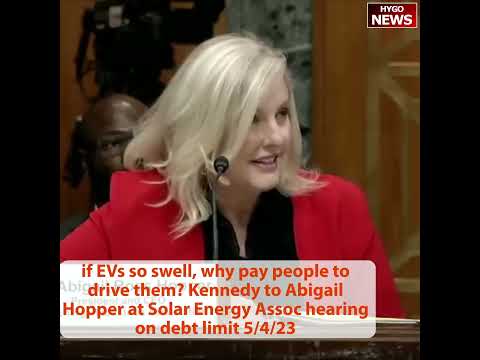
Kennedy: “If EVs Are So Swell, Why Do We Have To Pay People To Drive Them?”
Senator John Kennedy (R-LA) used a Senate hearing on energy and electric vehicle policy to put a folksy question to a witness identified as Ms. Hopper: if electric vehicles are so good, why does the federal government have to pay people to drive them? The witness defended the federal EV tax credit as “a policy to incent more purchase of electric vehicles,” and argued the credit reflects how “most government policies” work — by shaping behavior toward preferred outcomes. Kennedy treated the credit as evidence that EVs cannot yet stand on their own in a “competitive market.” The exchange dramatized one of the most durable Republican critiques of the 2022 Inflation Reduction Act’s EV tax credit framework.
The Tax Credit At Issue
- IRA tax credit: The 2022 Inflation Reduction Act created up to $7,500 in federal tax credits for qualifying EV purchases.
- Used vehicle credit: A separate credit of up to $4,000 covers used EV purchases by qualifying buyers.
- Income limits: The new credit framework included income caps that excluded high earners.
- Sourcing rules: Battery and assembly sourcing requirements made the full credit harder to qualify for.
- Industry impact: The credit reshaped EV pricing and inventory across the U.S. market.
The Kennedy Framing
- Folksy hypothetical: Kennedy used “swell” to frame the credit as overcompensating for an underperforming product.
- Market test: He argued a truly competitive product should not need a public subsidy.
- Behavior question: Why pay people to do something they would do anyway?
- Editorial line: The framing fit a long-running Republican critique of green energy subsidies.
- Hearing record: Kennedy placed the framing into the formal Senate energy hearing record.
The Witness Defense
- Policy framing: Hopper defended the credit as a policy to “incent” particular behaviors.
- Standard tool: She argued the credit is consistent with how “most government policies” operate.
- Editorial pivot: Hopper resisted the framing of the credit as “paying people to drive them.”
- Rhetorical pushback: Kennedy responded “well sure we are” — pointing at the dollar value of the credit.
- Stated goal: Hopper said the policy intent is to drive more EV purchases.
The Policy Logic
- Externality argument: EV credits are typically defended on climate and externality grounds.
- Market failure: Defenders argue private markets don’t price climate externalities correctly.
- Adoption curve: Subsidies aim to accelerate adoption past an inflection point.
- Industrial policy: The IRA framework treats EV adoption as part of broader industrial policy.
- Sourcing leverage: Sourcing rules use the credit to shape supply chain decisions.
The Republican Critique
- Pick-winners objection: Republicans argue federal credits “pick winners” rather than letting markets decide.
- Cost framing: Kennedy framed the credit in terms of cost to taxpayers rather than benefit to drivers.
- Equity concern: Republicans note credit benefits skew toward higher-income buyers.
- Policy stack: The critique pairs with Republican opposition to other IRA energy provisions.
- Hearing record: The critique now sits in the formal hearing record.
The Industry Response
- Manufacturer support: Major automakers — including Ford, GM, and Tesla — support the credit.
- Investment commitment: Manufacturers have committed billions to EV production capacity in the U.S.
- Pricing impact: Credit eligibility has shaped EV list pricing across major manufacturers.
- Battery supply: Sourcing rules have driven new battery and mineral processing investment.
- Adoption forecast: Industry forecasts assume continued credit support through the 2020s.
The Adoption Picture
- Market share: EVs accounted for a growing share of new vehicle sales in 2023.
- Regional concentration: Adoption skews to coastal and high-income markets.
- Charging infrastructure: Adoption depends on continued public and private charging investment.
- Battery cost trajectory: Battery costs have continued to fall, narrowing the EV-ICE price gap.
- Policy contingency: Adoption forecasts depend heavily on continued credit availability.
The Political Stakes
- Election-year horizon: 2024 campaigns will likely use EV policy as a wedge issue.
- Auto state politics: Michigan, Ohio, and Tennessee have substantial stakes in the credit framework.
- Republican coalition: Republican messaging treats EV mandates and credits as a unified target.
- Democratic coalition: Democratic messaging defends the credits as climate and industrial policy.
- Long arc: The credit fight will continue through the 2024 cycle and beyond.
The Sourcing Rules
- Mineral sourcing: Battery minerals must be sourced from the U.S. or free trade partners.
- Battery components: Battery components must be assembled in the U.S. or partner countries.
- Threshold ramp: Sourcing thresholds rise over time, making the full credit harder to qualify for.
- Manufacturer adjustment: Manufacturers have restructured supply chains to maintain credit eligibility.
- Editorial impact: Sourcing rules transformed the credit into an industrial policy tool.
The Income Limits
- Buyer caps: Credit eligibility includes income caps for individual and joint filers.
- Vehicle price cap: A separate cap limits credit eligibility by vehicle MSRP.
- Distributional argument: Caps were intended to address criticism of credit benefits skewing rich.
- Practical effect: Many premium EVs fall above the price cap and lose credit eligibility.
- Dealer mechanics: Dealers can apply the credit at point of sale starting in 2024.
The Charging Infrastructure
- Federal investment: The 2021 infrastructure law funds public charging deployment.
- State role: States deploy charging through joint federal-state programs.
- Private deployment: Private charging networks are expanding alongside federal programs.
- Coverage gaps: Rural and lower-income areas continue to face coverage gaps.
- Adoption tie: Charging coverage shapes consumer willingness to switch from internal combustion.
The Climate Argument
- Emissions reduction: Transportation is the largest source of U.S. greenhouse gas emissions.
- Vehicle lifetime: EVs reduce lifetime emissions even on a mixed grid in most U.S. regions.
- Policy bundle: Credits sit inside a broader policy bundle on emissions, fuel economy, and grid.
- Long arc: Climate goals require sustained adoption over decades, not just initial sales.
- Editorial line: Republicans contest the climate framing as overstated; Democrats stand behind it.
The Manufacturing Footprint
- New facilities: Major battery and EV facilities have been announced across the Southeast and Midwest.
- Job creation: Manufacturers cite tens of thousands of new jobs tied to credit-driven investment.
- Tennessee and Georgia: Both states have hosted major credit-driven manufacturing announcements.
- Michigan: Michigan continues to draw EV investment despite the geographic spread.
- Long arc: The manufacturing footprint will be politically durable across administrations.
The Hopper Witness Posture
- Defensive framing: Hopper consistently defended the credit as standard policy practice.
- Refusal to concede: She declined to characterize the credit as “paying people.”
- Behavior incentive: She used “incent” — the policy term — rather than “pay.”
- Rhetorical limit: Kennedy pressed past the rhetorical limit by noting the dollar value.
- Editorial discipline: Hopper held the policy frame even under direct pressure.
The Linguistic Frame
- Pay vs. incent: The exchange centered on whether the credit is properly described as “paying.”
- Public messaging: The choice of word matters for public messaging on policy programs.
- Republican choice: Kennedy’s choice — “pay people to drive them” — is built for clip distribution.
- Democratic choice: Defenders prefer “incent” or “support” or “credit.”
- Linguistic stakes: How the program is described shapes how it polls.
The Senate Energy Dynamic
- Committee posture: The Senate Energy and Natural Resources Committee handles much of the policy debate.
- Hearing format: Witness panels typically include industry, academic, and advocacy representatives.
- Cross-examination: Senators on both sides use cross-examination to advance broader narratives.
- Hearing record: The hearings produce material used in subsequent floor debates and elections.
- Bipartisan tension: Despite policy differences, the committee maintains substantive working relationships.
The Industrial Policy Question
- Policy precedent: U.S. industrial policy has historically been ad hoc rather than systematic.
- IRA shift: The 2022 IRA represented a significant industrial policy expansion.
- Allied response: Allied countries have responded with their own subsidies to retain investment.
- Trade questions: Allies have raised trade concerns about IRA sourcing rules.
- Long arc: The industrial policy turn will likely outlast any single administration.
The 2024 Implications
- Election positioning: Both parties will use EV policy as a 2024 positioning tool.
- State politics: Auto state politics will shape Senate races in 2024.
- Repeal threat: Republican proposals to scale back the credit will be live in 2024.
- Industry posture: Industry will lobby aggressively to defend credit stability.
- Long arc: Credit stability matters for industrial commitments stretching through the decade.
The Future Of The Credit
- Phased changes: Sourcing thresholds will continue to tighten through the late 2020s.
- Possible repeal: Repeal scenarios depend on 2024 election outcomes.
- Industry adjustment: Manufacturers are positioning for both continuation and partial rollback.
- Consumer impact: Consumer prices and product availability will track credit changes.
- Long arc: The credit will remain a central feature of U.S. auto market politics.
Key Takeaways
- Kennedy asked why the federal government has to pay people to drive electric vehicles.
- Witness Hopper defended the EV tax credit as a policy to incentivize EV purchases.
- Hopper said most government policies operate by incentivizing behavior.
- Kennedy argued EVs would prevail in a competitive market without a credit.
- The exchange dramatized the Republican critique of IRA-era green energy subsidies.
- The credit framework remains a central 2024 election positioning tool.
Transcript Highlights
The following quotations are drawn from an AI-generated Whisper transcript of the hearing and should be considered unverified pending official transcript release.
- “I love solar energy. I just want you to know that. And I love electric cars” — Sen. Kennedy
- “If electric cars are so swell, how come government has to pay people to drive them?” — Sen. Kennedy
- “Most government policies are put in place to incent certain behaviors” — witness Hopper
- “If they’re so swell…why wouldn’t they be choosing electric cars over internal combustion engine cars?” — Sen. Kennedy
- “I wouldn’t characterize as paying people to drive them” — witness Hopper
- “Well, sure we are. We’re giving them a big old tax credit” — Sen. Kennedy
Full transcript: 164 words transcribed via Whisper AI.