 HYGO News
 Hyundai Chair Chung Announces $21B U.S. Investment: Steel Plant, $8B Georgia Auto Plant, 8,500 Jobs -- 'Initiated With Trump in 2019'
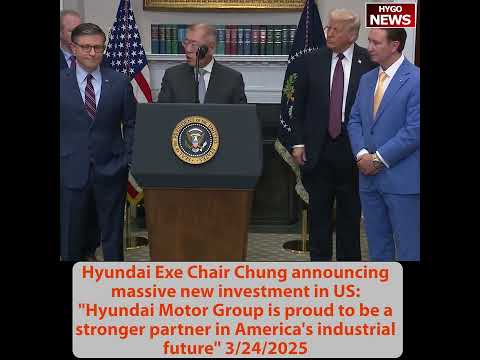
Hyundai Chair Chung Announces $21B U.S. Investment: Steel Plant, $8B Georgia Auto Plant, 8,500 Jobs — “Initiated With Trump in 2019”
Hyundai Motor Group Executive Chair Euisun Chung stood beside President Trump in March 2025 to announce $21 billion in new U.S. investment over the next four years — the company’s “largest U.S. investment ever.” The package included $6 billion to strengthen the American steel supply chain, a new multi-billion-dollar steel facility in Louisiana creating 1,300 jobs, an $8 billion auto plant opening in Georgia with 8,500 jobs, and $3 billion in U.S. liquefied natural gas purchases. Chung revealed that the Georgia investment had been “initiated during my meeting with President Trump in Seoul in 2019,” connecting the second-term announcement to first-term diplomacy.
”Our Largest U.S. Investment Ever”
Chung opened by establishing Hyundai’s long history in the United States before announcing the expansion that would transform that relationship.
“Hyundai Motor entered the U.S. in 1986,” Chung said. “Since then, we have invested over $20 billion and now support more than 570,000 American jobs across all 50 states.”
The existing scale was impressive: $20 billion invested over four decades, supporting more than half a million jobs. But Chung was about to announce an investment that would match four decades of accumulated spending in just four years.
“Today, I’m pleased to announce an additional $21 billion in new investment over the next four years,” Chung said. “Our largest U.S. investment ever.”
The $21 billion figure meant that Hyundai planned to invest more in America in four years of Trump’s second term than it had invested in nearly 40 years of prior operations. The acceleration was not incremental; it was exponential. The company was not gradually expanding its U.S. presence — it was making a generational bet on American manufacturing.
$6 Billion for the Steel Supply Chain
Chung detailed the largest component of the investment.
“A key part of this commitment is our $6 billion investment to strengthen the U.S. supply chain from steel and parts to automobiles,” he said.
He focused on the centerpiece: “We are especially excited about Hyundai Steel’s multi-billion investment in a new facility in Louisiana, which will create 1,300 American jobs and serve as the foundation for a more self-reliant and secure automotive supply chain in the U.S.”
The “self-reliant and secure” language was significant coming from a Korean executive. Hyundai was acknowledging what the Trump administration had been arguing: that global supply chains dependent on overseas production were neither reliable nor secure. The COVID-19 pandemic, shipping disruptions, and geopolitical tensions had demonstrated that companies dependent on transoceanic supply chains were vulnerable to disruptions that domestic production would avoid.
By building a steel mill in Louisiana to supply its auto plants in Alabama and Georgia, Hyundai was creating a fully domestic supply chain that could operate independently of international shipping, foreign trade policies, and the kind of disruptions that had plagued global manufacturing in recent years.
Chung noted the dignitaries present: “To mark this milestone, we are honored to visit President Trump alongside Governor Landry and Speaker Johnson and Leader Scalise, and we are deeply honored to be part of this partnership with the United States and reinforcing our shared vision for American industrial leadership.”
$8 Billion Georgia Auto Plant: 8,500 Jobs
Chung then announced the opening that would mark Hyundai’s transformation into a major American manufacturer.
“This week, we are also proud to open our new $8 billion auto plant in Georgia,” he said. “With this, our U.S. vehicle production will exceed 1 million units per year, as President mentioned.”
He provided the employment figure: “Our U.S. investment in Savannah, Georgia, creating more than 8,500 American jobs.”
Then the detail that connected the Georgia plant to Trump personally: “Was initiated during my meeting with President Trump in Seoul in 2019.”
Chung elaborated: “After that, 2020, in Dallas, I mentioned about the new plant. So American jobs were initiated at the time.”
He noted the symbolism of the timing: “Now, as we proudly marked the completion of this transformative project, in coincidence with the beginning of President Trump’s second term, making this moment even more special.”
The 2019 origin story was significant because it demonstrated that the investment predated the tariff environment of Trump’s second term. Chung had begun planning the Georgia plant during Trump’s first term, when the initial tariffs and the broader message of “America First” had already shifted corporate calculations. The second-term tariffs had accelerated and expanded the investment, but the seed had been planted years earlier.
The 8,500 jobs at a single facility represented the kind of concentrated employment that could transform a community. Savannah and its surrounding area would gain not just the direct auto plant jobs but the multiplier effect of supporting industries — restaurants, housing, retail, and services — that accompanied a major employer.
$3 Billion in LNG: Energy Diplomacy
Chung added an energy component to the investment package.
“Furthermore, HMG will purchase $3 billion worth of U.S. LNG to support America’s energy industry, enhance our energy security,” he said.
The LNG purchase was both an energy transaction and a diplomatic gesture. By committing to buy American natural gas, Hyundai was supporting the Trump administration’s energy dominance agenda while securing its own energy supply. The purchase also created a trade flow that partially offset the trade imbalance between the U.S. and South Korea — a factor that had been central to the tariff negotiations.
”Proud to Be a Stronger Partner”
Chung concluded with a statement that captured the relationship between corporate strategy and presidential leadership.
“All of these efforts will accelerate the localization of our supply chain in the U.S., expand our operations, and grow our American workforce,” he said.
The final line: “With your leadership, Mr. President, Hyundai Motor Group is proud to be a stronger partner in America’s industrial future.”
He extended a personal invitation: “I’d like to personally invite you to visit one of our state-of-the-art manufacturing facilities, see firsthand our commitment to the United States and our American workers.”
Chung closed: “Thank you to our American partners and employees and communities. We are really proud to stand with you and proud to build the future together.”
The Full Package
The Hyundai announcement, when assembled from Chung’s remarks, represented one of the most comprehensive foreign direct investment commitments in American history:
- $6 billion for the steel supply chain, including the Louisiana steel mill
- $8 billion for the Georgia auto plant (opening that week)
- $3 billion in U.S. LNG purchases
- Additional investments bringing the total to $21 billion over four years
- 1,300 jobs in Louisiana, 8,500 jobs in Georgia, plus the multiplier effect across the supply chain
- 1 million vehicles per year in U.S. production capacity
The investment transformed Hyundai from a foreign automaker that sold cars in America to an American manufacturer that happened to be Korean-owned. The steel would be American. The factories would be American. The workers would be American. The energy powering the facilities would be American LNG. The only thing Korean about the operation would be the corporate headquarters.
This was, in concrete form, exactly what the Trump administration’s trade policy was designed to produce: foreign companies investing in American production rather than importing foreign-made goods. The tariffs had changed the calculus; the investment was the result.
Key Takeaways
- Hyundai announced $21 billion in new U.S. investment over four years — its “largest U.S. investment ever” — on top of $20 billion invested since 1986.
- The package: $6B for the steel supply chain (Louisiana mill, 1,300 jobs), $8B Georgia auto plant (8,500 jobs, opening that week), $3B in U.S. LNG purchases.
- U.S. vehicle production will exceed 1 million units per year with the new Georgia plant.
- Chair Chung revealed the Georgia plant was “initiated during my meeting with President Trump in Seoul in 2019” — connecting first-term diplomacy to second-term results.
- Hyundai now supports 570,000 American jobs across all 50 states, with the new investments accelerating “localization of our supply chain in the U.S.”