 HYGO News
 How long to wait for work visa: legal=6 months illegal=3 weeks, Admin incentivize illegal activity
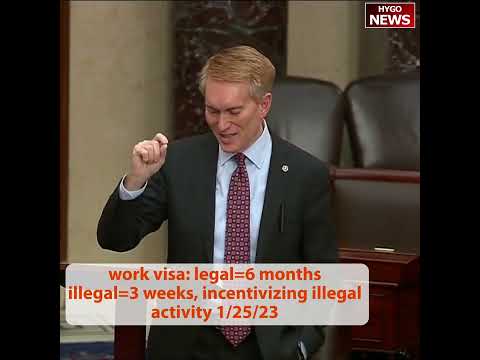
Lankford: Legal Work Visa Takes 6.5 Months, Illegal Entry Plus Parole Gets Work Permit in 3 Weeks
In January 2023, Senator James Lankford highlighted stark comparison in administrative processing times that he argued incentivized illegal immigration. “People from all over the world are coming because there’s an invitation to illegally cross the border. People are coming right now easier to get a job in America if you illegally cross. That’s not just me saying that, that’s the data saying that,” Lankford said. The specific comparison: “If you’re outside the United States and you apply for a work visa and want to be able to come in in a legal normal process to be able to go through, currently it is six and a half months to be able to get that work visa. Six and a half months. But if you illegally cross our border and you’re labeled with parole, which is the mass number of people, or labeled with parole when they illegally cross our border, you get a work permit within three to four weeks.”
The Processing Time Comparison
Processing comparison:
Legal work visa — 6.5 months.
Illegal crossing + parole — 3-4 weeks.
Ratio — ~7x faster illegal.
System dysfunction — Evident.
Policy incentive — Backward.
The processing time comparison was striking. If data was accurate, the current system processed illegal entries with parole much faster than legal work visas. This created perverse incentive.
”Invitation to Illegally Cross”
Lankford’s framing. “People from all over the world are coming because there’s an invitation to illegally cross the border,” Lankford said.
The framing:
“Invitation” — Strong word.
Policy signals — Being sent.
Immigrant behavior — Rational response.
Administration responsibility — Implied.
Attack framing — Effective.
Calling U.S. policy “invitation” was politically charged but had basis. If processing times favored illegal entry, policies were effectively inviting such entries.
”Easier to Get a Job in America If You Illegally Cross”
The specific claim. “People are coming right now easier to get a job in America if you illegally cross,” Lankford said.
The claim:
Easier job access — Via illegal entry.
Compared to legal — Path.
System preference — Backward.
Incentive structure — Broken.
Reform needed — Obvious.
If correct, this claim was damning. Immigration policy supposedly existed to prevent illegal entry. Current system apparently made illegal entry easier path to employment than legal route.
”That’s Not Just Me Saying That”
Data attribution. “That’s not just me saying that, that’s the data saying that,” Lankford said.
The attribution:
Data-based claim — Not opinion.
Objective evidence — Cited.
Research grounded — Position.
Not partisan — Asserted.
Credibility — Enhanced.
By attributing claim to data rather than his opinion, Lankford was strengthening argument. If data supported position, political attacks couldn’t dismiss it.
The Legal Work Visa Process
Legal work visa process:
Application required — From abroad.
Processing time — 6.5 months.
Various steps — USCIS, State.
Background checks — Extensive.
Complex requirements — Multiple.
Legal work visa process was genuinely lengthy. Various checks, documentation, processing steps took months. Cost and complexity were substantial. This was well-documented.
”Six and a Half Months”
Specific time repeated:
6.5 months — Emphasized.
Repeated — For effect.
Specific number — Memorable.
Accountable — Statement.
Stark number — Communicated.
Lankford repeated the specific time for emphasis. This made the number memorable and the claim specific. Fact-checkers would verify, adding accountability.
The Parole Process
Parole process:
Immigration parole — Executive authority.
Various categories — Emerging.
Work authorization — Often included.
Faster processing — Than standard.
Administrative tool — Flexible.
Immigration parole was executive authority allowing entry outside normal processes. Biden administration had expanded parole use. Work authorization was often faster than standard visa routes.
”Labeled With Parole”
The parole labeling. “Or labeled with parole when they illegally cross our border, you get a work permit within three to four weeks,” Lankford said.
The claim:
“Labeled” — Administrative designation.
After illegal crossing — Specifically.
Work permit — Received.
3-4 weeks — Processing.
Fast track — Described.
The claim that people who crossed illegally were “labeled with parole” and quickly received work permits described administrative process. Whether accurate in detail, there was genuine pattern being described.
”The Mass Number of People”
Scale claim. “Which is the mass number of people,” Lankford said.
The scale:
Large numbers — Claimed.
Parole designation — Applied broadly.
Administrative scale — Significant.
Pattern widespread — Not exception.
Rule rather than exception — Implied.
If parole was being used for large numbers, this was systemic issue rather than individual cases. This elevated the policy significance.
”Literally This Administration Is Incentivizing Illegal Activity”
The direct accusation. “Literally this administration is incentivizing illegal activity with how they’re setting up the work permits,” Lankford said.
The accusation:
“Incentivizing” — Direct.
“Illegal activity” — Strong term.
Administrative choice — Implied.
Intentional or not — Effect is real.
Policy critique — Severe.
Saying administration was “incentivizing illegal activity” was strong charge. Even if unintended, if the effect was real, policy criticism was warranted.
The Legal Immigration Supporters
Legal immigration supporters:
Various interests — Business, advocacy.
Concerned — About processing times.
Wait-and-see — Approach.
Legal path valued — In principle.
Administrative reform — Sought.
Many groups supported legal immigration but were concerned about processing inefficiency. If legal path was slow and illegal was fast, this undermined legitimate immigration system.
The Administrative Choices
Administrative choices:
Parole processing — Expedited.
Legal visa processing — Not prioritized.
Resource allocation — Revealing.
Policy priorities — Shown.
Reform possibilities — Clear.
The administration’s choice to expedite parole processing while legal visa processing remained slow was administrative choice reflecting priorities. Reform was possible but wasn’t happening.
The Work Permit Reality
Work permit reality:
Legal process — Slow.
Parole-related — Faster.
Administration decisions — Factor.
Labor markets — Affected.
Legal employers — Frustrated.
Employers seeking legal workers faced long waits. Meanwhile, other workers could be employed through parole processes more quickly. This created labor market distortions.
The Economic Incentives
Economic incentives:
Employers need workers — Yes.
Legal workers — Slow to arrive.
Parole workers — Faster.
Market preference — For faster.
Legal system — Bypassed.
When legal path was slow, employers might favor parole or undocumented workers. This undermined legal immigration system’s integrity and effectiveness.
The Reform Possibilities
Reform possibilities:
Streamline legal — Processing.
Increase staffing — USCIS.
Technology upgrades — Needed.
Processing priorities — Rebalance.
Systemic reform — Required.
Reform was possible but required political will and resources. Making legal processing faster and parole processing consistent would reduce perverse incentives.
The Congressional Role
Congressional role:
USCIS funding — Insufficient.
Processing delays — Result.
Staffing levels — Inadequate.
Modernization — Needed.
Reform legislation — Blocked.
Congress had responsibility for USCIS funding and immigration laws. Processing delays reflected resource limitations Congress hadn’t addressed. Reform legislation had been blocked repeatedly.
The Historical Processing Times
Historical processing:
Decades — Of backlog growth.
Staffing — Not matched demand.
Technology — Lagging.
Complexity — Growing.
Multi-administration — Issue.
The processing time issue spanned multiple administrations. It wasn’t purely Biden responsibility. But current administrative choices affected current processing times.
The USCIS Funding
USCIS funding:
Fee-based — Largely.
Not appropriations — Mostly.
Budget pressures — Real.
Modernization — Costly.
Resource limits — Structural.
USCIS was largely fee-funded rather than appropriations-funded. This created budget constraints. Modernization was expensive and political.
The Legal Immigration Framework
Legal immigration framework:
1965 Immigration Act — Basic structure.
Various amendments — Over decades.
Quotas — Country-based.
Family-based — Categories.
Employment-based — Limited.
The legal immigration framework dated largely to 1965 with various updates. It was seen as outdated by many observers. Reform had been discussed for decades without major change.
The Parole Authority
Parole authority:
Case-by-case — Legally.
“Urgent humanitarian reasons” — Standard.
“Significant public benefit” — Also.
Administrative discretion — Considerable.
Recent expansion — Notable.
Immigration parole was flexible executive authority. Biden administration had used it creatively for expanded programs (Venezuelans, Cubans, Haitians, Nicaraguans). This was legally questioned.
The Lankford Alternative
Lankford alternative:
Enforcement emphasis — Traditional GOP.
Legal channels — Speed up.
System integrity — Maintain.
Incentive alignment — Correct.
Comprehensive approach — Needed.
Lankford had consistently favored enforcement plus legal process reform. His alternative would make legal immigration faster while slowing illegal. This was coherent framework.
The Media Coverage
Media coverage:
Complex issue — Hard to explain.
Processing times — Technical.
Political framing — Variable.
Data claims — Need verification.
Public understanding — Limited.
Processing time comparisons were technically complex. Media coverage often preferred simpler narratives. Public understanding of actual system dysfunction was limited.
The 2024 Campaign Issue
2024 campaign:
Immigration — Major issue.
Specific critiques — Like this one.
Data-based attacks — Powerful.
Democratic vulnerability — Real.
GOP advantage — Possible.
Specific data-based critiques like Lankford’s provided 2024 campaign material. These were more effective than general attacks. The cumulative effect of multiple such critiques could affect electoral outcomes.
The Progressive Critique
Progressive critique:
Enforcement — Opposed.
Humanitarian focus — Preferred.
Parole expansion — Supported.
Faster processing — For all.
Different framework — Entirely.
Progressive critics would respond differently to Lankford’s critique. They would support faster legal processing but oppose enforcement emphasis. The trade-offs were different.
The Moderate Position
Moderate position:
Fix both — Legal and illegal.
Faster legal processing — Supported.
Some enforcement — Maintained.
Compromise possible — In theory.
Rarely achieved — Politically.
A moderate position would support both faster legal processing and some enforcement. This was theoretical compromise position. Political polarization made it difficult to achieve.
The Administrative Response Options
Administrative response:
Dispute data — If possible.
Explain context — Of parole.
Defend choices — Made.
Attack Republicans — Standard.
Process concerns — Address.
Administration had limited good responses to Lankford’s specific critique. Disputing data would be hard if he was accurate. Attacking Republicans wouldn’t address substance.
The Border Community Perspective
Border community perspective:
Firsthand experience — Of dysfunction.
System failures — Visible.
Concerns legitimate — Both ways.
Local impact — Severe.
Federal response — Inadequate.
Border communities saw daily evidence of system dysfunction. Their perspective often combined elements from both parties’ framings. Their direct experience was valuable.
The Employer Perspective
Employer perspective:
Legal workers — Slow to get.
Compliance burden — Heavy.
E-Verify pressures — Various.
Labor shortages — Real.
System dysfunction — Acknowledged.
Employers dealing with legal immigration faced real challenges. Slow processing, compliance requirements, and labor shortages created difficulties. Many preferred predictable systems.
The Immigrant Perspective
Immigrant perspective:
Desperation — Often.
Wait vs. risk — Trade-off.
Smuggler incentives — Clear.
Legal path blocked — Effectively.
Rational choice — Illegal for many.
From immigrant perspective, the choice between 6.5-month wait and 3-4 week parole processing made illegal entry rational. The system wasn’t rewarding legal behavior.
Key Takeaways
- Senator James Lankford highlighted stark processing time comparison in immigration system.
- Legal work visa: “Currently it is six and a half months to be able to get that work visa.”
- Parole after illegal crossing: “You get a work permit within three to four weeks.”
- The perverse incentive: “You could legally do this and wait six and a half months, or you could illegally do this and you get it in three to four weeks.”
- Lankford’s assessment: “Literally this administration is incentivizing illegal activity with how they’re setting up the work permits.”
- The claim was data-based: “That’s not just me saying that, that’s the data saying that” — adding credibility to specific critique of administrative choices.
Transcript Highlights
The following is transcribed from the video audio (unverified — AI-generated from audio).
- People from all over the world are coming because there’s an invitation to illegally cross the border.
- People are coming right now easier to get a job in America if you illegally cross. That’s not just me saying that, that’s the data saying that.
- If you’re outside the United States and you apply for a work visa and want to be able to come in in a legal normal process to be able to go through, currently it is six and a half months to be able to get that work visa.
- But if you illegally cross our border and you’re labeled with parole, which is the mass number of people, or labeled with parole when they illegally cross our border, you get a work permit within three to four weeks.
- So you could legally do this and wait six and a half months, or you could illegally do this and you get it in three to four weeks.
- Literally this administration is incentivizing illegal activity with how they’re setting up the work permits.
Full transcript: 179 words transcribed via Whisper AI.