 HYGO News
 Hawley: 'Why Not Open Courtroom Doors to Normal Americans Against Big Tech?' -- Google Has '$1 Billion' for Legal Risk
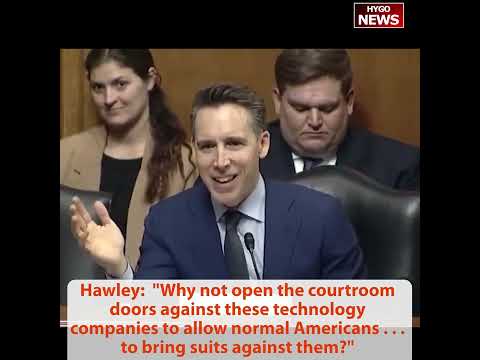
Hawley: “Why Not Open Courtroom Doors to Normal Americans Against Big Tech?” — Google Has “$1 Billion” for Legal Risk
Senator Josh Hawley questioned a Trump DOJ antitrust nominee in April 2025 about opening the courtroom doors to ordinary Americans harmed by big tech monopolies. The hearing revealed that Google’s former chief legal officer had publicly stated the company had “about a billion dollars to manage any sort of legal risk,” while government enforcers operated with “about a tenth of the resources” of their defendants. Hawley proposed empowering private lawsuits under the Clayton Act with increased damages and bounty provisions, arguing: “How would they like to face a billion lawsuits that could run into damage totals of tens of billions, hundreds of billions of dollars?”
The Resource Imbalance: “$1 Billion” vs. Government Enforcers
Hawley opened by asking about the barriers to effective antitrust enforcement against technology companies.
“Antitrust suits that you would think should be brought don’t get brought by the government,” Hawley said. “Suits that you think should be pursued don’t get pursued. Can you speak to some of the barriers to effective antitrust enforcement?”
The nominee’s answer was candid: “Usually what is most challenging for enforcers is having enough resources. These guys are often outgunned by the big tech firms that have unlimited budgets.”
Then the number that framed the entire hearing: “The former chief legal officer at Google said publicly that they had about a billion dollars to manage any sort of legal risk that was presented to them as a company.”
The comparison: “And we have enforcers that even in these trials will have about a tenth of the resources that any individual defendant that they’re taking on might have. So put all of that on turbo speed when it comes to big tech, and the inequity in resources is quite stark.”
Hawley reacted: “That’s startling. A billion dollars. And that’s versus government enforcers who have the resources of the government.”
The billion-dollar legal budget was the figure that explained why big tech companies had been effectively immune to antitrust enforcement. When a company could dedicate a billion dollars to defending itself against government lawsuits, the economics of enforcement broke down. Government lawyers — even well-funded ones — could not match the depth of legal talent, expert witnesses, and litigation resources that a trillion-dollar company could deploy. The result was a system where antitrust laws existed on paper but were functionally unenforceable against the companies that most warranted enforcement.
Why Private Suits Don’t Happen
Hawley explored why private antitrust suits — which the Clayton Act explicitly authorized — were so rare.
“There are private antitrust suits out there, but usually it’s government suits that we see,” Hawley noted. “Is that because of the resource imbalance?”
The nominee explained: “It can be difficult to find a plaintiff’s attorney that’s willing to take on the risk. And when we’re looking at bringing a suit against big tech, you know you are taking on not just the biggest giants of the United States, the biggest giants of the world that have unlimited resources. That can be quite intimidating for anyone who’s running their own law firm.”
A startup representative confirmed the same dynamic: “As a startup, you have to sort of pick your battles.” The company had not brought a private enforcement suit under the Clayton Act because the cost and risk of suing a technology giant with a billion-dollar legal budget was prohibitive for a company trying to survive.
The nominee added another dimension: “It can also be quite scary to take on that public lawsuit for fear of retaliation. We know it’s happening behind the scenes, but once you become the named party in a lawsuit, that can heighten quite a bit that risk.”
The picture was clear: the Clayton Act gave private parties the right to sue monopolists, but the practical barriers — resource imbalance, retaliation risk, and the sheer intimidation of suing a trillion-dollar company — had made that right effectively meaningless.
”Getting Back to First Principles”
Hawley proposed the solution with characteristic directness.
“I just wonder if it’s time we start thinking outside the box a little bit,” he said. “Or maybe it’s not outside the box — maybe it’s getting back to first principles. Because this is after all how the Clayton Act was written.”
He described the original intent: “It was written to allow not just government enforcers — we understand the importance of that — but it was also meant to allow injured private parties to get into court and have a real shot at enforcing the law and recovering damages, treble damages under the current law.”
Hawley outlined specific reforms: “Maybe we ought to increase those damages awards. Maybe we ought to change some of the injury and standing requirements that the courts have imposed that I think frankly are not there in the text, the history of the Clayton Act.”
The nominee supported the approach: “We need to increase the incentives and rewards for bringing these lawsuits. We have bounties in other areas such as securities laws. We could bring that into antitrust.”
He explained the dual benefit: “It’s good for incentivizing the lawsuits to be brought. It’s also good for deterring anti-competitive conduct because the penalties are greater.”
Hawley added: “There’s something particularly market-reinforcing about private suits because you have private actors who in real time are responding to harms. If they are properly incentivized and able to get into court to enforce their rights, that’s good for the company, good for everyone in a similar position, good for the government — the government is not expending resources — and good for the market.”
He praised the original drafters: “As it turns out, the people who drafted the Clayton Antitrust Law were pretty smart, actually. They had a good intuition 100 years ago, and maybe it’s time that we made better on that promise."
"A Billion Lawsuits”
Hawley delivered the rhetorical climax that imagined what private antitrust enforcement could look like.
“Having to face a jury, maybe, with a competitor who’s sitting on the other side of the table and facing a judgment that will run to billions of dollars,” Hawley said. “It really gets the attention of these CEOs and frankly, their shareholders.”
He cited the failure of government fines: “I remember the FTC fined Meta not that long ago. It was a pretty large fine. Meta didn’t meaningfully change their conduct. Their stock price went up the next day after the fine was announced. I mean, it’s ridiculous.”
Then the vision: “How would they like to face like a billion lawsuits that could run into damage totals of tens of billions, hundreds of billions of dollars? I don’t know. Seems like that was the intuition of the drafters of the Clayton Act.”
The Meta example crystallized why government enforcement alone was insufficient. A fine large enough to generate headlines — but small enough that Meta’s stock price rose the next day — was not a punishment; it was a cost of doing business. The company’s shareholders calculated that the fine was worth paying to continue the anti-competitive conduct that generated far more revenue than the penalty cost.
Private lawsuits changed the calculus entirely. A single government fine could be absorbed. A thousand private lawsuits, each seeking treble damages, each decided by a jury, each with the potential for a judgment in the billions — that was an existential threat that no CEO or board of directors could dismiss.
Key Takeaways
- Google’s former chief legal officer said the company had “$1 billion to manage any sort of legal risk”; government enforcers operate with “a tenth of the resources.”
- Private antitrust suits are rare because “taking on big tech with unlimited resources is quite intimidating” and companies fear retaliation.
- Hawley proposed empowering private lawsuits under the Clayton Act: increase damages, add bounty provisions, reduce standing barriers.
- He cited Meta’s FTC fine as proof government enforcement fails: “Meta didn’t meaningfully change conduct. Their stock price went up the next day.”
- Hawley’s vision: “How would they like to face a billion lawsuits running into tens of billions, hundreds of billions in damages?”