 HYGO News
 Hawley Confronts Dem Witness on DEI and Antisemitism: 'If You Assault a Jewish Student, You Ought to Be Out'
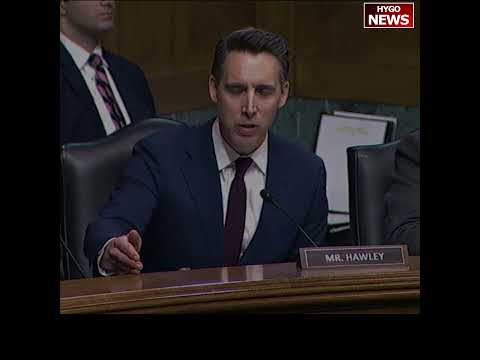
Hawley Confronts Dem Witness on DEI and Antisemitism: “If You Assault a Jewish Student, You Ought to Be Out”
Senator Josh Hawley confronted a Democratic witness at a March 2025 Senate Judiciary Committee hearing on campus antisemitism, pressing Kevin Rachlin of The Nexus Project on his refusal to support revoking visas for foreign students who assault Jewish students. “If you come to this country on a student visa, you are here as a guest of the United States for particular purposes,” Hawley said to loud applause. “If you assault a Jewish student on campus, you ought to be out of here.” Hawley then cited specific examples of DEI officials calling Israel “a genocidal apartheid state” and Jewish students “colonizers,” demanding the witness condemn the practice “full stop, no conditions.” The witness instead defended DEI programs, prompting Hawley to suggest: “Why don’t we just eliminate them?”
The Visa Question: “You’re Out of Here”
Hawley opened by pressing Rachlin on a position that seemed straightforward but that the witness could not bring himself to endorse.
“Did you say that you’re not in favor of canceling visas for foreign students who commit unlawful acts against Jewish students?” Hawley asked.
Rachlin’s answer was hedging: “I said at this time, Nexus does not have a position on that, the organization I work for. And then I went on to describe how in the national strategy, it doesn’t talk about that, doesn’t recommend that, and that was done in consultation with 1,000 leaders across the board and was supported by the ADL, AJC, JFNA, J Street, all of us.”
Hawley pressed: “So you don’t think that’s a good idea? I mean, we’re going to revoke your visa. You’re going home.”
Rachlin struggled: “So I think on that issue itself, sorry, I’m trying to think now…”
Hawley cut through: “You’re out of here. You’re gone.”
The room erupted in applause.
Rachlin attempted a conditional response: “If it was written in the statute, and if it was broad enough to be not just for Jews but for all people that experience discrimination, regardless of who they are, I think that we should look at that.”
Hawley expressed disbelief: “I don’t understand the hesitation here at all. This is an easy call.”
He then described his advocacy for action: “I’ve urged the current Secretary of State, Secretary Rubio, to do this. I think he’s got the authority to do it. My position is it would send an incredibly clear message.”
Hawley delivered the statement that drew the loudest applause: “If you come to this country on a student visa, you are here as a guest of the United States for particular purposes. If you assault a Jewish student on campus, you ought to be out of here. And we ought to make it clear to people that we are not going to tolerate it.”
The exchange exposed the gap between the rhetoric of antisemitism concern and the willingness to act on it. Rachlin’s organization claimed to fight antisemitism but would not endorse the most direct consequence available — deportation of foreign students who physically attacked Jewish classmates. The hedging, the appeals to committee processes, and the insistence on broader language before supporting action revealed an institutional reluctance to impose real consequences.
DEI Officials: “Colonizers” and “Apartheid”
Hawley then shifted to the institutional apparatus that was producing campus antisemitism, citing specific examples from named universities.
“The DEI chair at MIT publicly issued statements calling Israel a genocidal apartheid state,” Hawley said. “You have the University of Washington’s DEI office that sent out an email describing Israel as an ‘unlawful and oppressive settler colonial apartheid state.’”
He added the most visceral example: “The DEI program coordinator at Rutgers said to Jewish students: ‘F you, f you colonizer, f you Zionist.’”
Hawley posed the direct question: “Isn’t it time to speak some truth to power here to these people and to say that Israel is not a colonizer state? It is not an apartheid state. Jewish students are not colonizers, and this kind of rhetoric shouldn’t be weaponized against them. You’d agree with that, surely.”
Rachlin’s response began with agreement but quickly devolved into qualification. “I would say that it’s wrong to blame Jewish students for the actions of the state of Israel in any way, shape, or form,” he said. “And it’s wrong to call the state of Israel a colonial apartheid state.”
But then: “I would say that Israel right now, a number of different human rights organizations talk about them in that sense. Personally, I don’t see them that way. I’ve been there many times. I have family that lives there.”
He continued: “However, there are considerable issues regarding the occupation that need to be addressed.”
The pivot from condemning the “apartheid” label to introducing “considerable issues regarding the occupation” demonstrated exactly the kind of equivocation that Hawley was challenging. A witness who could not condemn the characterization of Israel as an apartheid state without immediately adding qualifications was not the ally Jewish students needed.
”Full Stop, No Conditions”
Hawley made his final push for an unequivocal statement.
“We’re seeing it over and over and over where you have actual campus apparatus — DEI apparatus on these campuses. These are departments, these are officials, these are professors who are weaponizing that against Jewish students,” Hawley said.
He demanded clarity: “My question is, shouldn’t we condemn that? No holds barred. Say that is wrong for DEI officials to be saying Israeli students are colonizers, Jewish-American students are colonizers, Israel’s an apartheid state. That is wrong — full stop, no conditions. Would you agree with that?”
Rachlin’s response was to call for reform rather than elimination: “I would say that a lot of DEI programs need to actually bring into its antisemitism training, either going to other organizations, because so much of what is happening within the DEI program…”
Hawley interrupted with the conclusion: “Or just be eliminated. Why don’t we just eliminate the DEI programs and eliminate the kind of reverse discrimination against Jews that they are promoting?”
The exchange ended with the committee chairwoman thanking the witness for his participation — but the political damage was done. The Democratic witness had been unable to state, without qualification, that foreign students who assaulted Jewish students should be deported, that Israel was not an apartheid state, or that DEI programs promoting antisemitic rhetoric should be condemned. Each hesitation, each qualification, each “however” had made Hawley’s case for him.
The Broader DEI-Antisemitism Connection
The hearing illustrated the administration’s argument that DEI programs were not merely inefficient bureaucracies but active threats to specific groups — in this case, Jewish students. The examples Hawley cited — MIT, University of Washington, Rutgers — showed that DEI offices were producing and distributing antisemitic content under the guise of “social justice” and “anti-colonialism.”
The connection between DEI and antisemitism was not incidental. The ideological framework that powered campus DEI programs — which divided the world into “oppressors” and “oppressed” — categorized Israel as an oppressor state and Jewish students as beneficiaries of colonialism. The rhetoric that followed — “apartheid,” “colonizer,” “genocide” — was not a distortion of DEI ideology but its logical application to the Israeli-Palestinian conflict.
Trump’s executive orders eliminating DEI from the federal government and conditioning federal funding on its elimination from universities were, in this context, not merely about ending racial preferences. They were about dismantling an ideological apparatus that was producing active harm to Jewish students on campuses funded by American taxpayers.
Key Takeaways
- Hawley told the hearing: “If you come to this country on a student visa and assault a Jewish student, you ought to be out of here,” drawing loud applause from the room.
- Democratic witness Kevin Rachlin refused to take a position on revoking visas for foreign students who attack Jewish classmates, saying his organization “does not have a position on that.”
- Hawley cited DEI officials at MIT, University of Washington, and Rutgers who called Israel “a genocidal apartheid state” and told Jewish students “F you, colonizer.”
- He demanded the witness condemn the rhetoric “full stop, no conditions” — but Rachlin instead called for DEI reform rather than elimination.
- Hawley concluded: “Why don’t we just eliminate the DEI programs and eliminate the kind of reverse discrimination against Jews that they are promoting?”