 HYGO News
 Graham: Obliterated is good word for me; Neera Tanden Biden's mental acuity; OMB Vought medical care
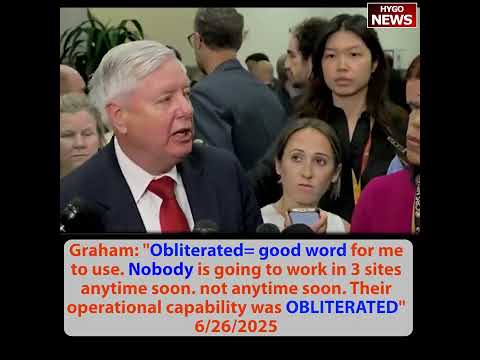
Graham: Obliterated is good word for me; Neera Tanden Biden’s mental acuity; OMB Vought medical care
Senator Lindsey Graham of South Carolina validated the administration’s “obliterated” characterization of the Iran strikes following a classified briefing, offering constituents the same language Trump had used. Former Biden administration senior advisor Neera Tanden testified before the House Oversight Committee about what she knew of President Biden’s mental condition, denying any effort to disguise it. Representative Wesley Bell characterized the Tanden deposition as “an extraordinary waste of time.” OMB Director Russ Vought, in a separate appearance, defended the administration’s rescissions package, noting that taxpayer dollars had been funding LGBTQ advocacy in Uganda, transgender sex workers in Nepal, and “gender blindness” training — all of which the rescissions package would cut while preserving all life-saving medical treatments.
”Obliterated Is A Good Word For Me”
Senator Graham’s opening was direct. “Obliterated is a good word for me to use. I can tell people in South Carolina, nobody is going to work in these three sites anytime soon. They’re not going to get into them anytime soon. Their operational capability was obliterated. There’s nobody working there tonight. It was highly effective.”
Graham’s validation is significant because he has access to classified briefings. He is not offering a political characterization based on public reporting. He is offering a characterization based on his direct access to the intelligence community’s assessments.
“Nobody is going to work in these three sites anytime soon” is the operational framing. Graham’s constituents — his audience for the statement — will understand the claim in terms of what it means for Iranian capability. Iran cannot operate the targeted facilities. Iran will not be able to operate them in the near term. That is obliteration.
Why Graham’s Validation Matters
Graham’s validation is strategically important for the administration. He is a senior Republican senator with a longtime focus on foreign policy and national security. His access to classified intelligence is extensive. His willingness to publicly validate the administration’s damage assessment provides political cover for other Republican senators who might otherwise hedge.
If Graham had said anything less than “obliterated,” the administration’s framing would have been weakened. Graham’s choice to affirm the “obliterated” characterization — and to do so in forceful language — is a form of intra-party validation that shapes how the Republican caucus messages the operation.
Duckworth “Pissed Off”
The video then pivoted to a different story. Senator Tammy Duckworth of Illinois, speaking about the One Big Beautiful Bill, delivered the Democratic framing. “I am pissed off and I hope that everyone here is as well. My Republican colleagues should be ashamed and I am certainly ashamed of them.”
The emotional intensity — “pissed off,” “ashamed” — is strong language from a senator. Duckworth, a veteran who lost both legs in Iraq combat, carries substantial political credibility on veterans’ and military issues. Her characterization of the bill as deserving shame is the kind of statement that can move fence-sitting colleagues.
”Join Me In Voting Hell No”
Duckworth continued. “And I urge every one of my colleagues on the other side of the aisle who claim to care about veterans or families when they’re on the campaign trail to actually spend a half a second proving it when the rubber hits the road. And to join me in voting hell no against this abomination that they’re trying to call legislation.”
“Voting hell no” is the Senate floor equivalent of emphatic rejection. Duckworth is calling for a unanimous Democratic opposition, framed as a test of sincerity for Republicans who have previously claimed concern for veterans and families.
Why Duckworth’s Framing Struggles
The administrative response would be that Duckworth’s characterization does not survive contact with the bill’s provisions. The One Big Beautiful Bill provides expanded child tax credits, a 15% tax cut for Americans earning $30K-$80K, elimination of taxes on tips and overtime, and substantial support for veterans’ care. Duckworth’s description of the bill as an “abomination” that fails veterans and families is not consistent with the bill’s actual contents.
The Democratic framing, repeated by Schumer, Baldwin, Wyden, Jeffries, and now Duckworth, may not survive scrutiny when voters read what the bill actually does. That is the administration’s strategic bet.
The Tanden Deposition
The video then pivoted to the House Oversight hearing on Biden’s mental condition. Former Biden administration senior advisor Neera Tanden had been deposed.
“I just spoke with the House Oversight Committee, Majority and Minority Council. I answered every question, was pleased to discuss my public service and it was a thorough process. And I’m glad I answered every question.”
Tanden’s framing is defensive but cooperative. She appeared. She answered questions. She cooperated with the investigation. That framing positions her as a transparent witness rather than as an evasive insider.
”Was There An Effort To Disguise?”
The reporter asked directly. “Was there an effort to disguise President Biden’s condition?”
Tanden: “Absolutely not.”
The denial is categorical. Tanden is asserting that no administration effort existed to hide Biden’s cognitive condition from the public.
The denial is not inherently credible or incredible. It depends on what evidence exists and how that evidence is interpreted. House Oversight is, in principle, gathering that evidence through its investigation.
”I Got A Tour Of The White House”
Tanden’s characterization of her own exposure to Biden was vague. “Well I got a tour of the White House so I learned about where offices are in the White House. I heard about different spots to have coffee, none of which the President at the time, President Obama, I mean President Biden attended.”
The slip — “Obama, I mean Biden” — is the kind of verbal mistake that reveals the ordinary challenges of discussing multiple administrations. Tanden served under both Obama and Biden. The mistake is easy to make.
The substance of her answer is a denial of direct observation. She got a tour. She saw offices. She heard about coffee spots. But she did not have direct contact with Biden in settings where his cognitive state would have been observable.
Wesley Bell’s Characterization
Representative Wesley Bell, a Missouri Democrat, offered his characterization. “I’m a prosecutor like I said and if you’re going to make a case you got to prove it. And so I didn’t hear anything that suggested any new evidence, anything to suggest that the failed impeachment process was validated in any manner.”
Bell’s characterization is that Tanden’s testimony produced no new evidence. Whatever House Oversight had hoped to establish through her deposition, the deposition did not advance the investigation.
”The Previous President”
Bell then offered a broader reframing. “And again, I look at the economy under the previous President, the economy now. I look at the bipartisan infrastructure bill. I look at the Inflation Reduction Act. I think there’s some things that the administration did that benefited Americans. And I think we need to get back to dealing with working class Americans.”
Bell is pivoting from the mental-acuity question to the achievements of the Biden administration. The framing is the Democratic argument that Biden’s policies benefited working-class Americans, regardless of the broader debate about his cognitive condition.
Whether the characterization holds up to scrutiny is debatable. Critics of the infrastructure bill and the Inflation Reduction Act point to specific provisions that flowed to specific constituencies rather than to working-class Americans generally. But Bell’s framing is the Democratic counter to the ongoing investigation of Biden’s condition.
Vought On Foreign Aid Waste
The video then pivoted to OMB Director Russ Vought. He addressed the rescissions package’s foreign aid provisions. “Americans have been funding the following, 5.5 million to LGBTQ advocacy in Uganda, 800,000 for transgender people, sex workers and their clients in Nepal, 3.6 for LGBTQ activism, free training and pastry cooking, psychological, psychosocial counseling, a cyber cafe and the dance focus groups for male prostitutes in Haiti, and 1.1 million to produce gender transformation in diverse social and behavior change report which advocates again, quote, gender blindness.”
The specific line items Vought is identifying are striking. Taxpayer dollars flowing to LGBTQ advocacy in Uganda. Taxpayer dollars for transgender sex workers in Nepal. Taxpayer dollars for pastry-cooking training and dance focus groups for male prostitutes in Haiti. Taxpayer dollars for “gender transformation” reports advocating “gender blindness.”
Each item will strike most American voters as an unusual use of federal funds. Most Americans assume their taxes fund domestic services, defense, and modest foreign aid for humanitarian purposes. Taxpayer funding of LGBTQ advocacy in other countries — or of dance focus groups for foreign sex workers — is not what most voters imagine when they pay their taxes.
”Shocked And Appalled”
Vought’s framing captured the political calculation. “Most Americans would be shocked and appalled to learn that their tax dollars, money they thought was going to medical care, was actually going to far left activism, population control and sex workers.”
The “shocked and appalled” framing is the administration’s bet. If voters learn about the specific foreign aid expenditures that have been buried in federal budgets, they will support rescinding them. The political strategy is to surface the specific expenditures and force Democrats to defend them individually.
”No Life-Saving Treatment Will Be Impacted”
Vought closed with the critical reassurance. “To be clear, no life-saving treatment will be impacted by this recisions package. Anyone currently receiving life-saving treatment will continue to receive that treatment.”
The reassurance addresses the Democratic critique. Democrats have characterized the rescissions package as cutting “life-saving treatment.” Vought is explicitly denying that characterization. The specific cuts — LGBTQ advocacy, gender transformation reports, foreign prostitute training — do not affect medical care. Patients currently receiving treatment will continue to receive it.
The Rescissions Political Math
The administration’s political math on rescissions is straightforward. If Democrats attack the package, they will have to defend the specific line items being cut. “Fighting to preserve LGBTQ advocacy in Uganda” is not a winning political message in most American districts. “Fighting to preserve medical treatment” is. The administration is trying to force Democrats to defend the former while the administration preserves the latter.
The political challenge for Democrats is that they cannot engage substantively with the rescissions without appearing to defend indefensible line items. The alternative — agreeing to the rescissions — undermines their opposition narrative. Democrats are caught between rhetorical escalation and substantive defensibility.
Why The Specific Items Matter
The specific items Vought named serve a rhetorical purpose beyond the immediate fiscal impact. Even if the line items amount to relatively small sums compared to the full federal budget, they represent categories of spending that most voters do not understand or support.
Political fundraising often depends on voters’ sense that the government spends their money responsibly. When voters learn about specific line items that do not align with their sense of what government should fund, the cumulative effect is erosion of trust in the fiscal structure as a whole.
The rescissions package is therefore not just a fiscal exercise. It is a political exercise in rebuilding voter trust that the federal budget reflects American values. Removing line items that do not match those values, in the administration’s framing, is both fiscally and politically useful.
The Day’s Strategic Integration
The day’s multiple threads — Graham validating the Iran operation, Duckworth attacking the One Big Beautiful Bill, the Tanden deposition producing no new evidence, Vought identifying specific foreign aid waste — all fit within the administration’s broader strategic positioning.
Graham’s validation supports the Iran narrative. Duckworth’s attack demonstrates Democratic opposition as emotional rather than substantive. The Tanden deposition’s lack of findings validates Republican claims that Biden’s condition was concealed without producing the documentary evidence Democrats demand. Vought’s line items demonstrate concrete spending choices that Americans will find hard to defend.
Each thread serves a different strategic purpose. Collectively, they shape the political environment in which the administration operates.
Key Takeaways
- Graham’s validation: “Obliterated is a good word for me to use…Their operational capability was obliterated. There’s nobody working there tonight.”
- Duckworth on the One Big Beautiful Bill: “I am pissed off and I hope that everyone here is as well. My Republican colleagues should be ashamed.”
- Tanden on the Biden condition: “Absolutely not” in response to whether there was an effort to disguise it.
- Rep. Wesley Bell: “The only thing extraordinary that came out of that deposition was it was an extraordinary waste of time.”
- Vought on foreign aid: “$5.5 million to LGBTQ advocacy in Uganda, $800,000 for transgender people, sex workers and their clients in Nepal…No life-saving treatment will be impacted by this rescissions package.”