 HYGO News
 GAO: Half of COVID Purchases Flagged for Fraud Were Never Investigated; $1.2M Sent to Offshore Account
GAO: Half of COVID Purchases Flagged for Fraud Were Never Investigated; $1.2M Sent to Offshore Account
During a February 12, 2025, House Natural Resources Committee hearing, a Government Accountability Office official testified that nearly half of COVID-era spending made through purchase cards at the Bureau of Indian Education involved transactions “at elevated risk for fraud and misuse” — and that none of those flagged transactions were ever investigated. The testimony revealed $13.8 million in unallowable spending at 24 schools, one school that transferred $1.2 million of federal funds to an offshore account, and suspicious purchases involving PayPal, Venmo, and $2,000 in gift cards at electronics stores. Rep. Lauren Boebert pressed the witnesses on school conditions and school choice, while the GAO official committed to working with DOGE to ensure taxpayer dollars were spent properly.
Nearly Half of Purchases Flagged for Fraud
The GAO official’s testimony opened with a statistic that captured the scale of the oversight failure. “The Government Accountability Office found nearly half of COVID spending that was made with purchase cards at the Bureau involved transactions at elevated risk for fraud and misuse,” the official said.
The Bureau of Indian Education (BIE), which operates within the Department of the Interior and administers federal schools serving Native American students, had received substantial COVID-era funding. The GAO’s review found that the money was not merely misspent but potentially stolen, with systematic failures in the controls that were supposed to prevent fraud.
The specific dollar amounts were staggering for an agency of BIE’s size. “There was $13.8 million in unallowable spending at 24 schools,” the official testified. Even more alarming: “One school transferred $1.2 million of federal funds to an offshore account.”
The offshore transfer was perhaps the most disturbing finding. A school that served Native American children — many of them in facilities the GAO described as having “leaking roofs and walls, mold, and signs of asbestos” — had moved $1.2 million in taxpayer funds to an account outside the United States. The official did not elaborate on the purpose of the transfer or whether it had been investigated, but the mere fact that it occurred demonstrated the absence of basic financial controls.
PayPal, Venmo, and $2,000 Gift Cards
The GAO official then described the specific types of transactions that had been flagged as suspicious but never followed up on.
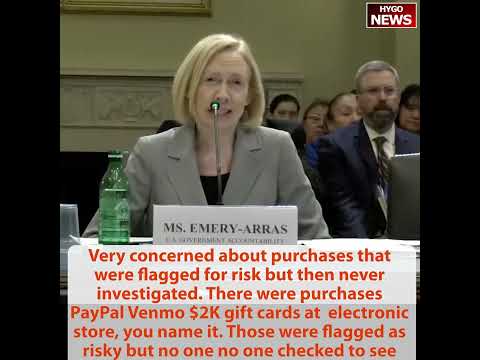
“We are very concerned about the credit card purchases that were flagged for risk but then never investigated,” the official said. “There were purchases involving PayPal, Venmo, $2,000 in gift cards at an electronics store — you name it. And those were flagged as risky, but no one checked to see what was going on.”
The list of transactions read like a textbook case of government procurement fraud. PayPal and Venmo are peer-to-peer payment platforms typically used for personal transactions, not official government purchases. Gift cards are a well-known vehicle for fraud because they convert traceable government funds into untraceable cash equivalents. The fact that these transactions were flagged by the system’s own risk detection software but never investigated meant that the controls existed on paper but were not enforced in practice.
The GAO had made recommendations to address the problem. “We have recommendations to BIE to actually use existing software that it has to investigate those charges and determine whether they are in fact fraudulent,” the official said. The revelation that BIE possessed fraud detection software but was not using it added another layer of institutional failure to the story.
Schools in “Extreme States of Despair”
The hearing then shifted to the physical condition of the schools where BIE was supposed to be directing federal education dollars. The contrast between the fraud and the facilities was devastating.
“Several schools are in extreme states of despair due to leaking roofs and walls, mold, and signs of asbestos,” Boebert noted. “How are students able to receive a quality education in these conditions?”
The GAO official acknowledged the severity but noted the agency had not specifically studied the educational impact. “We have not looked specifically about how education has been impacted on the students as a result of these conditions, but I think it’s fair to say that we all recognize that the students aren’t going to have a good education if they’re in these facilities,” the official said. “And that’s exactly why we’ve prioritized this work for the last 10 years.”
The juxtaposition was impossible to miss. Federal dollars that could have been used to repair crumbling school buildings were instead flowing through PayPal, Venmo, and gift card purchases that no one bothered to investigate. Children were sitting in classrooms with moldy walls and leaking roofs while $1.2 million went to an offshore account and $13.8 million was classified as “unallowable spending.”
Boebert pressed the point: “I think you would agree that that money could have been better spent on outdated facilities, teacher shortages, safety concerns, and inadequate infrastructure impacting tribal-controlled schools. Is that correct?”
“We believe that the federal funds need to be safeguarded from fraud and misuse. Yes, ma’am,” the official confirmed.
GAO Commits to Working with DOGE
In what became the most forward-looking moment of the hearing, the GAO official committed to cooperating with Elon Musk’s Department of Government Efficiency.
“GAO planned to work with the Department of Government Efficiency to ensure taxpayer dollars are spent properly at BIE,” the official said. “We work with every new administration to share information on the programs and operations of the federal government, and we will do the same this time.”
The commitment was significant because the GAO is a nonpartisan agency that reports to Congress, not the executive branch. Its willingness to coordinate with DOGE — an executive branch initiative — on the BIE fraud problem suggested that the institutional accountability apparatus recognized the severity of the waste and was prepared to work across institutional boundaries to address it.
For DOGE, the BIE case provided exactly the kind of concrete, documented fraud that supported its broader mission. The GAO had already done the investigative work and identified the specific failures. DOGE’s role would be to ensure that the recommendations were actually implemented and that the financial controls were enforced — something the BIE had failed to do despite a decade of GAO findings.
Boebert on School Choice for Tribal Communities
Boebert concluded her questioning by connecting the BIE’s failures to the school choice debate. “Do you think that this is providing an opportunity for our tribal members to explore school choice and have funding go directly towards the parents so they have those resources and are able to choose where their child goes to school and receives their education?” Boebert asked.
The GAO official declined to offer a policy recommendation on school choice but expressed willingness to provide analysis. “We haven’t done an analysis of that issue yet, but we would be happy to talk to your staff about how we could help or provide any additional information about that,” the official said.
Boebert made her position clear: “I think school choice would be valuable to them and certainly having those resources follow the student.”
The school choice argument gained particular force in the context of BIE’s documented failures. If the federal government could not prevent $13.8 million in fraudulent spending at its own schools while those schools’ roofs leaked and walls grew mold, the case for allowing parents to direct funding to schools of their choosing — schools that were actually providing quality education in functional facilities — became considerably stronger.
Key Takeaways
- GAO found that nearly half of COVID-era purchase card transactions at the Bureau of Indian Education were flagged for fraud risk but never investigated, including PayPal, Venmo, and $2,000 gift card purchases.
- One BIE school transferred $1.2 million of federal funds to an offshore account, while $13.8 million in “unallowable spending” was identified across 24 schools.
- BIE possessed fraud detection software but was not using it, prompting GAO recommendations that had gone unimplemented for years.
- Schools serving Native American students were described as in “extreme states of despair” with leaking roofs, mold, and asbestos — while federal funds were being diverted to untraceable purchases.
- The GAO committed to working with DOGE to ensure proper spending at BIE, and Rep. Boebert argued the failures strengthened the case for school choice in tribal communities.