 HYGO News
 GOP Rep Chip Roy on BBB: Senate failed us, Rep Norman (R-SC): I'll vote against it; McBride: cruelty
GOP Rep Chip Roy on BBB: Senate failed us, Rep Norman (R-SC): I’ll vote against it; McBride: cruelty
The One Big Beautiful Bill’s passage through the Senate did not end the administration’s legislative challenge. House Republican conservatives — led by Representative Chip Roy of Texas — publicly declared that the Senate had “failed” the House and that the Senate’s modifications to the bill required House rejection. Representative Ralph Norman (R-SC) committed to voting no on the bill until it was corrected. The administration now faced the problem of House passage of a Senate-modified bill that House conservatives viewed as inadequate. Democrats simultaneously escalated rhetoric — Rep. Sarah McBride calling the bill “trickle down cruelty” that would cause deaths, Rep. Angie Craig dismissing the bill’s provisions. The final push toward July 4 signing would require House Republicans to accept the Senate’s modifications or the bill to be sent to a conference committee.
”My Colleagues In The Senate Failed Us”
Representative Chip Roy opened with the conservative caucus position. “My colleagues in the Senate failed us. My colleagues in the Senate failed us. They sent us a bill knowingly, using a policy baseline gimmick.”
The repetition — “failed us” stated twice — captures Roy’s intensity. The Senate, in Roy’s framing, did not merely modify the House bill. They used “a policy baseline gimmick” — a specific accounting mechanism that makes the bill’s fiscal impact appear better than it actually is.
The specific gimmick Roy is likely referencing involves assumptions about future tax policy. The CBO scoring assumes various tax provisions expire at various points. The Senate’s version of the bill, in Roy’s analysis, manipulates those assumptions to make the bill’s projected fiscal effect appear more favorable than a realistic projection would show.
”They Sent It Knowingly”
Roy extended the accusation. “They sent it knowingly, and they sent it knowing that it was going to have increased deficits. Do they even care? Every yes vote shows very clearly that they don’t.”
“Every yes vote shows very clearly that they don’t” is the accusation that senators who voted yes are, in Roy’s view, either ignorant of or indifferent to the bill’s fiscal problems. Neither option is flattering to the senators.
The House conservative critique of the Senate has been building throughout the legislative process. House conservatives wrote a bill with more aggressive spending cuts. The Senate moderated those cuts. House conservatives viewed the moderation as unprincipled accommodation. Now that the Senate has passed its version, the House conservatives are publicly objecting.
”Trickle Down Cruelty”
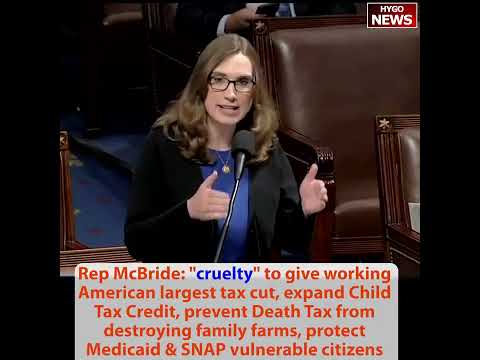
Representative Sarah McBride offered the Democratic framing. “This bill is trickle down cruelty, and people will die because of it.”
“Trickle down cruelty” is a rhetorical construction. “Trickle-down economics” is the classical critique of supply-side tax policy — that benefits to the wealthy “trickle down” to everyone else. McBride is fusing “trickle down” with “cruelty” to suggest that the bill is not just unwise economics but actively harmful.
“People will die because of it” is the most extreme characterization. The claim requires specific causal mechanisms linking specific bill provisions to specific deaths. Those mechanisms would involve Medicaid coverage losses, food assistance reductions, or similar specific program changes leading to premature death.
Whether the causal chain holds up depends on what the bill actually does to specific beneficiaries. The administration’s counter is that the bill preserves Medicaid and SNAP for the genuinely needy while reducing benefits for able-bodied adults who can work. Under that framing, no deaths follow from the bill. Under McBride’s framing, the bill’s changes to benefits produce deaths.
The Angie Craig Framing
The video then pivoted to Representative Angie Craig of Minnesota. “The White House says Senate Democrats voted against lower taxes, bigger paychecks, stronger national security, and more. How do you respond to that?”
Craig’s response. “Democrats agree that we need to have strong border security, and we’re willing to discuss that in a separate forum. But for goodness sakes, we’re talking about just about 60 cents a day in savings for individuals who make $50,000 a year or less. They were adding debt to our children and grandchildren who are defenseless. Debt is a curse.”
“60 cents a day in savings for individuals who make $50,000 a year or less” is Craig’s specific counterclaim. She is arguing that the bill’s tax savings for middle-income Americans are trivial — only 60 cents per day, which annualizes to approximately $219.
The 60-cent figure is much smaller than the administration’s claims. The administration has cited tax savings ranging from $5,000 to $14,700 for families of four. Craig’s figure appears to address a different metric — perhaps daily cash savings for single individuals at specific income levels rather than family-of-four annual totals.
Both figures can be accurate if they are measuring different things. Daily cash savings for single $50K earners might indeed be 60 cents. Annual family-of-four tax reductions might indeed be $5K-$14K. The political framing depends on which metric is highlighted.
Craig’s Debt Framing
Craig then pivoted to the generational debt argument. “And, Jody, you were right. We got to reverse a curse. And what the Senate did is unconscionable. What they did to our bill was unconscionable.”
“Reverse a curse” frames the fiscal debate in generational terms. Debt, in Craig’s framing, is not just a fiscal balance sheet issue — it is a moral obligation to future generations. Adding debt is cursing those generations.
The administration’s counter is that the bill’s growth effects will address the debt problem more effectively than the alternative. Continued current trajectories produce escalating debt regardless of party. The bill’s combination of tax cuts, growth provisions, and spending reforms, in the administration’s framing, addresses the underlying fiscal imbalance.
The Mamdani Tangent
Craig then pivoted to attack Mamdani’s New York mayoral candidacy — unusual for a Minnesota Democrat. “That’s why I will be, unlike my Democrat colleagues, they will not support anything that’s… I mean, their new leader in New York, Mandani, government-run stores, government-run gas stations, government-run apartments. I wonder how many U-Haulets are now leaving New York, and the theory, the socialist theory, just does not work.”
The tangent is revealing. Craig, representing a more moderate Midwestern Democratic district, is distancing herself from Mamdani’s New York democratic socialism. The specific policy critiques — government-run stores, government-run gas stations, government-run apartments — are attacks on Mamdani’s platform from within the Democratic Party.
“How many U-Hauls are now leaving New York” is the practical critique. If Mamdani’s proposed policies are implemented, New Yorkers (particularly those with the means to relocate) will leave. The outflow will hurt New York’s tax base, its economic dynamism, and its political power. Socialist economic theory, Craig is arguing, produces this outflow pattern consistently.
This is the kind of intra-party critique that reveals the strain within the Democratic coalition. Moderate Democrats from competitive districts cannot afford to be associated with Mamdani’s positions. Progressive Democrats from safe seats can embrace them. The party’s ability to present a unified national message is constrained by those internal divisions.
Norman’s Vote Commitment
Representative Ralph Norman (R-SC) then offered his specific vote commitment. “I’m against this because of what the Senate did. I’ll vote against it here, and I’ll vote against it on the floor until we get it right.”
“Until we get it right” is the conditional framing. Norman is not categorically opposing the bill’s substance. He is opposing the specific Senate-modified version. If the bill is corrected — either through House modifications or through conference committee negotiation — Norman could support a final version that addresses his specific concerns.
”Tax Cuts Don’t Expire Until December”
Norman then offered his procedural analysis. “The good news, we’re going to pass the tax cuts. The tax cuts don’t expire until the December of this year. We’re going to pass the tax cuts. And I think we’re going to go back to the drawing table. It is my hope.”
The observation is important. The 2017 tax cuts that the bill extends are scheduled to expire at the end of 2025. Congress has until December to act before the automatic tax increases take effect. If the current bill fails, there is still time to produce a different bill that addresses the tax cut extension.
“Back to the drawing table” is Norman’s preferred path. The House could reject the Senate bill, negotiate modifications through conference committee, and produce a final version that House conservatives can support. The process takes longer than July 4 passage but preserves the bill’s core priorities.
”We’ll Go Back To The Drawing Table”
Norman continued. “We’ll go back to the drawing table and get very close to what we sent the Senate, because instead of each individual senator getting a goodie bag and sacrificing the health of this country, is an abomination to, again, the founders and the 56 senators of Declaration of Independence.”
“Goodie bag” is Norman’s characterization of the Senate’s modification process. Individual senators, in his framing, extracted specific concessions that benefited their particular priorities or constituencies. The cumulative effect of all those concessions is a bill that is fiscally weaker than what the House had produced.
“The 56 senators of Declaration of Independence” is a historical reference. The Declaration was signed by 56 representatives across the 13 colonies. Norman is invoking that founding-era standard of principled commitment as a contrast to what he views as the current Senate’s transactional process.
”The American People Will Be Better Off”
Norman closed with the confidence framing. “So I do think that hopefully we’ll get to that. We’re not there yet, but I think hopefully we will be, and the American people, will be better off for it. I yield back.”
“The American people will be better off” is the objective that Norman is pursuing. His opposition to the current Senate version is not obstruction for its own sake — it is effort to produce a better final bill. If the back-and-forth between House and Senate produces a bill closer to House priorities, American citizens benefit from the more rigorous fiscal framework.
The Craig Counter-Attack
An exchange between Craig and presumably Norman then produced one of the more memorable moments. “The gentleman just took a swipe at me. Let me return a swipe. I think he spent too much time at Murilago and with people who are well off and well connected. He needs to spend a little bit more time talking to people who are struggling in this country.”
“Spent too much time at Mar-a-Lago” is Craig’s personal attack on Norman. The argument is that Norman has become disconnected from ordinary Americans through his engagement with wealthy Republican donors at Trump’s Florida property.
Whether the attack is accurate or fair depends on Norman’s specific personal practices. Members of Congress who accept donor engagement are not, by that fact, disconnected from their constituents. But Craig’s framing is that Norman’s fiscal conservatism — his opposition to the Senate bill’s modifications — reflects wealthy-donor priorities rather than working-class priorities.
The counter-framing, which the administration has pushed, is that working-class Americans benefit directly from the bill’s specific provisions. No tax on tips benefits service workers. No tax on overtime benefits first responders and healthcare workers. Expanded child tax credits benefit families with children. Fiscal discipline over the long run preserves the programs working-class Americans depend on.
”Three People Will Vote Against The Rule”
The video closed with a practical procedural observation. “And by the way, I think we just have another announcement of somebody who’s opposed to the bill you posted the rule to. Yes, I’m going to vote against the rule, and I’m going to vote against it. So that’s three. We get one more than we’re done for today, and we’re going to work out something different.”
The procedural vote is the “rule” vote — the House vote on the parameters under which the bill will be debated. If the rule fails, the bill cannot proceed to final passage. Republican leadership needs every vote for the rule, because Democrats universally oppose the bill.
“Three people” opposing the rule, with one more making it “done for today” means the rule will fail if four Republicans defect. That mathematics gives specific Republicans enormous leverage. Each conservative who threatens to vote against the rule can extract specific concessions from leadership.
”Unless You Cave”
The speaker closed with the practical observation. “I don’t even get this thing to the floor unless you cave, which has become a…”
The transcription cuts off, but the meaning is clear. The speaker is saying that Republican leadership cannot get the bill to final passage without making concessions to conservative dissenters. “Which has become a…” presumably continues with a characterization of the pattern — perhaps “habit” or “routine.”
The leverage pattern has been defining the House Republican caucus throughout the current Congress. Small groups of conservatives can hold up major legislation by threatening rule votes. Leadership has had to make concessions repeatedly to move bills forward. The dynamic complicates the leadership’s ability to enforce discipline on other matters.
The Path Forward
The House vote remains uncertain as of this coverage. Conservative dissenters — Roy, Norman, and others — are publicly opposing the Senate version. Democrats are universally opposed. Leadership must find a path that either secures enough conservative votes to pass the current version or produces modifications that conservatives can support.
The July 4 target may slip. Alternative paths include:
- House passage of the Senate version through leadership pressure on conservatives.
- Conference committee process that modifies the bill before final passage.
- Separate bills addressing specific priorities that conservatives support individually.
Whichever path emerges, the bill’s ultimate trajectory toward presidential signature depends on resolving the House Republican internal dispute that this video captures.
Key Takeaways
- Rep. Chip Roy on the Senate: “My colleagues in the Senate failed us…They sent us a bill knowingly, using a policy baseline gimmick.”
- Rep. Ralph Norman on his vote: “I’ll vote against it here, and I’ll vote against it on the floor until we get it right.”
- Rep. McBride’s framing: “This bill is trickle down cruelty, and people will die because of it.”
- Rep. Angie Craig on Mamdani: “I mean, their new leader in New York, Mandani, government-run stores, government-run gas stations, government-run apartments. I wonder how many U-Hauls are now leaving New York.”
- The procedural reality: “Three people will vote against the rule. We get one more than we’re done for today” — conservative leverage on passage.