 HYGO News
 McMahon to Rep. Summer Lee: 'We Should Teach Accurately' -- Refuses to Confirm Biden Won 2020 as 'Illegal DEI'; Sen. Kennedy-Lutnick Exchange on Vietnam: 'If Vietnam Offered Zero Tariffs Both Ways, Would You Accept?' Lutnick: 'Absolutely Not -- They Buy $90B from China, Mark It Up, Send It to Us -- Just a Pathway of China to Us'
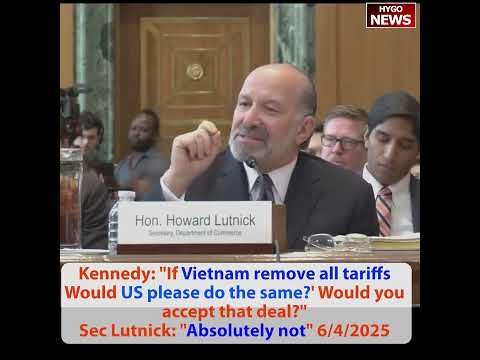
McMahon to Rep. Summer Lee: “We Should Teach Accurately” — Refuses to Confirm Biden Won 2020 as “Illegal DEI”; Sen. Kennedy-Lutnick Exchange on Vietnam: “If Vietnam Offered Zero Tariffs Both Ways, Would You Accept?” Lutnick: “Absolutely Not — They Buy $90B from China, Mark It Up, Send It to Us — Just a Pathway of China to Us”
Two fascinating exchanges illustrated administration policy frameworks in early June 2025. In a House hearing, Rep. Summer Lee (D-PA) tried to trap Education Secretary Linda McMahon about whether teaching that Biden won the 2020 election would be “illegal DEI.” Lee: “Do you believe that social studies standards that teach that Biden won the 2020 election is an ‘illegal DEI’? Yes or no?” McMahon: “I think I have said we should teach accurately.” Lee: “You have not answered the question.” McMahon: “I’m just not giving you the answer you want.” Separately, Sen. John Kennedy (R-LA) asked Commerce Secretary Howard Lutnick a hypothetical: “If Vietnam, for example, came to you tomorrow and said, ‘OK Mr. Secretary, you win. We’re going to remove all tariffs and all trade barriers. Would the United States please do the same?’ Would you accept that deal?” Lutnick: “Absolutely not. Absolutely not. That would be the silliest thing we could do. Vietnam has a $125 billion in exports to us and imports from us, $12 and a half million dollars. They buy $90 billion from China, then they mark it up and send it to us. So you would just be a pathway of China to us. We wouldn’t accept that deal. It’s a terrible deal.”
The Summer Lee Trap
Rep. Summer Lee (D-PA) designed a pointed question for McMahon.
“How about social studies standards that teach that president Biden won the 2020 election?” Lee asked.
McMahon’s first response: “I think our study should all be taught accurately.”
Lee pressed: “Yes or no?”
McMahon repeated: “I think our study should be taught accurately.”
Lee tried to clarify: “The question was, do you believe that social studies standards that teach that president Biden won the 2020 election is an illegal DEI? Yes or no?”
McMahon’s principled response: “I think I have said we should teach accurately.”
Lee expressed frustration: “No, you have not answered the question. I don’t understand why you’re incapable of answering.”
McMahon’s final response: “I’m just not giving you the answer you want.”
Lee: “No, I want the answer, whatever your answer is.”
McMahon: “I just gave you the answer.”
Lee: “No, the answer is yes or no.”
The Specific Trap
Lee’s question was designed as a political trap.
The trap’s structure:
- Teaching Biden won 2020 was factually accurate (electoral college outcome)
- Labeling this teaching as “illegal DEI” would be absurd
- If McMahon said “no,” Democrats would claim she accepted the teaching
- If McMahon said “yes,” Democrats would claim she denied 2020 election results
- Either answer could be weaponized politically
McMahon’s response strategy:
- Refuse to accept the framing
- Insist on accurate teaching as the standard
- Avoid partisan false dilemmas
- Maintain principled position
- Force Lee to accept the principle of accuracy
Why this worked:
- Teaching should be accurate (uncontroversial)
- Biden won the 2020 election as determined by electoral college (factual)
- Teaching this fact would not be “illegal DEI”
- But McMahon wasn’t forced to endorse specific teaching content
- The principle of accuracy was what mattered
McMahon’s “I’m just not giving you the answer you want” was masterful political communication. She refused Lee’s framing while staying principled.
The Larger DEI Context
The “illegal DEI” framing reflected the Trump administration’s approach to civil rights enforcement.
What was being targeted:
- Explicit racial preferences in hiring, admissions, contracts
- Programs that discriminated based on race or sex
- Identity-based curricula that taught one group to disadvantage another
- Quotas or targets that required specific demographic outcomes
- Discriminatory approaches to college admissions
What was NOT being targeted:
- Teaching accurate history
- Teaching about civil rights movements
- Teaching about diverse American communities
- Teaching about discrimination’s historical reality
- Teaching that promoted equal treatment
The distinction:
- Accurate factual teaching: acceptable
- Accurate factual teaching that acknowledged diversity: acceptable
- Discriminatory policies or curricula that privileged some groups over others: unacceptable
- Indoctrination that taught students to categorize themselves and others by race as primary: unacceptable
Summer Lee’s question tried to blur this distinction. By asking if teaching Biden won 2020 was “illegal DEI,” Lee was suggesting that factual teaching could be categorized as discriminatory. This was a rhetorical effort to expand “DEI” to include basic factual instruction — which would make McMahon look like she opposed teaching historical facts.
McMahon’s response correctly identified the issue: accurate teaching was fine. Discriminatory policies were not. These were different categories.
The Kennedy-Lutnick Exchange
Sen. John Kennedy (R-LA) asked Commerce Secretary Howard Lutnick a devastating hypothetical.
“If Vietnam, for example, came to you tomorrow and said, ‘OK, Mr. Secretary, you win. We’re going to remove all tariffs and all trade barriers. Would the United States please do the same?’ Would you accept that deal?” Kennedy asked.
Lutnick’s response was immediate and emphatic: “Absolutely not. Absolutely not. That would be the silliest thing we could do.”
The Stunning Answer
Kennedy’s question had assumed that reciprocal zero-tariff trade was the obvious ideal goal.
The traditional economic framework:
- Free trade eliminates distortions
- Zero tariffs on both sides is “pure” reciprocity
- Any deviation from zero tariffs represents inefficiency
- Ideal economic policy maximizes free trade
- Any country offering zero tariffs should receive zero tariffs in return
Under this framework, Kennedy’s hypothetical should have been the ideal answer. If Vietnam offered complete reciprocity, the United States should accept. That would be the maximum economic freedom.
Lutnick’s “absolutely not” rejection was therefore surprising. But his reasoning was substantive.
The China Pathway Problem
Lutnick explained why the deal would be bad.
“Vietnam has $125 billion in exports to us and imports from us, $12 and a half billion dollars,” Lutnick said.
Kennedy responded: “I’m aware of the figures, but tell me where they get it from.”
Lutnick delivered the key insight: “They buy $90 billion from China, then they mark it up and send it to us. So you would just a pathway of China to us.”
He summarized: “You wouldn’t accept that deal. It’s a terrible deal.”
The Pathway Economics
Lutnick’s “pathway of China to us” described a specific economic phenomenon.
How the Vietnam pathway worked:
- China produces $90 billion worth of goods (tariffed by US)
- China sells those goods to Vietnam at Chinese prices
- Vietnam buys from China
- Vietnam marks up the goods by some margin
- Vietnam sells to the US as “Vietnamese” exports
- Goods enter US without US-China tariffs
- Americans pay for goods that are substantially Chinese
Why this was bad for US:
- China effectively avoids US tariffs
- American manufacturing still can’t compete
- Vietnamese “production” is often just trans-shipment
- Economic value flows primarily to China
- Tariff revenue for US Treasury is reduced
- American jobs still compete against Chinese pricing
- Supply chain dependencies on China continue
Why Vietnam would offer zero tariffs:
- Vietnam doesn’t care about protecting its tiny US imports
- Vietnam’s manufacturing is largely assembly of Chinese parts
- Vietnam benefits from US market access
- Vietnam loses little from zero tariffs both ways
- Vietnam’s economic interest is selling American-bound goods
- Vietnam has limited domestic market to protect
Why US should reject:
- Zero tariffs would enable Chinese pass-through
- American manufacturing benefits nothing from Vietnamese zero tariffs
- US Treasury loses tariff revenue
- Strategic goal of reducing China dependency is undermined
- Economic sovereignty is compromised through pathway
”We’re the One with Money, We’re the One with Store”
Lutnick articulated the leverage asymmetry.
“We’re the one with money. We’re the one with the store,” Lutnick said.
He elaborated: “Of course, I want to take down the purpose of reciprocity.”
Then Kennedy challenged: “Then is reciprocity not one of your goals? Are you telling the president that we shouldn’t seek reciprocity? If that’s what you’re telling him, why are you trying to do these trade deals?”
Lutnick refined: “We want to encourage Vietnam to produce products. They’re great at producing.”
Kennedy pressed: “I want to get back to reciprocity. You just said, you don’t believe that you don’t accept reciprocity as a goal. What are you negotiating in these trade?”
Lutnick gave the principle: “Why would we open our bank account and their bank account?”
Kennedy challenged: “Why are you negotiating trade deals? You’re trying to get other countries to lower their trade, their tariffs and trade barriers in return for us lowering ours.”
Lutnick refined further: “I think that’s true for the things that they’ll take from us. That’s called reciprocity. Of course.”
The Reciprocity Distinction
Kennedy pushed for a clear answer: “Are you or are you not seeking reciprocity in these trade deals?”
Lutnick: “We are absolutely seeking reciprocity with respect to things that can be reciprocal. When they’re imported from China and sending it to us, they’re not.”
The Specific Framework
Lutnick’s framework was nuanced:
True reciprocity is acceptable:
- When Vietnam produces goods themselves
- When Vietnamese products compete on their actual merits
- When trade is balanced with actual manufacturing
- When lower tariffs support genuine commerce
- When both countries benefit economically
Fake reciprocity is unacceptable:
- When Vietnam is pathway for Chinese goods
- When “Vietnamese” exports are just relabeled Chinese exports
- When zero tariffs enable strategic evasion
- When economic value flows primarily to third parties
- When security concerns override economic theory
The judgment requires:
- Understanding actual supply chains
- Recognition of strategic considerations
- Awareness of trade restructuring techniques
- Sophisticated analysis of bilateral trade flows
- Willingness to refuse superficial “wins”
Kennedy’s Challenge
Kennedy continued probing.
“You just said that if a country came to you and offered you the ultimate reciprocity, no tariffs, no trade barriers in return for us doing the same, you would reject that.”
Lutnick: “Of course, because they buy from China and send it to us.”
Kennedy pivoted: “Don’t you agree with me? Supposedly said we won’t buy from China. Now we’re talking. Now we’re talking. Would you accept that deal?”
Lutnick: “We would consider it for what things for products.”
Kennedy: “Want to change?”
Lutnick laid out exceptions: “Well, there are certain products we want to reassure. We don’t want other people making them. We want to make pharmaceuticals here. We need to protect ourselves.”
The “Re-Assure” Framework
Lutnick’s use of “reassure” (likely meant “ensure” or “re-insource”) captured a key policy goal.
Products that must be made in America:
- Pharmaceutical ingredients (essential health security)
- Critical defense components (national security)
- Key infrastructure materials (economic resilience)
- Strategic metals and minerals (military and tech)
- Advanced semiconductors (AI and defense)
Why this matters beyond economics:
- Pandemic showed pharmaceutical vulnerabilities
- Taiwan crisis shows semiconductor vulnerabilities
- Rare earth disputes show critical material vulnerabilities
- Defense supply chain gaps create military risks
- Infrastructure dependencies create leverage over US
Trade policy framework:
- Accept trade for non-strategic products
- Restrict or eliminate trade for strategic products
- Build American capacity for strategic products
- Maintain flexibility for evolving strategic categories
- Coordinate trade policy with national security policy
This was more sophisticated than simple free trade or protectionism. It was strategic trade policy that:
- Recognized some products as economic commodities
- Recognized other products as strategic necessities
- Applied different policies to different categories
- Built American capability in critical areas
- Maintained efficient trade for non-critical products
The “Why Open Our Bank Account?” Framework
Lutnick’s “Why would we open our bank account and their bank account?” framing was important.
The traditional framework:
- Open markets benefit both sides
- Free trade maximizes aggregate welfare
- Producers in both countries gain access
- Consumers in both countries pay lower prices
- Economic theory supports free trade
Lutnick’s framework:
- Consumers in US have large bank account
- Consumers in many countries have small bank account
- “Opening both bank accounts” gives foreign producers access to US wealth
- But US producers get access to foreign poverty
- The trade is unequal in practice
- Strategic US interest requires protecting the US bank account
Implications:
- US should charge for access to its wealthy consumer market
- Foreign producers should pay for access through tariffs
- US should only reduce tariffs when receiving meaningful reciprocal benefits
- Meaningful benefits require actual market access, not just formal reciprocity
- Strategic considerations trump simple reciprocity
This was economic realism. The US market was more valuable to foreign producers than foreign markets were to US producers. “Reciprocity” in formal terms was not reciprocity in practical terms.
The Strategic Implications
Lutnick’s framework had broader implications for trade policy:
For trade negotiations:
- Don’t accept superficial reciprocity
- Analyze actual supply chain origins
- Protect American strategic industries
- Use market access as leverage
- Demand substantive rather than formal reciprocity
For supply chains:
- Understand where goods actually come from
- Track value chain origins
- Identify China pass-throughs
- Prevent tariff evasion via third countries
- Restore American manufacturing capability
For economic theory:
- Challenge simple free trade assumptions
- Recognize strategic dimensions of trade
- Account for national security considerations
- Accept that economics alone is insufficient framework
- Integrate economics with broader national interest
For policy implementation:
- Specific country-by-country analysis
- Product-by-product evaluation
- Strategic categorization of imports
- Flexible response to changing conditions
- Coordinated across multiple policy areas
Key Takeaways
- McMahon refuses Summer Lee’s trap: “We should teach accurately” — neither endorsing nor denying “illegal DEI” framing on 2020 election teaching.
- McMahon: “I’m just not giving you the answer you want” — principled refusal of politically constructed dilemma.
- Lutnick on Vietnam zero-tariff hypothetical: “Absolutely not. Silliest thing we could do.”
- The China pathway: “They buy $90B from China, mark it up, send to us. You’d just be pathway of China to us.”
- Strategic trade framework: “True reciprocity for things they’ll take from us. China pathway is not reciprocity.”