 HYGO News
 Sen. Kennedy: 'Easier to Divorce Your Spouse Than to Get Rid of a Federal Employee'; 'Microsoft Reducing 6,000 -- End of Microsoft? No'; Energy Sec Wright: 'Headcount Ultimately Reduced by Thousands -- Doing It Slowly, Carefully'
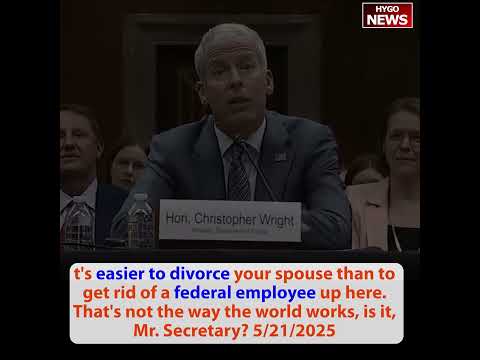
Sen. Kennedy: “Easier to Divorce Your Spouse Than to Get Rid of a Federal Employee”; “Microsoft Reducing 6,000 — End of Microsoft? No”; Energy Sec Wright: “Headcount Ultimately Reduced by Thousands — Doing It Slowly, Carefully”
Senator John Kennedy (R-LA) conducted a remarkable exchange with Energy Secretary Chris Wright in May 2025, drawing out the substantive reality of federal workforce reform. Kennedy invoked private-sector parallels: “Most entities in the private sector of the size of the Department of Energy know how to modernize and downsize. It’s essential to survival as a business. I just read recently where Microsoft, one of the most successful companies in the world, is going to reduce its workforce by 6,000 employees. Do you think that’s going to be the end of Microsoft? No, it won’t be the end of Microsoft.” He delivered the memorable line: “It’s easier to divorce your spouse than to get rid of a federal employee up here. That’s not the way the world works, is it, Mr. Secretary?” Wright: “It’s not the way the world should work. I give enormous credit to President Trump, who had the boldness to say if there’s a right thing that needs to be done and it’s difficult, please do it.” Current status: “Just around 16,000 government employees when I took over. A little under 16,000 today… Our headcount will ultimately be reduced by thousands. But we’re doing it slowly.”
The Warm Opening
Kennedy opened with genuine praise.
“I’m not kidding, I am reading your book and it’s fascinating,” Kennedy told Wright. “Some of it I don’t understand. I may have to call you and get you to explain it to me, but it’s very accessible.”
He expressed appreciation for the appointment: “And when the president appointed you, I was so excited that we would have someone running the Department of Energy who has such a deep background in the subject.”
Chris Wright’s background was indeed exceptional for a Secretary of Energy. Before his appointment, Wright had been:
- CEO of Liberty Energy, a major oilfield services company
- Published author on energy economics and policy
- Advocate for fossil fuel development and nuclear expansion
- Skeptic of climate alarmism but supporter of climate mitigation
- Champion of energy abundance as key to human prosperity
His book (referenced by Kennedy) was “Bettering Human Lives,” which argued that cheap, abundant energy had been the foundation of human progress and that restricting energy access in the name of climate policy was morally problematic given the human costs.
Wright’s combination of:
- Deep technical knowledge from his engineering background
- Business experience from running a major energy company
- Policy sophistication from his writing
- Clear ideological framework
made him exceptionally well-suited to lead Department of Energy reform. Kennedy’s enthusiasm was not formal; it reflected genuine appreciation for a cabinet appointment that had matched technical expertise with the specific portfolio.
The Staff Recognition
Wright acknowledged his team.
“Yes, yeah, great thanks to that team behind me,” Wright said. “That’ll be here for after the meeting too. If we’ve got questions or follow up, Senator Murray, if you have unpaid invoices, please bring them to us right now. We pay our bills.”
The “Senator Murray, unpaid invoices” reference was sharp. Sen. Patty Murray had been conducting aggressive questioning of various administration officials (we covered RFK Jr.’s confrontation with Murray earlier). Wright was turning the tables by offering to address any specific grievances Murray had rather than allowing her to make general accusations.
The “we pay our bills, we follow the law” framing was important. Democratic senators had frequently accused the Trump administration of various procedural improprieties — failing to implement programs, not spending appropriated funds, violating administrative procedures. Wright was preemptively addressing any such concerns: if any specific complaints existed, they would be addressed; blanket accusations would be rejected.
The Employee Numbers
Kennedy pivoted to the workforce question.
“How many employees did the Department of Energy have when you took over?” Kennedy asked.
Wright: “Just around 16,000 government employees.”
“How many does it have today?”
“A little under 16,000 today.”
“How much of you reduced it percentage wise?”
“So far only a relatively small amount. We are looking at larger reductions.”
Wright explained the approach: “And as Senator Murray mentioned, we have offered voluntary plans and programs for people to be compensated by the government as they transition to another career.”
He described the deliberate pace: “We’ve done this slowly, carefully, with a lot of engagement with people and while looking at how to restructure our department.”
He gave the direction: “So the ultimate reduction in workforce will be larger than it’s been today. But today our payroll has barely moved.”
The DOE workforce of approximately 16,000 was substantial but not huge by federal standards. Larger departments (Defense, VA, HHS, etc.) had hundreds of thousands of employees. DOE’s role — running nuclear weapons programs, managing national laboratories, overseeing energy research, managing Strategic Petroleum Reserve — required specialized expertise but not massive workforce scale.
The “slowly, carefully” approach Wright described was a specific contrast with some other agencies (like USAID) where dramatic reductions had occurred rapidly. Wright’s approach was:
- Offer voluntary separation packages
- Allow employees to choose transition timing
- Engage with career workforce about structural changes
- Make reductions consistent with mission requirements
- Preserve critical expertise
The Microsoft Comparison
Kennedy introduced his key analogy.
“Most entities in the private sector of the size of the Department of Energy know how to modernize and downsize,” Kennedy said. “Do they not?”
He made the point: “It’s essential to survival as a business. If you want to roll with changes in the marketplace and the business, you better be ready to change your organization.”
He introduced the specific example: “I just read recently where Microsoft, one of the most successful companies in the world, is going to reduce its workforce by 6,000 employees.”
He asked the rhetorical question: “Do you think that’s gonna be the end of Microsoft?”
Wright: “No, it won’t be the end of Microsoft.”
Wright offered a thoughtful elaboration: “Now there have been some allegations today. You’ve cut tens of thousands of employees. Is that accurate?”
Kennedy noted the factual accuracy: “Well, I think the allegations were thousands. And our head count will ultimately be reduced by thousands. But we are doing it slowly.”
Kennedy confirmed: “You’ve got 16,000 now?”
Wright: “Yes.”
Kennedy: “And you think you can do it with fewer than 16,000?”
Wright: “Correct.”
The Microsoft comparison was apt. Microsoft in 2025 had approximately 228,000 global employees and was announcing 6,000 workforce reductions — approximately 2.6% of total headcount. Microsoft was:
- One of the most valuable companies in world history
- Highly profitable with strong growth
- Leading in cloud computing and AI
- Competitive in multiple major technology markets
Even Microsoft, despite its success, was reducing workforce. This wasn’t about distress or failure; it was about continuous organizational optimization. Successful organizations routinely adjusted workforce to match needs, technology evolution, and efficiency opportunities.
The federal government’s historical inability to manage workforce the same way was the underlying issue. Federal employment had grown substantially over decades, with reductions rare and often accompanied by political controversy. Trump administration workforce reforms (through DOGE, voluntary separations, and agency consolidations) were unusual historically.
”Common Sense Business”
Kennedy made the essential point.
“What’s wrong with that?” Kennedy asked.
Wright: “I think it’s just common sense business.”
Kennedy: “Yeah. Businesses do it every day in the real world. America, taxpayers deserve it.”
Kennedy: “That’s never happened in the federal government.”
This was the crux of the matter. The federal government had been structurally unable to reduce itself, even when reductions would improve effectiveness. Multiple factors contributed:
Civil service protections: Federal employees had elaborate due process protections that made firing or laying off employees extremely difficult.
Union resistance: Federal employee unions had substantial political influence and fought workforce reductions.
Congressional patronage: Many federal positions existed because specific members of Congress had advocated for them.
Bureaucratic inertia: Existing positions tended to persist even after their original justifications had faded.
Political risk: Administrations that attempted workforce reductions faced accusations of attacking public service, federal workers, government capacity, etc.
No accountability: Unlike business executives who faced shareholders demanding efficiency, federal managers faced no equivalent pressure.
The combined result was a federal government that grew steadily over decades, with occasional adjustments but no sustained reduction in most categories. The Trump administration’s workforce reforms were attempting to break this pattern.
”Easier to Divorce Your Spouse”
Kennedy delivered the memorable line.
“I mean, it’s easier to divorce your spouse than to get rid of a federal employee up here,” Kennedy said. “That’s not the way the world works, is it, Mr. Secretary?”
The comparison was not hyperbolic. Federal civil service termination processes required:
- Extensive documentation over time
- Progressive discipline approaches
- Multiple opportunities for improvement
- Union grievance procedures
- Merit Systems Protection Board review
- Appeals processes
- Often years of proceedings
- Extensive legal representation
- Back pay for wrongful termination
Compare this with divorce, which typically required:
- Filing paperwork
- Settlement negotiations
- Division of assets
- Months of proceedings
- Final judgment
In many states, no-fault divorce could be completed in months. Firing a federal employee for performance issues could take years and often resulted in settlements rather than terminations. Kennedy’s comparison, while rhetorical, was substantively accurate.
”Not the Way the World Should Work”
Wright’s response embraced the critique.
“It’s not the way the world should work,” Wright said.
He credited Trump: “And I give enormous credit to President Trump, who had the boldness to say, ‘If there’s a right thing that needs to be done and it’s difficult, please do it.’”
He acknowledged the difficulty: “And so, yes, this is new territory. This is not what happens normally in the federal government, but it is what needs to happen periodically in the federal government.”
He credited Trump’s political courage: “And I give the credit to President Trump, who’s willing to take the heat and has set the departments free, make the changes you need to make to better serve American taxpayers and American consumers.”
He described the cross-administration pattern: “And across his administration, that’s what’s being done.”
Wright’s credit to Trump was substantive. Workforce reduction in federal agencies was politically costly. Each position eliminated created:
- An individual losing employment (who could be featured in media stories)
- A community losing federal jobs (creating local political opposition)
- A union losing members (creating institutional opposition)
- Democrats charging “attacks on government” (creating national political pressure)
For a president to authorize workforce reductions required accepting these political costs. Past presidents had generally avoided doing so, preferring to freeze or slow hiring rather than make reductions. Trump’s explicit authorization of reductions gave cabinet secretaries the political cover to implement unpopular but necessary changes.
Kennedy’s Closing Tribute
Kennedy closed with personal praise.
“I don’t know you to be a person who doesn’t return his phone calls or take care of business,” Kennedy said.
He made the implicit standard: “And my guess is you don’t tolerate people around you who take a cavalier approach to their job.”
He offered the specific applause: “And I wanted to get that on the record. I applaud you for being able to do the job with fewer people.”
He closed the meeting: “Thank you for being here today. Thank you to all of your staff. Y’all can’t take the rest of the day off, it’s still.”
The tribute reflected Kennedy’s specific appreciation for Wright’s management style. Wright had demonstrated:
- Accountability (returning calls, taking responsibility)
- Standards (high expectations for his team)
- Efficiency (doing more with less)
- Results orientation (focusing on outcomes rather than processes)
These were business-world virtues being transferred to government service. Wright exemplified the kind of senior official that Kennedy and other Republicans wanted in government: experienced private sector executives bringing business discipline to federal management.
The Larger Reform Context
The Wright testimony fit the broader administration pattern of workforce reform:
DOGE: The Department of Government Efficiency (DOGE), led by Elon Musk in early administration but continuing after his departure, had systematically identified wasteful spending, unnecessary positions, and duplicative programs.
Agency consolidation: Several federal agencies had been merged or restructured, eliminating overlapping positions.
Voluntary separations: Many federal employees had accepted early retirement or buyout packages, reducing workforce without formal terminations.
Contractor reductions: Federal contractor workforce (often larger than civil service in many agencies) had been reduced alongside direct employment.
USAID dramatic reduction: The most dramatic example had been USAID, where substantial portions of the workforce had been eliminated.
VA workforce changes: Veterans Affairs had been restructured with significant position eliminations, especially in administrative functions.
The DOE approach Wright described was at the slower, more measured end of this spectrum. Other agencies had moved faster and more dramatically. DOE’s specialized expertise (particularly in nuclear weapons programs) required careful workforce management to preserve critical capabilities.
Key Takeaways
- Sen. Kennedy: “Easier to divorce your spouse than to get rid of a federal employee up here. That’s not the way the world works.”
- Microsoft reducing 6,000 employees: “Do you think that’s gonna be the end of Microsoft? No.” Wright confirmed.
- DOE employee count: 16,000 when Wright took over, “a little under 16,000 today” — reductions coming.
- Wright approach: “Slowly, carefully, with engagement” — voluntary separations and careful restructuring.
- Wright credits Trump: “Boldness to say if there’s a right thing that needs to be done and it’s difficult, please do it.”