 HYGO News
 Rep. Coleman Race-Baits RFK Jr., Won't Let Him Answer; RFK Shuts Her Down: 'My Time Has Expired'; Coleman: 'So Has Your Legitimacy'
Rep. Coleman Race-Baits RFK Jr., Won’t Let Him Answer; RFK Shuts Her Down: “My Time Has Expired”; Coleman: “So Has Your Legitimacy”
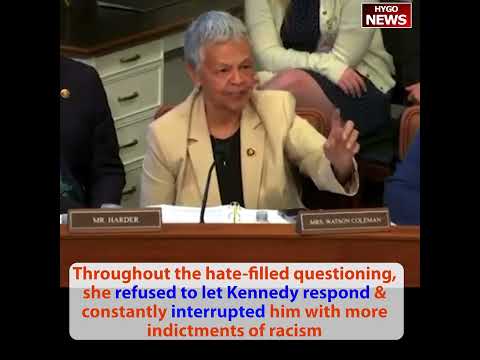
Rep. Bonnie Watson Coleman (D-NJ) delivered a race-focused attack on HHS Secretary Robert F. Kennedy Jr. at a May 2025 congressional hearing, accusing the administration of “racist attacks” and “attempting to legitimize racial discrimination.” Kennedy responded by invoking MLK: “President Trump’s vision of this country is the same as Martin Luther King’s — that we should have a colorblind administration.” When Coleman refused to let him answer her questions, repeatedly cutting him off, Kennedy provided specific data: “We have eight divisions for minority health at HHS. We closed one. We’re maintaining the other seven. We have 42 programs for maternal health. We’re going to close a couple and consolidate. Still spending $1.7 billion a year.” When her time ran out and Coleman demanded further answers, Kennedy delivered: “My time has expired.” Coleman fired back: “So has your legitimacy.”
The Attack
Coleman — one of the three Democrats who had stormed the Delaney Hall Detention Center — delivered a prepared attack.
“Few things enraged me more than the racist attacks I see this administration carrying out by embarking on an ignorant crusade to rid the government of any programs that are working to improve the lives of Black Americans,” Coleman said.
She made a sweeping claim: “The administration has moved to ban the words Black, race, bias, minority, oppression, prejudice, discrimination, disparity, and racism.”
She continued the framing: “Any grant application on federal programs that included these words had them immediately stripped.”
She delivered the moral judgment: “It is painfully clear to me that in doing this, this administration that you work with and work for is attempting to legitimize racial discrimination, and that, sir, is a moral disgrace.”
She defended DEI: “It is not woke to improve the health and well-being of Black people who are disparagingly impacted by just about every health issue.”
She delivered the specific accusation: “Your decision and justifications are damning and troubling, particularly for destructive impacts your choices and benefits will have on poor minorities.”
The word-banning claim was overblown. The administration had not banned any words; it had directed federal agencies to eliminate programs and grants that used race as a distributing factor. Programs that measured outcomes by race, required race-based hiring, or distributed resources based on racial demographics had been terminated. The words themselves remained in common use; what had ended was the use of those words to justify race-based government actions.
”Colorblind Administration”
Kennedy invoked Martin Luther King Jr. in his response.
“Congressman, President Trump’s vision of this country is the same as Martin Luther King’s — that we should have a colorblind administration,” Kennedy said.
He addressed the specific concern: “President Trump is deeply concerned about the maternal health crisis.”
Coleman cut him off: “Excuse me, sir. Let me reclaim my time because I don’t need this rhetoric about Donald Trump and the lie that he cares about me and Black people.”
She demanded specifics: “What I want to know is — the proposals I’m reclaiming my time, sir, reclaiming it. I want to know specifically — how do you intend?”
Kennedy attempted to answer: “I’ve spent a lifetime working on those priorities and I continue to do so.”
The MLK reference was significant. Martin Luther King Jr. had famously called for a colorblind society where individuals would be “judged by the content of their character, not the color of their skin.” For decades, this had been the stated goal of American civil rights.
In recent years, progressive activists had explicitly rejected the colorblind ideal, arguing that race-neutrality itself perpetuated inequality. Kennedy’s invocation of MLK placed the administration in the original civil rights tradition while implying that Coleman’s race-based advocacy had departed from that tradition.
The “rhetoric” dismissal was revealing. Coleman explicitly rejected the claim that Trump cared about Black Americans as “a lie” — refusing to engage with any argument that didn’t align with her predetermined narrative about racist Republicans. This approach made actual dialogue impossible; any substantive response from Kennedy could be dismissed as “rhetoric” without engagement.
The Specific Data
Kennedy provided concrete numbers that demolished the “elimination” narrative.
“We have eight divisions, eight programs for minority health at HHS,” Kennedy explained. “We closed one of those offices. We’re maintaining the other seven.”
He addressed maternal health: “We have 42 programs for maternal health. We’re going to close a couple of them and consolidate them. We’re going to still spend $1.7 billion a year. The commitment is there. We’re just reorganizing.”
Coleman pivoted to another topic: “Okay, you know what? The impact of reorganization is something that I shall continually ask you to show me. So please let me warn you now.”
Kennedy responded: “I welcome those inquiries.”
Coleman pressed: “And I don’t want rhetoric. I want numbers.”
The data Kennedy provided contradicted Coleman’s claims:
- 8 minority health divisions → 7 maintained (one closed via consolidation)
- 42 maternal health programs → consolidating a few
- $1.7 billion annual maternal health spending maintained
This was not elimination of minority-focused health programs. It was modest reorganization that closed one of eight minority health offices while maintaining the other seven, consolidated a handful of duplicative maternal health programs, and preserved essentially all the funding. Coleman’s characterization of “eliminating minority health offices” was simply false.
The fact that Coleman demanded “numbers not rhetoric” immediately before Kennedy provided specific numbers was particularly revealing. She wasn’t actually interested in numbers; she was interested in preserving her narrative. When Kennedy provided the data she claimed to want, she pivoted to a different topic rather than engaging with the specifics.
The LIHEAP Dispute
Coleman moved to a new subject.
“The other thing that really troubles me, sir, is LIHEAP,” Coleman said. “It is a program specifically to address the needs of low-income and minority families as it relates to heating and even air conditioning.”
She repeated the emotional plea: “Why? Why, why, why? And what is your rationale for eliminating that program specifically? Why, why, why?”
Kennedy began: “I’m very committed to LIHEAP. My brother ran a low…”
Coleman interrupted: “I don’t care about your past. I care about your functioning in this department, in this administration, right now in response to this question.”
Kennedy stopped: “My time has expired.”
Coleman delivered the comeback: “Well then, so has your legitimacy. I yield back.”
LIHEAP — the Low Income Home Energy Assistance Program — helped low-income families pay heating and cooling costs. Kennedy had begun to explain his personal connection to the program (his brother had run a state-level LIHEAP program) before Coleman cut him off.
Her dismissal — “I don’t care about your past” — was designed to deny Kennedy any personal credibility. Kennedy’s actual history mattered because it demonstrated his genuine commitment to the program. A cabinet secretary with a personal, family connection to a low-income assistance program was more likely to be a sincere advocate for that program than an opponent seeking to eliminate it.
The “so has your legitimacy” retort was Coleman’s attempt to have the last word after running out of time. But the exchange had revealed the hollowness of her attack. When Kennedy offered substantive answers, she refused to listen. When he offered personal context, she dismissed it. Her attack required Kennedy to be the villain of her narrative, and any evidence to the contrary was rejected as “rhetoric.”
The Broader Context
The hearing exchange captured a larger pattern in Democratic congressional oversight. Rather than using hearing time to extract information from administration officials, Democrats increasingly used hearings to deliver prepared monologues designed for social media distribution. The actual responses of cabinet secretaries were treated as obstacles to the performance rather than as substantive answers worth engaging.
Kennedy’s approach throughout had been remarkably patient. Despite being accused of racism, despite being interrupted repeatedly, despite having his substantive answers dismissed, he remained composed and provided factual responses. When Coleman’s time ran out, he simply stated the procedural reality: his time had expired.
The “so has your legitimacy” response was Coleman’s attempt to convert the exchange into a viral moment about racial injustice. Whether it succeeded would depend on whether audiences focused on the surface drama or examined the underlying facts. Audiences that looked at the record would find that Coleman’s accusations were unsupported, her characterizations were inaccurate, and Kennedy’s responses were measured and substantive.
Key Takeaways
- Coleman accused RFK Jr. and Trump administration of “racist attacks” and “attempting to legitimize racial discrimination.”
- Kennedy: “President Trump’s vision is the same as Martin Luther King’s — we should have a colorblind administration.”
- Coleman dismissed Kennedy’s response as “the lie that [Trump] cares about me and Black people.”
- Specific data: 8 minority health divisions → 7 maintained; 42 maternal health programs consolidating; $1.7 billion/year maintained.
- “My time has expired.” Coleman: “So has your legitimacy.” — closing the exchange after Kennedy refused to engage further.