 HYGO News
 Kate Shaw Called Supreme Court Justices 'Evil' Then Appeared Before Senate to Lecture on 'Respecting Judges': 'I Don't Recall That Word'; Kennedy: 'Gag Me with a Spoon -- You're an Officer of the Court'; Stephen Miller on OBBB: 'If Ronald Reagan Had Passed No Tax on Tips in 1981, There'd Be 15 Museums and History Channel Reels -- That's Just ONE Part of This Bill'
Kate Shaw Called Supreme Court Justices “Evil” Then Appeared Before Senate to Lecture on “Respecting Judges”: “I Don’t Recall That Word”; Kennedy: “Gag Me with a Spoon — You’re an Officer of the Court”; Stephen Miller on OBBB: “If Ronald Reagan Had Passed No Tax on Tips in 1981, There’d Be 15 Museums and History Channel Reels — That’s Just ONE Part of This Bill”
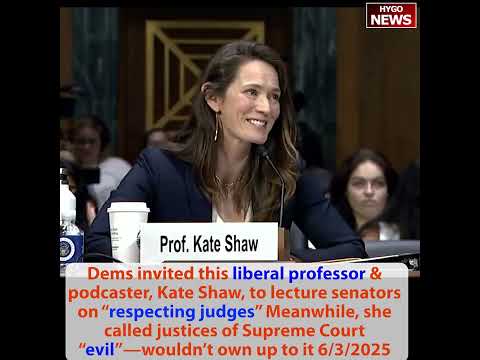
In a devastating Senate hearing moment, Sen. John Kennedy (R-LA) exposed Kate Shaw, a Democrat-invited liberal professor and podcaster, for previously calling Supreme Court justices “evil” while she was there to lecture senators on “respecting judges.” Kennedy: “On April 22nd, 2024, you said there are some members of the Supreme Court that are evil. ‘Will she be able to control its potential future distortion by her evil colleagues?’” Shaw’s evasion: “I’ll take it your word, Senator. I don’t recall using that word, but…” Kennedy cited the exact transcript. Shaw claimed: “If it’s transcription, it was probably a transcription error. I do not think I said…” Kennedy’s skepticism: “You’re an officer of the court. It doesn’t sound like something that I would say.” Kennedy delivered the memorable line: “You know what I’m embarrassed at? That you’re teaching our kids… gag me with a spoon… You’re part of what’s the problem in all of this.” Stephen Miller on OBBB: “If we had just did a bill that say, just did no tax on tips, that would be… people talk about that in 50 years. If Ronald Reagan had passed the bill in 1981, saying no tax on tips, there’d be 15 museums out there talking about the time that Ronald Reagan did no tax on tips. There’d be a constant reel on the history channel… That’s just ONE PART of this bill.” The bill “fully funds the entire wall across the entire southern border, land and river” paid for by “raising fees on foreign nationals who are seeking visas.”
Kate Shaw’s Testimony Trap
Sen. John Kennedy exposed Kate Shaw’s hypocrisy.
“On April 22nd, 2024, you said there are some members of the Supreme Court that are evil,” Kennedy said. “‘Will she be able to control its potential future distortion by her evil colleagues?’ Probably not.”
He demanded specifics: “Which justices were you talking about?”
Shaw’s evasion was immediate: “I’ll take it your word, Senator. I don’t recall using that word, but…”
Kennedy had the exact quote ready: “All right, here’s what you said. You were talking about the majority opinion in Muldrow v. City of St. Louis. You said, quote, Justice Kagan, I mean, will she be able to control the opinions future distortion by her evil colleagues? Probably not. End quote.”
He demanded identification: “Who are you talking about?”
Shaw’s Desperate Denials
Shaw’s response was increasingly desperate.
“Sir, I’m very skeptical,” Shaw said. “If it’s transcription, it was probably a transcription error.”
She continued: “I do not think I said…”
Kennedy: “No, you said it.”
Shaw tried to change subject: “Are your evil colleagues?”
Kennedy pressed: “Once she’ll own up to it.”
Kennedy continued: “Which you call some members of the Supreme Court evil. Now, which ones do you think are evil?”
Shaw: “I would have to refresh my recollection. I’ve been very critical of some members of the Supreme Court.”
Kennedy: “You made this statement, won’t you? I’m… You’re an officer of the court. You’re an officer of the court.”
Shaw: “It doesn’t sound like something that I would say.”
Kennedy’s Takedown
Kennedy delivered the memorable line.
“You know what I’m embarrassed at? That you’re teaching our kids,” Kennedy said.
Shaw protested: “I don’t refer to Supreme Court justices as evil.”
Kennedy confronted: “By your evil colleagues.”
Shaw tried: “In the classroom, sir. In the classroom, sir.”
Kennedy was relentless: “On the broadcast, April 22nd, 2024. Okay, well…”
He delivered the line that became viral: “Big as Dallas.”
He drew the contrast: “And you’re an officer of the court and you’re here advising us to be respectful to federal judges. And you say they’re evil members of the United States Supreme Court.”
He pronounced his judgment: “Gag me with a spoon. You’re part of what’s the problem in all of this.”
The Kate Shaw Context
Kate Shaw was a specific liberal professor and podcaster.
Her background:
- Professor at Cardozo Law School
- Podcast host of “Strict Scrutiny”
- Frequent media commentator
- Critic of conservative Supreme Court majority
- Co-founder of law podcast network
Her husband:
- Chris Hayes, MSNBC host
- Liberal commentator
- Family positioned in progressive media ecosystem
- Multiple media interconnections
- Cultural liberal elite
Her testimony context:
- Democratic senators invited her
- To lecture senators on respecting judges
- In context of Trump administration conflicts with judges
- Democrats framing Trump as attacking judicial independence
- Using academic credential for political messaging
The trap:
- Kennedy knew about her podcast comments
- Her comments called justices “evil”
- She was lecturing about “respecting judges”
- The contradiction was devastating
- Her denials made it worse
The Muldrow Case
Shaw’s specific comment was about the Supreme Court case Muldrow v. City of St. Louis.
The case:
- Title VII employment discrimination
- Workplace transfer as discriminatory action
- Unanimous decision in 2024
- Justice Kagan wrote the opinion
- Ruled that any adverse employment action qualified under Title VII
Shaw’s criticism:
- Questioning Kagan’s ability to “control” the opinion’s “future distortion”
- Characterizing other justices as “evil colleagues”
- Suggesting they would distort the ruling
- Criticizing the conservative majority
- Using emotional rather than legal language
Why the comment was problematic:
- Academic commentary should be analytical
- “Evil” is moral denunciation
- Characterization lacks intellectual grounding
- Demeans opponents rather than engaging arguments
- Illustrates progressive academic pattern
”Big as Dallas”
Kennedy’s “big as Dallas” was a memorable Southern expression.
The phrase meant:
- Very large/prominent/obvious
- Impossible to miss
- Undeniably clear
- As big as something very big
- Cannot be hidden or denied
Kennedy’s point was that Shaw’s hypocrisy was obvious and undeniable. She had:
- Publicly called justices “evil”
- Now lecturing about respecting judges
- Claiming not to remember her own comments
- The contradiction was as visible as Dallas
- Couldn’t be denied by sophisticated evasion
The “Gag Me with a Spoon” Line
The “gag me with a spoon” was Kennedy’s signature expression of disgust.
The line was:
- Vintage Kennedy phrasing
- Expression of revulsion
- Colloquial rather than legal
- Genuinely dismissive
- Memorable for audience
Combined with “you’re part of what’s the problem in all of this,” Kennedy was making a broader institutional critique:
- Shaw represented academic hypocrisy
- Her position demonstrated elite double standards
- Democratic invitations of such witnesses undermined serious hearings
- The academic-legal complex had become politicized
- Respect for institutions required better witnesses
Miller’s Framing of OBBB
Stephen Miller continued his effort to frame OBBB’s significance.
“There’s so much to celebrate in this bill,” Miller said.
He lamented the difficulty of conveying the point: “And again, I don’t think it’s even possible to convey sort of the point that Russ made.”
He articulated the key insight: “If any of these things was done on its own, this would be considered a historic victory for the movement, for the presidency, for the country.”
The Reagan Parallel
Miller made a striking historical comparison.
“In other words, if we had just did a bill that say, just did no tax on tips, that would be… People talk about that in 50 years, right?”
He extended with Reagan: “If Ronald Reagan had passed the bill in 1981, saying no tax on tips, there’d be 15 museums out there talking about the time that Ronald Reagan did no tax on tips.”
He predicted media coverage: “There’d be a constant reel on the history channel about when Ronald Reagan did no tax on tips.”
He made the comparative point: “That’s just one part of this bill.”
The Reagan Comparison Context
Miller’s Reagan comparison was substantive.
What Reagan is remembered for:
- 1981 tax cuts (Kemp-Roth)
- 1986 tax reform
- Deregulation
- Military buildup
- Cultural restoration
The 1981 tax cut:
- Reduced top marginal rate from 70% to 50%
- Produced unprecedented economic expansion
- Generated 20+ million jobs
- Created “Reagan Revolution”
- Still celebrated 45+ years later
Miller’s point: If Reagan had simply passed “no tax on tips”:
- It would have been his signature domestic achievement
- Celebrated in conservative museums
- Featured on history documentaries
- Remembered as transformative
- Added to Reagan’s legacy
But OBBB does this AND more:
- No tax on tips
- No tax on overtime
- No tax on Social Security
- TCJA extension
- Medicaid reforms
- Border funding
- Energy policy
- Regulatory relief
- Immigration enforcement
- And more
OBBB was Reagan-level significance in a single provision, but the bill had dozens of such provisions. Miller was arguing that the bill’s comprehensive nature had made its significance underappreciated — each piece was historic, but the sum was truly transformative.
The Border Wall Funding
Miller detailed specific immigration provisions.
“Take, of course, something that I’ve talked a lot about with you and with many others, on immigration and border security.”
He laid out the commitment: “This bill fully funds the entire wall across the entire southern border, land and river.”
He emphasized the completeness: “So again, you think about promises made, promises kept. Is there a bigger promise than having full, complete upfront funding that Democrats can never take away?”
He noted the permanence: “In other words, it’s there, it’s upfront.”
The Funding Mechanism
Miller described an elegant financial solution.
“And by the way, it’s paid for,” Miller said.
He described the source: “Here’s another point that isn’t discussed very much at all. The immigration provisions in this bill are paid for by charging foreign nationals more money when they want to come to America.”
He explained the mechanism: “So by raising the fees on foreign nationals who are seeking visas and other immigration benefits.”
He listed what the fees paid for: “We are paying for the wall, for the ICE officers, for the border agents, for the pay raise that President Trump promised the ICE officers and the border agents.”
He delivered the conclusion: “So we are literally paying for the defense of the homeland by increasing fees on those in other countries who want to come here. So it’s a win-win.”
The Foreign National Fee Increase
The specific funding mechanism was elegant.
Who pays:
- Foreign nationals applying for U.S. immigration benefits
- Various visa categories
- Not American taxpayers
- Not ordinary Americans
- People seeking to come to America
What they pay for:
- Border wall construction
- ICE officer hiring
- Border Patrol expansion
- Pay raises for federal law enforcement
- Immigration enforcement generally
Why this made sense:
- Those benefiting from the system pay for it
- No burden on American taxpayers
- Market-based pricing for immigration benefits
- Incentive for legal immigration
- Deterrent for illegal immigration
The political brilliance:
- Democrats couldn’t attack as costing taxpayers money
- Democrats couldn’t defend lower fees (help illegals)
- Addressed fiscal concerns
- Addressed immigration concerns
- Made Democratic opposition more difficult
The practical effect:
- Border wall fully funded without taxpayer burden
- Enforcement expansion paid for
- Pay raises enabled
- Immigration system strengthened
- Fiscal sustainability improved
The “Promises Made, Promises Kept”
Miller’s “promises made, promises kept” framing captured OBBB’s political significance.
Trump campaign promises:
- Build the wall
- Secure the border
- End illegal immigration
- Hire more ICE officers
- Give border agents a raise
- Enforce immigration law
- Make America safer
OBBB’s fulfillment:
- Full wall funding
- Border security funding
- Immigration enforcement funding
- ICE officer expansion
- Border agent pay raises
- Enhanced enforcement
- Homeland safety priority
Why this mattered politically:
- Democratic criticism had said Trump wouldn’t deliver
- Democrats had expected broken promises
- Voters had been skeptical about follow-through
- Delivery exceeded expectations
- Trust in Trump increased
Miller’s strategic point:
- The wall commitment was long-standing
- Democrats had tried to undermine it
- OBBB made it immune to future Democratic administrations
- Full funding upfront meant immediate construction
- Future Democratic reversals couldn’t undo construction
The “Democrats can never take away” framing was key. Trump had learned from his first term that temporary measures could be reversed. OBBB’s permanent structural changes would persist even under future Democratic administrations.
The Integrated Approach
Miller’s presentation captured the bill’s integration.
The bill addressed:
- Economic concerns (tax cuts)
- Security concerns (border funding)
- Fiscal concerns ($1.6T savings)
- Program concerns (Medicaid reform)
- Energy concerns (policy reform)
- Immigration concerns (enforcement)
- All through coordinated policy
This was more sophisticated than single-issue legislation. Rather than:
- Tax cut only
- Security only
- Specific program only
- Limited reform only
OBBB represented:
- Comprehensive conservative governance
- Integrated policy approach
- Mutually reinforcing provisions
- Coordinated strategy
- Transformative reform
Key Takeaways
- Kennedy catches Kate Shaw: Called Supreme Court justices “evil” before coming to Senate to lecture on “respecting judges.”
- Shaw’s desperate denials: “I don’t recall that word. It was probably a transcription error.”
- Kennedy’s memorable line: “Gag me with a spoon. You’re part of what’s the problem in all of this.”
- Miller’s Reagan parallel: “If Reagan had passed just ‘No Tax on Tips’ in 1981, there’d be 15 museums celebrating it. That’s just ONE part of this bill.”
- Border wall fully funded through foreign national visa fees — “win-win” paid for by those who want to come to America.