 HYGO News
 Dem Sen Padilla recklessly lunged toward Sec Noem; Chuck Schumer sickened; Gov Pritzker: disrespect
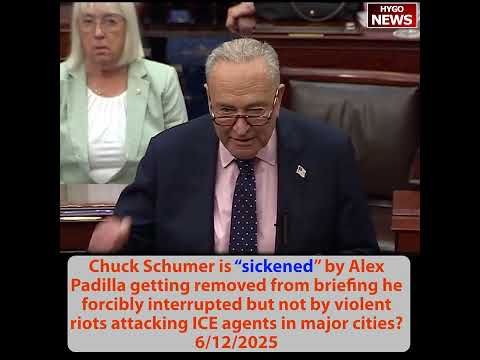
Dem Sen Padilla recklessly lunged toward Sec Noem; Chuck Schumer sickened; Gov Pritzker: disrespect
The incident at Homeland Security Secretary Kristi Noem’s press conference became the political flash point of the week. Democratic Senator Alex Padilla of California charged into a cabinet secretary’s press conference, pushed toward the podium, failed to identify himself by displaying the required Senate security pin, and was physically removed after refusing to follow directions from protective detail officers. Within hours, Senate Democratic Leader Chuck Schumer declared himself “sickened” by the removal. Illinois Governor JB Pritzker called it an “irrational” act of “disrespect” to a United States senator. The administration’s response was to point out that a Spanish-speaking man in street clothes charging a cabinet secretary without identifying himself is exactly the kind of scenario the Secret Service is trained to prevent — and that the sitting party that has been coordinating rhetoric about “terrorism” by federal agents bears responsibility for creating a climate where such a confrontation could occur. This article walks through the transcript and the political fallout line by line.
The Entry: “Hands Up. Hands Up.”
The scene on the video begins with protective detail calling out to the incoming figure. “Hands up, hands up.” The instruction is standard procedure. Anyone who enters an active press conference with a cabinet secretary at the podium is, from the Secret Service perspective, an unknown quantity until identification is confirmed. The shout for hands to be visible is the first protective step.
What makes the moment volatile is that Padilla was in street clothes, speaking Spanish at various points, and moving toward the podium rather than away from it. The combination of factors meant that protective officers had no visual cues — no lapel pin, no formal attire, no credential displayed — that would indicate a U.S. senator was approaching. From their perspective in the moment, they were looking at an unidentified individual closing on a cabinet secretary.
”I’m Senator Alex Padilla”
Padilla then identified himself verbally. “I’m Senator Alex Padilla. I have questions for the Secretary because the fact of the matter is a half a dozen violent criminals that are rotating on your… on your…”
The verbal identification is important procedurally. Once a senator identifies himself, protective officers are trained to verify the claim quickly. But the identification came after Padilla had already moved toward the podium, not before. And the verification process takes a meaningful number of seconds — seconds during which officers must continue to protect the person they are assigned to protect.
”Hands Up!” — The Takedown
The protective officers interrupted Padilla’s statement. “Hands up!” The repeated command is the indicator that officers were no longer accepting verbal engagement as a substitute for physical compliance. At that point, the transcript suggests, Padilla was physically restrained — which led to him being moved out of the press room and, ultimately, briefly cuffed.
The administration’s framing: a United States senator who wanted to ask questions of a cabinet secretary has the proper procedural route to do so. He can request a meeting. He can attend congressional hearings. He can submit written questions. What he cannot do — or more precisely, what will produce exactly the reaction Padilla received — is enter an active press conference, push toward the podium, and then fail to follow officer directions when the protective detail responds.
”Childish Behavior”
The administration’s immediate response was to label the conduct as “childish behavior” by a sitting senator. “Democrat Senator Alex Padilla should be ashamed of his childish behavior today. He crashed the middle of an official press conference being held by a cabinet secretary, recklessly lunged toward the podium where Sec Noem was speaking, and then refused to leave the room and follow the directions of law enforcement officers.”
The word “lunged” is operationally specific. It is the description used by Secret Service protocols when someone makes an aggressive movement toward a protected principal. The administration’s use of the term is deliberate — it signals that the protective detail perceived a threat movement, not a senator asking a question.
Schumer’s “Sickened” Response
Back on Capitol Hill, Senate Democratic Leader Chuck Schumer rose to object. “Mr. President, I just saw something that sickened my stomach. The manhandling of a United States senator, we need immediate answers to what the hell went on. I yield the floor.”
The phrase “sickened my stomach” is emotionally charged. It positions Schumer as personally affected by the footage and pledges Senate oversight. The phrase “what the hell went on” is meant to invite a broader investigation of the incident — presumably with the Democratic theory of the case being that Padilla was handled inappropriately because he was a Democratic senator, rather than because he failed to follow protective officer directions.
The Asymmetry Schumer Ignored
The administration’s counter-framing pointed out what Schumer’s statement did not address. Schumer declared himself “sickened” by the removal of Padilla from a briefing Padilla forcibly interrupted. He did not, in the same statement, declare himself sickened by the violent riots that had been attacking ICE agents in major cities over the preceding weeks.
The asymmetry matters because it signals to the administration — and to voters paying attention — that Schumer’s moral concern is selectively deployed. Agents being pelted with rocks and Molotov cocktails have not prompted “sickened my stomach” statements from the Senate minority leader. A senator being cuffed after charging a cabinet press conference did. The contrast is the part the administration wants voters to see.
The “Would You Handcuff Him” Thought Experiment
The administration’s best rhetorical move on the incident was a thought experiment directed at any reasonable person. “Would you handcuff him if you’re a Secret Service agent: Spanish speaking guy you’ve never seen before, dressed in street clothes, charges toward the DHS Sec. while yelling. He’s not wearing his Senate security hard-pin, didn’t previously identify himself. It’s your job to handcuff him.”
The framing asks the listener to inhabit the Secret Service agent’s decision calculus in real time. The agent does not know in advance that the approaching individual is a senator. The agent has no visual credential to rely on. The agent has an auditory signal — Spanish — that may or may not register as the agent’s native language. The agent sees movement toward the principal.
Under those circumstances, the correct protective response is to stop the advance, secure the principal, and sort out identification afterward. That is exactly what the Secret Service did. The incident would have been the story of a protective failure if they had done less.
Pritzker: “Thrown Down, Handcuffed, And Not Allowed To Ask A Question”
Illinois Governor JB Pritzker weighed in from the Democratic side with a forceful statement of disapproval. “And by the way, I want to say to all of you, all of you on both sides, but particularly those on the Republican side, that I cannot believe the disrespect that was shown to a United States senator who was thrown down, handcuffed, and not allowed to ask a question of our Secretary of Homeland Security, Kristi Noem. That seems completely irrational.”
Pritzker’s framing collapses the distinction between the protective response and the substantive access question. In his telling, Padilla was “not allowed to ask a question of our Secretary of Homeland Security” — as if the press conference format is the forum in which senators ordinarily ask questions of cabinet officers. It is not. Senators ask questions in hearings. Press conferences are not Q&A sessions with senators; they are public events convened by the executive branch. Padilla’s entry to the press conference was not a normal exercise of senatorial oversight. It was unusual, and the unusual nature of the entry is why the protective detail responded the way they did.
”Thrown Down, Handcuffed”
The physical description Pritzker used — “thrown down, handcuffed” — is the Democratic framing of what the administration describes as lawful use of force by protective officers. The video does show Padilla being taken to the ground. Whether that action rises to the level of “thrown down” as Pritzker characterizes it, or whether it represents standard protective takedown technique applied to an individual who failed to comply with verbal directions, depends on the viewer’s prior.
What is not in dispute is that Padilla was physically restrained and was briefly handcuffed. The administration’s argument is that the restraint was proportionate to the protective concern in the moment, and that senators who wish to avoid such restraint can do so by identifying themselves before approaching a cabinet secretary, displaying the appropriate credential, and following officer directions.
”Weaponizing The Government Against U.S. Citizens”
The Democratic framing then escalated. The transcript records: “So let me go ahead and make sure that I say this clear, because I serve in Homeland Security, and I can tell you for a fact, they are weaponizing the government and the military against U.S. citizens to exert control and suppress dissent. I call that authoritarianism.”
The word “authoritarianism” is the flag every Democrat has been running up the pole in response to the federal operations of the second Trump term. The framing: federal actions that previously would have been described as enforcement are now being described as suppression of dissent.
The administration’s counter-framing is that enforcement of existing law is not authoritarianism — it is the discharge of the constitutional duty to take care that the laws be faithfully executed. The Democratic argument requires treating enforcement itself as illegitimate when the enforcement targets constituencies the party cares about, which is not a stable political position.
”They Don’t Want You Recording”
A striking moment in the transcript is the Democratic speaker’s assertion that recording was being suppressed in the press room. “There’s no recording loud out here per up guy, right? They don’t want you recording so that you don’t see how they violate the process repeatedly.”
The framing positions recording restrictions as evidence of misconduct. The administration’s counter is that press conferences have defined recording rules, that those rules are administered by press office staff, and that the senators claiming recording was suppressed are themselves in a better position to verify or refute that claim through normal congressional oversight — not through accusations made during floor speeches.
The Broader Stakes
The Padilla incident, taken as a whole, is a small procedural event that has become a major political story because it sits at the intersection of three larger narratives. First, the question of how federal protective officers should respond to elected officials who do not follow protective protocols. Second, the question of whether Democratic rhetoric about federal enforcement has made physical confrontation more likely. Third, the question of whether the political press will describe the incident as it occurred or as the partisan narrative prefers.
The administration has made clear which version it thinks is accurate. Secret Service protocols require protective officers to respond to unidentified individuals who charge a cabinet secretary at a press conference. Padilla created the conditions for that response by his entry, his movements, and his refusal to follow directions. The senators and governors calling the protective response “sickening” and “irrational” are making a political argument that requires ignoring what their own constituents would expect if they were the protected principal.
Pritzker’s Appeal To “Both Sides”
Pritzker’s attempt to appeal to both sides — “I want to say to all of you, all of you on both sides, but particularly those on the Republican side” — is a rhetorical move that deserves attention. By framing his plea as bipartisan while directing it primarily at Republicans, Pritzker is signaling that he expects Republicans to be morally persuaded by the incident. The political bet is that images of a senator being taken to the ground will produce cross-partisan discomfort.
The administration’s bet is that voters have now seen enough footage of federal agents being assaulted by protesters that they will not be moved by a senator being cuffed after charging a cabinet press conference. The question of which bet is right will be answered in polling over the coming weeks.
Key Takeaways
- Sen. Padilla entered a DHS press conference in street clothes, spoke Spanish at points, did not display the Senate security pin, and was physically restrained after approaching Sec. Noem’s podium.
- Schumer’s floor response: “I just saw something that sickened my stomach. The manhandling of a United States senator” — a framing that did not address weeks of attacks on ICE agents.
- Gov. Pritzker: “I cannot believe the disrespect that was shown to a United States senator who was thrown down, hand-cuffed and not allowed to ask a question of our Secretary of Homeland Security Kristi Noem. That seems completely irrational.”
- The administration’s thought experiment: “Would you handcuff him if you’re a Secret Service agent: Spanish speaking guy you’ve never seen before, dressed in street clothes, charges toward the DHS Sec. while yelling.”
- The broader Democratic frame, captured in the transcript: “they are weaponizing the government and the military against U.S. citizens to exert control and suppress dissent. I call that authoritarianism.”