 HYGO News
 Dem Blumenthal: no reason to surrender now; Thune is FURIOUS; Dem: undocumented not crime
Dem Blumenthal: no reason to surrender now; Thune is FURIOUS; Dem: undocumented not crime
Four distinct moments from Capitol Hill during day 37+ of the shutdown. Democratic Sen. Richard Blumenthal publicly declared “there is no reason to surrender now, every reason to stand firm” — effectively acknowledging the shutdown as political leverage rather than principled necessity. Democratic Rep. Pramila Jayapal repeated the factually incorrect claim that “being undocumented is actually not a crime” (federal law 8 USC § 1325 makes illegal entry a crime). Democratic Rep. John Garamendi admitted publicly that his own “very, very dangerous” rhetoric needs to be toned down — a rare acknowledgment that Democratic political language has contributed to political violence. Senate Majority Leader John Thune delivered furious floor remarks after Democrats objected to paying federal workers “for tomorrow and for the entire year” — not just back-pay for past work, but forward commitment. Democrats objected because forward-pay would remove their leverage. Thune’s reaction: pure anger at the cynicism. The transcript also included a compilation showing Democrats repeatedly acknowledging the Senate’s 60-vote filibuster requirement — a framework they themselves regularly invoke when in minority, now cast as Republican obstruction. Blumenthal: “I think that there is no reason to surrender now, every reason to stand firm.” Jayapal: “Being undocumented is actually not a crime.” Thune: “This is a straightforward proposal which addresses the concern that millions of Americans have who are headed to food banks and can’t pay their rent. And you’re coming down here and saying you’re going to object.” Garamendi: “We need to tone it down. And that includes me.”
Blumenthal: “No Reason to Surrender”
Sen. Richard Blumenthal (D-CT) opened with an extraordinary framework. “I think that there is no reason to surrender now, every reason to stand firm.”
“Surrender” language is revealing. Blumenthal’s framework is explicit: the shutdown is a battle. Democrats are combatants. Ending the shutdown constitutes surrender. The rhetorical choice treats American federal workers, SNAP recipients, and air travelers as collateral damage in a war.
The framework contrasts sharply with standard Democratic public framing (“Republicans caused this”). Blumenthal’s language reveals the internal framework — Democrats see the shutdown as a war they’re winning, and walking away would be defeat.
Jayapal: “Not a Crime”
Democratic Rep. Pramila Jayapal (WA) then made a factual claim. “And it has included people who have been here for 15, 20 years living, contributing in their communities. They have relationships across their communities. They’re undocumented, but they have no other crime.”
Jayapal’s framework: long-term undocumented residents have “no other crime” besides being undocumented.
“And as you know, being undocumented is actually not a crime.”
The claim is factually inaccurate. 8 USC § 1325 criminalizes improper entry into the United States:
- Unauthorized entry is a federal misdemeanor on first offense
- Felony on second offense (8 USC § 1326)
- Additionally, 8 USC § 1324 covers harboring and transporting undocumented immigrants
What’s accurate: being in the United States unlawfully (after having entered) is a civil violation, not a criminal one. But entering unlawfully is indeed a crime under federal law.
Jayapal’s statement conflates “being undocumented” (civil) with “illegal entry” (criminal). Most undocumented immigrants did enter illegally — making them criminals under 1325.
Thune’s Fury
Sen. Thune responded to Democratic objections on forward federal worker pay. The context: Republican proposal paid federal workers for today, tomorrow, and the entire year — guaranteeing they wouldn’t miss future paychecks regardless of shutdown duration.
“When he’s saying right here, we will pay him not only for today, but for tomorrow and for the entire year. And we won’t allow them to be held hostage and be pawns in a political game in the future.”
The forward-commitment principle:
- Pay federal workers for past work (standard)
- Commit to paying them for ongoing work during shutdown (forward)
- Remove them as leverage in political battles (future protection)
“And my understanding is the senator from Michigan on behalf, I suppose, of other Democrats is objecting to that.”
Senate Minority Leader Gary Peters (D-MI) or Sen. Debbie Stabenow (D-MI) presumably objected. The objection is telling — Democrats want federal workers remaining leverage, not removed from the political equation.
“Please, please help me understand. This is a straightforward proposal which addresses the concern that millions of Americans have who are headed to food banks and can’t pay their rent.”
Thune’s genuine bafflement at the objection. Democrats had been publicly claiming concern for federal workers. The forward-pay proposal addressed that concern. Democrats objected.
”It’s About Leverage”
“And you’re coming down here and saying you’re going to object because you just want to pay him for yesterday, not for tomorrow or the next day after that. It’s about leverage, isn’t it? Isn’t that what you all have been saying? It’s about leverage.”
Thune directly named the Democratic position. Democrats had been quoted — in the Schumer “every day gets better” moment, in the House Whip’s “families will suffer but we have leverage” statement, in the Delaware senator’s “our only moment of leverage” framing — using the word “leverage.”
“This isn’t leverage. This is the lives of the American people.”
Thune’s moral counter: what Democrats call leverage is actually human suffering. The distinction matters.
“The senator of Wisconsin has put forward a straightforward proposal to pay people, federal employees, today, tomorrow, and in the future.”
The Wisconsin senator — Ron Johnson (R-WI) — had sponsored the forward-pay legislation.
“And what you’re essentially saying is, well, I’m fine with paying him for yesterday. We’re not going to pay him for tomorrow or for the day after that for the future.”
Thune’s distillation: Democrats support paying for past work already done, but refuse to protect workers going forward — because the workers need to remain leverage.
Garamendi on Rhetoric
Democratic Rep. John Garamendi (CA) then delivered an unusual admission. “The rhetoric that is out there, very, very dangerous rhetoric. We need to tone it down. And that includes me.”
Garamendi’s acknowledgment is important:
- Political rhetoric is “very, very dangerous”
- It needs to be toned down
- Garamendi includes himself in that need
The moment came in context of extended political violence — the Charlie Kirk assassination, ICE officer attacks, Tesla vandalism, Minnesota Catholic school shooting, the pattern Schmitt had listed.
Democratic acknowledgment that Democratic rhetoric contributes to violence is rare. Garamendi’s self-inclusion is particularly notable.
“Well, I can get pretty excited about the potential. I never get excited about personal vindictive assaults on anybody.”
Garamendi drew a distinction between policy debate (getting excited about potential) and personal attacks (which he doesn’t do). The framework concedes that he has gotten excited in ways that could contribute to personal attacks, even if he doesn’t intentionally engage in them.
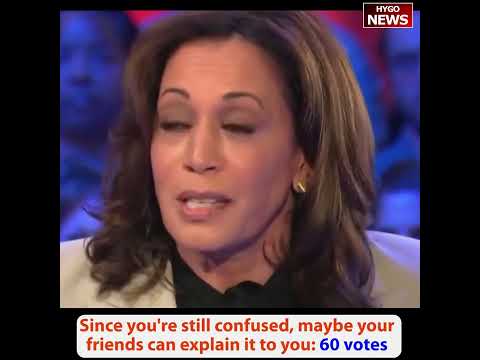
60 Votes Compilation
The transcript then captured a compilation of Democrats stating the Senate’s 60-vote requirement. Nearly all Democratic senators over decades had acknowledged the 60-vote rule:
“The Senate needs 60 votes to pass a bill.” “These days you need 60 votes for everything.” “You need 60 votes to acquire 60 votes in the United States Senate.” “But in the Senate, you’ve got this rule where you’ve got to get these days 60 votes.”
The compilation continues with essentially every Democratic senator acknowledging the requirement. Senators Schumer, Durbin, Warren, Sanders, Klobuchar, Booker — dozens of them, all on record stating the 60-vote framework as a fundamental Senate rule.
The point of the compilation: Democrats themselves have invoked the 60-vote rule repeatedly, often to justify their own blocking of Republican legislation during prior Republican majorities. Now Democrats frame the same rule as Republican obstruction when Democrats are the ones blocking.
The Filibuster Context
“With spending bills subject to 60 votes. If you couldn’t get 60 votes, you couldn’t get something moving. And of course, the Senate requires 60 votes. It’s a super majority. You need 60 votes.”
The structural fact: Senate rules require 60 votes for cloture (ending filibuster) on most legislation. The shutdown CR requires 60 votes. Republicans have 53. They need 7 Democratic senators to pass the CR.
Democrats blocking the CR = Democrats maintaining the shutdown. No Republican action or inaction could override 47 Democratic objections.
Trump’s call to terminate the filibuster (from prior articles) would change this dynamic. Democrats would lose their blocking power. Clean CR would pass. Shutdown would end. Similar future showdowns would be impossible.
Republicans who support filibuster preservation are, under current conditions, enabling continued Democratic blocking. The question of whether to end the filibuster is increasingly acute.
”You’ve Got to Get Essentially 60 Votes”
“You still need 60 votes. You need 60 votes. You still need 60 votes over in the Senate.”
The compilation hammered the point. If Democratic senators over decades acknowledged the 60-vote rule as the Senate’s operating reality, they cannot now credibly argue that Republicans blocking legislation requires different treatment than Democrats blocking legislation.
“Because you need Democrats and Republicans to pass a bill. You need Democratic votes to pass a budget. Everybody’s known that. That’s been the rule in the Senate for years.”
The bipartisan nature of Senate legislation is structural. Budget passage requires votes from both parties absent filibuster changes. Democrats know this; Democrats state this; Democrats have relied on this framework.
Significance
Day 37+ of the shutdown. Multiple Democratic cracks showing:
- Blumenthal’s “surrender” language exposing war framework
- Jayapal’s “not a crime” factually incorrect claim
- Garamendi’s self-inclusion in dangerous rhetoric admission
- Democratic objection to paying federal workers forward
- Compilation showing Democratic acknowledgment of 60-vote rule
Republican framework solidifying:
- Thune’s furious framing of Democratic leverage-over-workers
- Trump’s push to terminate filibuster
- Kennedy’s pay-withholding bill
- Accumulating polling shifts
Something would break soon. Either Democrats would face defections sufficient to pass CR (CNN’s “dozen willing” signal), or Republicans would face filibuster reform pressure, or consequences would force leadership shift. The shutdown couldn’t continue indefinitely without one of these developments.
Key Takeaways
- Blumenthal on shutdown: “I think that there is no reason to surrender now, every reason to stand firm” — using military/battle framework for political standoff affecting millions of Americans.
- Jayapal’s false claim: “Being undocumented is actually not a crime” — contradicting 8 USC § 1325 which makes illegal entry a federal misdemeanor.
- Thune on Democratic objection to forward pay: “We will pay him not only for today, but for tomorrow and for the entire year. And we won’t allow them to be held hostage and be pawns in a political game in the future … This is a straightforward proposal which addresses the concern that millions of Americans have who are headed to food banks and can’t pay their rent. And you’re coming down here and saying you’re going to object … It’s about leverage, isn’t it? … This isn’t leverage. This is the lives of the American people.”
- Garamendi’s self-inclusion: “The rhetoric that is out there, very, very dangerous rhetoric. We need to tone it down. And that includes me.”
- 60-vote compilation: Nearly every Democratic senator over decades on record acknowledging the Senate’s 60-vote threshold — the rule they now frame as Republican obstruction when they themselves are blocking.