 HYGO News
 Congress officially certified Trump & Vance; Pelosi uses a walker; Harris: Today should be the norm
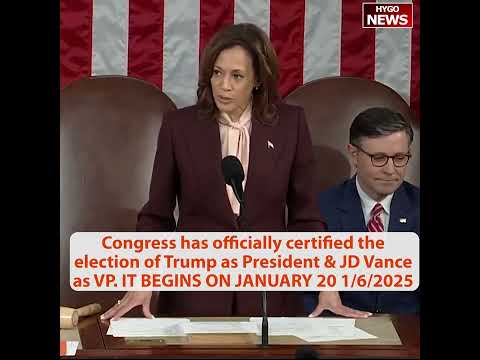
Congress officially certified Trump & Vance; Pelosi uses a walker; Harris: Today should be the norm
On January 6, 2025, Congress officially certified the election of Donald J. Trump of Florida as President and JD Vance of Ohio as Vice President of the United States. The certification, conducted during a Joint Session of Congress, proceeded without disruption and confirmed the results of the 2024 presidential election. Vice President Kamala Harris, presiding over the session, later described the day as being about “what should be the norm,” while former House Speaker Nancy Pelosi was observed using a walker as she attended the proceedings.
The Official Certification: Trump 312, Harris 226
The Joint Session of Congress formally tallied the Electoral College votes, with Harris herself reading the results aloud in her capacity as President of the Senate. The final count was definitive: Donald J. Trump of the state of Florida received 312 electoral votes, while Kamala D. Harris of the state of California received 226 electoral votes.
For the vice presidential contest, the results mirrored the presidential tally: JD Vance of the state of Ohio received 312 electoral votes, while Tim Walz of the state of Minnesota received 226 electoral votes.
Harris then read the formal declaration: “This announcement of the state of the vote by the President of the Senate shall be deemed a sufficient declaration of the persons elected, President and Vice President of the United States, each for a term beginning on the 20th day of January 2025, and shall be entered together with the list of the votes on the journals of the House and the Senate.”
The tellers were dispensed from reading the formal portions of the certificates, and the session concluded in orderly fashion. The certification cleared the final constitutional hurdle before Trump’s inauguration on January 20, 2025.
Harris Speaks After Certification: “What Should Be the Norm”
Following the Joint Session, Vice President Harris spoke to reporters about the significance of the day. Her remarks struck a tone of both solemnity and pointed commentary about the democratic process.
“Today was obviously a very important day,” Harris said. “It was about what should be the norm and what the American people should be able to take for granted, which is that one of the most important pillars of our democracy is that there will be a peaceful transfer of power.”
Harris framed her role in the proceedings as a continuation of her career-long commitment to constitutional principles: “Today I did what I have done my entire career, which is take seriously the oath that I have taken many times to support and defend the Constitution of the United States, which included today performing my constitutional duties to ensure that the people of America, the voters of America, will have their votes counted, that those votes matter, and that they will determine then the outcome of an election.”
She concluded with a broader statement about the fragility and resilience of democratic institutions: “I do believe very strongly that America’s democracy is only as strong as our willingness to fight for it. Every single person, their willingness to fight for and respect the importance of our democracy. Otherwise, it is very fragile and it will not be able to withstand moments of crisis. And today America’s democracy stood.”
The remarks were notable for their implicit references to the events of January 6, 2021, exactly four years earlier, when the certification of the 2020 election was disrupted. Harris’s emphasis on the “peaceful transfer of power” and the idea that the day’s proceedings represented “what should be the norm” underscored how the date itself had become freighted with political significance.
Pelosi Appears with a Walker
Among the notable observations from the day was the appearance of former House Speaker Nancy Pelosi using a walker as she attended the proceedings in Congress. Pelosi, who was 84 years old at the time, had suffered a hip injury during a trip to Luxembourg in December 2024, requiring hospitalization and subsequent recovery.
Her presence at the certification, despite her physical condition, was noted by observers on both sides of the aisle. For some, it was a demonstration of commitment to the institution she had led for years. For others, it became another data point in the ongoing national conversation about age and physical fitness among senior political figures in Washington.
The Significance of January 6, 2025
The date of January 6 carried enormous symbolic weight in 2025. Exactly four years earlier, the Capitol had been the site of unprecedented disruption during the certification of the 2020 presidential election. The contrast between the two days could not have been more stark.
The 2025 certification was conducted smoothly and without incident. Members of Congress from both parties participated in the constitutionally prescribed process. The Electoral College certificates were transported to the House Chamber, the votes were counted, and the results were announced by the presiding officer without objection or challenge.
The orderly nature of the proceedings was itself a subject of commentary. Harris’s post-certification remarks explicitly addressed the idea that a peaceful certification should be taken for granted, suggesting that the events of 2021 had made such proceedings something that could no longer be assumed.
The Electoral Count Reform Act in Practice
The 2025 certification was the first to take place under the Electoral Count Reform Act of 2022, which had been enacted specifically in response to the events of January 6, 2021. The law clarified the vice president’s role as purely ceremonial and raised the threshold for congressional objections to electoral votes.
Under the reformed process, the vice president’s function was limited to presiding over the session and announcing the results. The law removed any ambiguity about whether the vice president could independently influence the outcome of the certification. In practice, this meant that Harris’s role on January 6, 2025, was entirely procedural, despite her characterization of it as a “constitutional duty.”
The smooth application of the new law represented a successful test of the reforms that Congress had put in place to prevent future certification crises. The session proceeded according to the updated rules, and the certification was completed without the kind of procedural disputes that had marked the 2021 proceedings.
Additional Context
The certification of Trump’s 312-226 electoral vote victory confirmed one of the most decisive presidential elections in recent memory. Trump’s margin represented a significant improvement over his 2016 victory of 306-232 and reversed his 2020 loss of 232-306 to Biden. The breadth of Trump’s 2024 victory, including wins in key battleground states, gave the incoming administration a strong mandate as it prepared to take office on January 20.
For Harris, the day marked the effective end of her political chapter in the executive branch. Having lost the presidential race and now having presided over the certification of that loss, she would leave office two weeks later when Trump was inaugurated.
Key Takeaways
- Congress officially certified Donald J. Trump as the 47th President and JD Vance as Vice President on January 6, 2025, with Trump receiving 312 electoral votes to Harris’s 226.
- Vice President Harris presided over the certification and afterward stated the day was about “what should be the norm,” emphasizing the importance of the peaceful transfer of power.
- Harris declared that “America’s democracy is only as strong as our willingness to fight for it” and said her constitutional duties included ensuring voters’ choices were counted and respected.
- Former House Speaker Nancy Pelosi was observed using a walker during the proceedings, following a hip injury sustained in December 2024.
- The 2025 certification was the first conducted under the Electoral Count Reform Act of 2022, which clarified the vice president’s role as purely ceremonial and raised the threshold for congressional objections.