 HYGO News
 CNN: dozen Dems privately signaled to vote to reopen; Kennedy to STOP Congress PAID during Shutdown
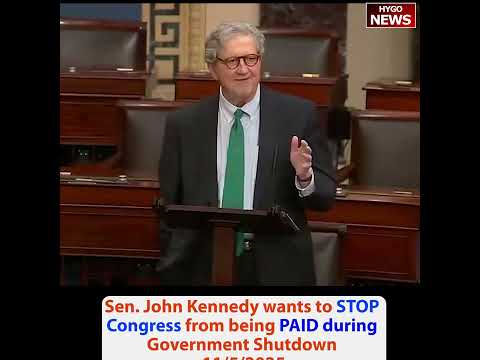
CNN: dozen Dems privately signaled to vote to reopen; Kennedy to STOP Congress PAID during Shutdown
CNN reported that roughly a dozen Senate Democrats have privately signaled willingness to vote to reopen the government in exchange for a future vote on extending the expiring ACA subsidies — yet Arizona Sen. Ruben Gallego publicly refused to back the deal. Sen. Chuck Schumer continued blaming Republicans for the shutdown despite controlling neither chamber of Congress. Sen. Jacky Rosen, who had voted 14 times to keep the shutdown going, repeated Democratic framing that blamed Republicans. Sen. John Kennedy (R-LA) announced he would offer bills to stop Congressional pay during the shutdown — citing 2013 precedent when President Obama supported similar legislation, which had driven Congress to reach a deal. Kennedy noted federal workers had borrowed $365 million during the 36-day shutdown just to pay rent — and “what’s good for the goose is good for the gander.” Kennedy was frank that he believed the shutdown would continue despite rumors of imminent resolution. CNN reporter: “Roughly a dozen Senate Democrats have privately signaled they’re willing to vote to reopen the government in exchange for a promise that there would be a future vote on extending those expiring ACA subsidies. Are you backing that deal?” Gallego: “No.” Kennedy: “What’s good for the goose is good for the gander.”
Dozen Democrats Willing
CNN reporter opening: “On the shutdown, roughly a dozen Senate Democrats have privately signaled they’re willing to vote to reopen the government in exchange for a promise that there would be a future vote on extending those expiring ACA subsidies. Are you backing that deal? Would you support it?”
The reported framework: a dozen Democratic senators would accept:
- Vote now to reopen the government (passing the clean CR)
- In exchange for: commitment to future vote on ACA subsidy extension
- The future vote doesn’t have to pass — just has to happen
This was a path out of the shutdown. Reopen now, fight ACA subsidies on a scheduled future vote rather than holding government funding hostage.
Arizona Sen. Ruben Gallego answered: “No.”
Gallego refused the deal. His framework: “The answer, as I said, is simple. And what’s we’ve been saying all along? Republicans who caused the shutdown by not even negotiating with us.”
Gallego’s position: even with a dozen Democrats willing to accept the deal, he personally would not. The shutdown must continue until Democrats get concrete policy wins, not just future-vote promises.
Schumer on Blame
The transcription included Schumer continuing his blame framework. “What do you say to the staff? What do you say to the TSA workers? What do you say to the air traffic controllers? What do you say to the military? What do you say to the public?”
A reporter had asked Schumer what he says to affected workers. Schumer’s response: turn the question around, ask Republicans what they say.
“What do you say to the government, please? The Republicans shut down, my friend. You are in control of the White House. You are in control of the House, and you are in control of the Senate.”
Schumer’s framework: Republicans control everything, therefore Republicans own the shutdown. The problem with the argument: Senate filibuster rules require 60 votes for most legislation. Republicans have 53 Senate votes. Democrats blocking via filibuster is the actual mechanism keeping the shutdown going.
But Schumer’s political framework: Republicans in control = Republicans responsible. He’d keep repeating it regardless of the technical Senate rules.
Kennedy’s Bill
Sen. John Kennedy then introduced the idea of stopping Congressional pay during the shutdown. “Like you, Mr. President, I’ve heard a lot of rumors about we’re that close to reaching an agreement. We’ve been that close for a week. Frankly, I hope I’m wrong in saying this, but I don’t think we’re really that close.”
Kennedy’s honest assessment: the rumors of imminent agreement had been circulating for a week. Kennedy didn’t believe them. The shutdown would continue.
“I wish we were, and I hope we are. But I think we’re going to be in the shutdown a while longer. That doesn’t give me any joy to say that.”
$365 Million Borrowed
“In the meantime, none of our staffs are being paid. No federal employees are being paid. I’ve got some numbers in this morning that federal workers have had to borrow $365 million so far during this 36-day shutdown in order just to pay their rent.”
$365 million in borrowed money for rent alone. This is not total financial stress — just rent. Additional borrowing for groceries, medical, childcare, utilities would multiply the figure.
The scale: federal workers going into debt to avoid eviction. The debt will take years to repay. Some may face repossession or credit damage that outlasts the shutdown by years.
“Our military is only being paid partially. Our air traffic controllers are not being paid. People who receive SNAP payments are only being partially paid.”
The full affected population:
- Military: partial pay (Pentagon used accounting tricks)
- Air traffic controllers: no pay
- SNAP recipients: partial benefits (court-ordered)
- Federal civilian workers: no pay
”Nobody Wants Hunger”
“I don’t think anybody wants to see anybody go hungry in America, and that’s not a partisan statement. I think that’s a bipartisan statement.”
Kennedy’s framing: hunger avoidance is bipartisan. Nobody — Democrat or Republican — genuinely wants Americans to go hungry. The dispute is about mechanism and responsibility, not about whether hunger is bad.
But the framework implicitly challenged Democrats: if hunger is bipartisan bad, then Democrats blocking clean CR and preventing SNAP funding is inconsistent with bipartisan hunger-avoidance.
2013 Obama Precedent
“There’s precedent for this, Mr. President. Some may say, well, this violates the 27th Amendment. I don’t think it does. That’s why I’m offering two different flavors of bills.”
The 27th Amendment prohibits mid-term Congressional pay changes. Kennedy’s framework: his proposal either doesn’t violate the Amendment, or if it might, he has alternative versions designed to comply.
“But in 2013, President Obama did the same thing that I’m doing now. They were in a shutdown, and President Obama supported legislation that said, if you don’t open up government by this certain date, then you’re going to lose your paychecks. And guess what? Members of Congress had an epiphany, and they found religion. They had a domicine moment, and they opened up government.”
The 2013 precedent:
- Government was in shutdown over ACA funding disputes
- Obama supported legislation to withhold Congressional pay during shutdowns
- Once Congress faced personal financial consequences, they rapidly reached agreement
Kennedy’s framework: the same mechanism will work now. Face Congress with actual financial stakes, and they’ll end the shutdown quickly.
”Domicine Moment”
The “domicine moment” — Whisper may have rendered “dominical” or similar — is Kennedy’s colloquial way of saying epiphany, religious-conversion-like moment. When pain becomes personal rather than abstract, solutions emerge rapidly.
Kennedy’s Bill
“And that’s all this bill will do. I’m not trying to grandstand. I wasn’t going to bring this bill. When I got back here Monday, I heard all the rumors like everybody else that we were close. And I hope we are close, but we’re not close enough.”
Kennedy’s framework: he would have preferred to reach agreement without the pay-withholding threat. But after observing continued stalemate after the “close” rumors, he decided to force the issue.
“And so I’ll offer these bills tomorrow, and people can vote yay or they can vote nay. But what’s good for the goose is good for the gander."
"Goose and Gander”
The idiom: if it applies to one person, it should apply equally to another. In this context:
- Federal workers aren’t being paid during shutdown
- Therefore, Congress shouldn’t be paid either
- Both feel the pain equally
- Incentive alignment on ending the shutdown quickly
Rosen’s Dishonesty
The transcription noted Sen. Jacky Rosen’s performance. She had voted 14 times to keep the shutdown going while blaming Republicans for it.
Rosen’s positioning reflects the Democratic Party’s coordinated framework: vote to maintain shutdown, publicly blame Republicans for the shutdown. The inconsistency is structural, not accidental — the framework depends on most voters not tracking individual votes.
The Schumer Contradiction
Schumer’s repeated “Republicans caused this” framework had a fundamental problem: Senate Democrats were voting 14 times to maintain the shutdown. Their votes were preventing any clean CR from passing.
Schumer’s framing logic:
- Republicans proposed the CR (true)
- Democrats are blocking it (true)
- Therefore Republicans caused the shutdown (doesn’t follow)
The more accurate framework: Republicans proposed a clean CR, Democrats refused to pass it, therefore Democrats caused the shutdown. But Schumer repeatedly used his framework regardless.
Significance
Several dynamics were converging:
- Public Democratic solidarity fraying (CNN reports of dozen willing to deal)
- Leadership unwillingness to accept deals that don’t extract policy wins
- Continued public framing blaming Republicans despite vote mechanics
- Real-world consequences mounting ($365M in borrowed rent, air travel disruptions)
- Creative Republican proposals (Kennedy’s pay-withholding bill)
Day 36 of the shutdown. The situation was approaching a breaking point. Either enough Democratic defections would deliver a CR vote, or consequences would force a larger resolution. Kennedy’s bill was one mechanism to accelerate that resolution.
The 2013 precedent was relevant. That shutdown — 16 days over ACA funding — ended when the political costs became unsustainable. The current shutdown had already exceeded that length by 2x, with further costs accumulating.
Key Takeaways
- CNN on dozen Democrats: “Roughly a dozen Senate Democrats have privately signaled they’re willing to vote to reopen the government in exchange for a promise that there would be a future vote on extending those expiring ACA subsidies. Are you backing that deal?”
- Gallego’s refusal: “No … Republicans who caused the shutdown by not even negotiating with us.”
- Schumer’s blame framework: “The Republicans shut down, my friend. You are in control of the White House. You are in control of the House, and you are in control of the Senate.”
- Kennedy on shutdown reality: “I don’t think we’re really that close. I wish we were, and I hope we are. But I think we’re going to be in the shutdown a while longer … federal workers have had to borrow $365 million so far during this 36-day shutdown in order just to pay their rent.”
- Kennedy on 2013 precedent: “In 2013, President Obama did the same thing that I’m doing now … Members of Congress had an epiphany, and they found religion … they opened up government. And that’s all this bill will do … what’s good for the goose is good for the gander.”