 HYGO News
 CNBC: LOT of revenue from tariffs; Bessent: 11% spending cut, bend curve, bring down debt; Warren
CNBC: LOT of revenue from tariffs; Bessent: 11% spending cut, bend curve, bring down debt; Warren
CNBC, not a reliable administration cheerleader, acknowledged on camera that tariff revenue is flowing into the United States at substantial rates — $121 billion so far this fiscal year, with June projected to add another $27 billion. Treasury Secretary Bessent described the One Big Beautiful Bill as “an 11% cut in non-discretionary spending” and committed the administration to “bend the curve, bring the debt levels down.” Senator Elizabeth Warren continued the billionaire-critique framing. Senator John Fetterman expressed his frustration with the extended Senate voting process — “Oh my God, I just want to go home.” Deputy Chief of Staff Stephen Miller delivered one of the more exhaustive catalogues of the bill’s achievements, calling it “the most conservative bill in my lifetime.”
CNBC Acknowledges The Revenue
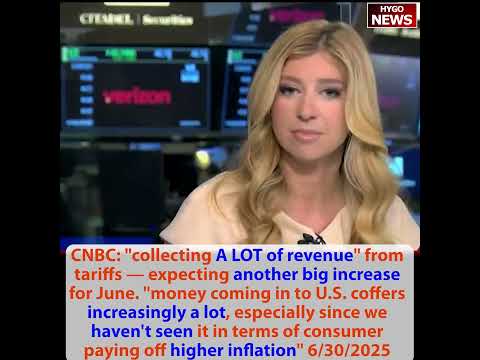
The CNBC segment was unusually generous to the administration’s tariff policy. “Look how much we’ve been collecting in revenues. And I did this in part because Wilfrid’s here and he can talk about the UK trade deal. But just this is the monthly numbers and they have gone up a lot. June is actually set for another big increase of $27 billion.”
$27 billion in a single month of tariff revenue is substantial. Cumulative annual tariff revenue at that pace would exceed $300 billion. That compares favorably to historical tariff revenue that had typically run in the tens of billions annually.
The $121 Billion Figure
CNBC then provided the fiscal-year-to-date figure. “So far, guys, $121 billion has flowed into the US government since the start of the fiscal year. We are a portion of the overall revenues that the US government gets, but it’s increasingly a lot, especially if we haven’t seen it in terms of the consumer paying off higher inflation.”
$121 billion in tariff revenue since October is an enormous figure relative to recent historical norms. The United States had not collected tariff revenue at that pace in decades. The combined effect across a full fiscal year could approach or exceed $400 billion.
“Especially since we haven’t seen it in terms of the consumer paying off higher inflation” is the analytical observation. If the tariffs were being passed through to consumers, the revenue would be effectively a consumer tax. But consumer inflation has not accelerated. That means the tariff cost is being absorbed elsewhere in the value chain — by foreign producers, importers, wholesalers, or retailers — rather than by American consumers.
Why The CNBC Acknowledgment Matters
CNBC’s willingness to acknowledge the tariff revenue story is significant. The network has generally been skeptical of the administration’s tariff framework. Its business-oriented audience has included many skeptics of Trump’s trade policy. The network’s acknowledgment that the revenue is real, that it is flowing into federal coffers, and that it is not producing consumer inflation is a form of factual validation.
That validation matters because it comes from a source that was not predisposed to favor the administration’s framing. When skeptical outlets acknowledge favorable data, the acknowledgment is more persuasive than similar claims from administration-friendly sources.
Bessent On The 11% Cut
Treasury Secretary Scott Bessent described the bill’s spending impact. “Everyone believes that this is a start. It’s an 11% cut in non-discretionary spending. We’re going to go from there.”
“Non-discretionary spending” is the category that includes most major federal programs — Medicare, Medicaid, Social Security, and related mandatory spending. Cuts in that category are politically difficult because they affect programs with large beneficiary populations. The 11% figure, if accurate, represents substantial policy change.
The “we’re going to go from there” framing indicates that the bill is not the end of the administration’s fiscal agenda. Additional reforms are planned. The 11% cut is an opening move in what the administration views as a longer campaign to restore fiscal discipline.
”20 Or 40 Years”
Bessent placed the current moment in historical context. “We didn’t get here all at once. We’ve gotten here 20 or 40 years and we are going to bend the curve, bring the debt levels down.”
The acknowledgment that current fiscal problems developed over decades is politically important. The administration is not claiming that the debt emerged under the Biden administration alone. The debt has accumulated across multiple administrations of both parties. Bush 43, Obama, Trump’s first term, Biden — each added substantially to the federal debt.
The current administration’s claim is that it will reverse the trajectory. “Bend the curve, bring the debt levels down” is the aspirational target. Whether the target is achievable depends on sustained political will across multiple years and the continuation of favorable economic conditions.
”I’m A Fiscal Hawk”
Bessent then addressed his own credibility. “I’m a fiscal hawk. I have had a lot of very good meetings with that group.”
The reference is to the fiscally conservative Republican caucus that has been skeptical of elements of the bill. Bessent, positioning himself as a fiscal hawk, claims common ground with that caucus. Their “good meetings” have, in his telling, produced agreement on how to “grow the economy while controlling and bringing down expenses.”
Whether the fiscal hawks truly agree is an open question. Some have publicly supported the bill. Others have expressed concerns. Bessent’s characterization may overstate the consensus, but the direction of engagement — fiscal conservatives working with Treasury leadership on a bill they can support — is accurate.
Warren’s Critique
Senator Elizabeth Warren’s critique was familiar. “And Republicans have made their values clear. They are willing to throw millions of Americans under the bus so that they can help out a handful of their billionaire buddies and giant corporations. They should be ashamed.”
The framing is consistent with the Democratic messaging playbook: Republicans care about billionaires, Republicans harm ordinary Americans, Republicans should be ashamed. The specific provisions of the bill — 15% tax cut for middle-class families, no tax on tips, expanded child tax credit — are not engaged with. The framing is aspirational rather than analytical.
The Small Business Counter
The administration’s counter to Warren’s critique draws on the National Federation of Independent Business characterization. NFIB called the bill “one of the most pro-small business pieces of legislation in recent history.”
That characterization is the opposite of Warren’s. If the bill is “pro-small business,” it is not “strictly designed to help billionaires and large corporations.” Small business owners, who compete against large corporations, benefit from provisions that reduce their tax burden and reduce compliance costs.
Which framing is correct is ultimately an empirical question answered by the bill’s actual effects on small businesses. If small business hiring, investment, and profitability increase under the bill, Warren’s framing is wrong. If they stagnate or decline, her framing has better standing.
Fetterman’s Frustration
Senator John Fetterman, who has been public about his frustration with Senate procedure, expressed exasperation with the extended voting. “Oh my God, I just want to go home. I’ve missed our entire trip to the beach. My family’s going to be back before we do that. So, and again, I’m going to vote no.”
The human dimension captures the reality of senatorial life. Fetterman has a young family. He had planned a family trip. The Senate’s extended voting — the vote-a-rama process — forced him to cancel the trip. He is voting no on the bill regardless, so his continued presence does not affect the outcome.
“I don’t think it’s really helpful to put people here until someone godly at our end” captures Fetterman’s view that the extended voting serves no constructive purpose. The votes will be what they will be. Keeping senators in the chamber until late night does not change outcomes — it just imposes personal costs on senators and their families.
Fetterman’s Analysis
Fetterman’s political analysis was candid. “There’s no drama. The votes are going to go. In fact, the only interesting votes are going to be on the margin, whether that’s Collins or Johnson and those. But all the Democrats, we all know how that’s going to go. And I think, I don’t think it’s really helpful to put people here until someone godly at our end again.”
The analysis is correct. The outcome depends on a handful of potentially wavering Republican senators — Collins (Maine), Johnson (Wisconsin), and a few others. Every Democrat will vote no. The margin is determined by how many Republicans join the no votes. That margin is established by now. Additional procedural delay does not change the underlying vote counts.
Fetterman’s willingness to speak this plainly, rather than participating in the theatrical drama of extended voting, is consistent with his overall political posture. He is more willing than most senators to acknowledge the procedural artificialities of Senate practice.
Whitehouse’s Offshoring Claim
Senator Sheldon Whitehouse offered a different critique. “It gives tax breaks for offshoring American jobs and offshoring American investment.”
The administration’s counter is that the bill’s specific provisions — full expensing for domestic manufacturing, extension of 2017 tax cuts that had targeted domestic investment, permanent restoration of immediate R&D expensing — are specifically designed to keep investment in the United States.
Whitehouse’s framing requires the bill to contain provisions that reward offshoring. The provisions he presumably has in mind are the corporate tax rate and international tax provisions that affect multinational corporations. Those provisions, as structured in 2017 and extended in the current bill, were designed to address the prior system under which companies kept profits offshore. The current system brings that profit back to the United States.
Whether the current system net encourages or discourages offshoring is debated by tax economists. Both sides can cite analyses supporting their position.
Miller’s Catalogue
Deputy Chief of Staff Stephen Miller then delivered one of the more comprehensive defenses of the bill. “Each and every one of the individual titles in this bill would be considered one of the great achievements in the history of the conservative movement.”
The framing is that the bill is not a single accomplishment but a series of accomplishments, each of which independently would be historic.
”Most Far-Reaching Border Security”
Miller walked through the specific achievements. “This is the most far-reaching border security proposal, homeland security proposal in my lifetime. Should I not just my lifetime? Going back to Eisenhower, going back to since we’ve had conversations about the border, it is the largest tax cut and reform in American history.”
The “going back to Eisenhower” framing places the bill’s border security provisions in the longest relevant historical context. American border security discussions have been ongoing since at least the 1950s. The current bill’s provisions, in Miller’s framing, exceed what any prior legislation has produced.
The Tax Cut Claims
Miller listed the tax provisions. “No tax on tips, no tax on social security, no tax on overtime, 100% expensing for new factories.”
Each provision is specific and beneficial to a particular constituency. Service workers benefit from tip tax elimination. Seniors benefit from Social Security tax elimination. Overtime workers benefit from overtime tax elimination. Manufacturers benefit from 100% expensing.
The collective effect is substantial. The tax base is reshaped in ways that favor specific working constituencies. The distributional effect is progressive in the working-class sense — low-to-middle-income Americans benefit disproportionately from the specific provisions.
Welfare Reform
Miller then addressed the welfare reform. “The largest welfare reform in American history, work requirements on food stamps, work requirements on Medicaid, the two largest welfare programs that exist, and now we are attaching work requirements to those programs. Orders of magnitude larger than the welfare reform the Republicans enacted into law in the 1990s.”
The 1990s welfare reform — the Personal Responsibility and Work Opportunity Reconciliation Act of 1996 — was the landmark welfare reform of recent decades. It added work requirements to TANF (Temporary Assistance for Needy Families) and restructured the welfare system fundamentally.
Miller’s claim is that the current bill’s reforms are “orders of magnitude larger.” SNAP and Medicaid are substantially larger programs than the TANF that was reformed in 1996. Adding work requirements to those larger programs, in Miller’s framing, produces much greater welfare reform impact than the prior generation of reform.
”Sick And Tired Of The Lies”
Miller’s emotional framing. “I am sick and tired of the lies about this bill that have been perpetrated by opportunists who are trying to make a name for themselves.”
“Opportunists” is Miller’s characterization of Democratic senators who have been criticizing the bill. The characterization is that their criticism is political positioning rather than substantive engagement. They are building their personal brands by attacking the bill, regardless of whether their specific claims are accurate.
The Democratic senators would, of course, characterize their own motivation differently. They would argue their criticisms are principled opposition to provisions they view as harmful.
”Most Conservative Bill In My Lifetime”
Miller’s summary. “This is the most conservative bill in my lifetime. Tax cuts, defense, border security, homeland security, welfare reform, and the largest spending cut in one bill that has ever been enacted.”
The claim is substantial. Miller is positioning the bill as the most conservative single piece of legislation enacted during his lifetime. That lifetime includes the Reagan tax cuts, the 1996 welfare reform, the 2017 Tax Cuts and Jobs Act, and various other conservative legislation.
Whether the current bill exceeds those prior milestones is a judgment call. What is clear is that the current bill combines multiple conservative priorities into a single legislative vehicle in a way that is unusual. Prior conservative legislation typically addressed one or two priority areas. The current bill addresses tax cuts, defense, border security, homeland security, welfare reform, and spending cuts simultaneously.
The Day’s Political Math
The day’s coverage captures the administration’s operating rhythm. Bessent sells the bill on CNBC. Warren attacks the bill in the Senate. Fetterman expresses procedural frustration. Miller defends the bill exhaustively.
Each player operates within their specific role. The cumulative effect is the bill’s continued progress toward passage despite sustained Democratic opposition. The administration has the votes because Republican unity has held, despite the margin being narrow.
Key Takeaways
- CNBC: “$121 billion has flowed into the US government since the start of the fiscal year” from tariffs, with June projected to add “$27 billion.”
- The consumer inflation observation: “especially since we haven’t seen it in terms of the consumer paying off higher inflation.”
- Bessent on the bill: “an 11% cut in non-discretionary spending…we are going to bend the curve, bring the debt levels down.”
- Fetterman’s candor: “Oh my God, I just want to go home. I’ve missed our entire trip to the beach.”
- Miller’s catalogue: “the most far-reaching border security proposal…the largest tax cut and reform in American history…the largest welfare reform in American history…the most conservative bill in my lifetime.”