 HYGO News
 Brown University Student Alex Shieh Testifies on Ivy League 'Cartel': $93K Tuition × 7,000 Students = $700M/Year, 3,805 Administrators (More Than Students in Many Depts); Asked 'What Do You Do All Day?' -- Most Didn't Respond; Brown Charged Him with 'Emotional and Psychological Harm'; Chairman Jordan Exposes the 'Bloat'
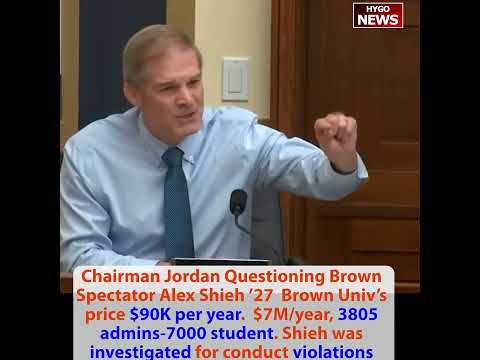
Brown University Student Alex Shieh Testifies on Ivy League “Cartel”: $93K Tuition × 7,000 Students = $700M/Year, 3,805 Administrators (More Than Students in Many Depts); Asked “What Do You Do All Day?” — Most Didn’t Respond; Brown Charged Him with “Emotional and Psychological Harm”; Chairman Jordan Exposes the “Bloat”
In a stunning June 2025 House committee hearing on Ivy League antitrust violations, Brown University student Alex Shieh testified about his Bloat@Brown investigation. Chairman Jim Jordan walked through the math: “What did you say tuition was again? $93,064 in direct costs including room and board… How many students at Brown? Over 7,000… That’s a lot of money coming in. $93,000 times 7,000… It’s like $700 million coming into Brown every year.” Shieh had asked a simple question: “Where the heck is all the money going?” When he checked the administrators: “I think the number you said was 3,805.” Shieh, working for the conservative Brown Spectator, had sent emails to the 3,800 administrators asking them: “What do you do all day?” The result: “Most of them didn’t respond.” Then Brown retaliated: “We were hit with disciplinary charges. First it was emotional and psychological harm, invasion of privacy and misrepresentation.” Then they charged the Brown Spectator’s entire board of directors for violating Brown’s trademark. Jordan exposed the broader cartel: “You can have a bloated bureaucracy when you’re colluding on price… when you limit output… when you engage in perfect price discrimination.” Jordan’s summary: “They don’t want anyone to look under the covers and see they’re colluding on price, limiting output, and doing perfect price discrimination.”
The Math of Brown
Jordan walked through the arithmetic.
“Mr. Shea, what did you say tuition was again at Brown annual tuition?” Jordan asked.
Shieh answered: “It’s $93,064 in direct costs.”
Jordan clarified: “$93, that doesn’t count room and board and books and everything, that’s just tuition, right?”
Shieh corrected: “No, that’s including room and board.”
Jordan confirmed: “That’s everything? Okay, $93,000.”
Jordan continued with the student count: “How many students you say again was at Brown? Over 7,000 I think you said?”
Shieh: “7,000.”
Jordan did the math: “Yeah, so that’s a lot of money coming in. Maybe it could be some grants, it could be some loans, whatever, but $93,000 times 7,000.”
Jordan delivered the calculation: “It’s like $700 million coming into Brown every year.”
The Brown Cost Scale
The $93,064 annual tuition (with room and board) was extraordinary.
Brown University scale:
- 7,000+ undergraduate students
- $93,000+ per student annually
- $700+ million in student revenue alone
- Plus research grants, endowment returns, alumni giving
- Total revenue likely $1.5-2 billion annually
Comparison to state universities:
- Average state university tuition: $15,000-25,000
- Brown’s tuition 4-5x higher than state universities
- Most state universities have much larger enrollment
- Per-student revenue advantage massive
- Brown had exceptional financial resources
The investment returned:
- Brown endowment: approximately $6 billion+
- Harvard endowment: approximately $50 billion
- Yale endowment: approximately $40 billion
- Princeton endowment: approximately $35 billion
- Columbia endowment: approximately $14 billion
- Cumulative Ivy League endowments: $150+ billion
Why tuition was so high:
- Ivy League brand premium
- Family willingness to pay
- Competitive pressure among elite universities
- Administrative bloat driving costs
- Price collusion (alleged in this hearing)
- Cost structures unrelated to educational quality
The Fundamental Question
Jordan framed Shieh’s investigation.
“And you asked a fundamental question, sort of a simple question,” Jordan said.
Shieh: “Yes, question.”
Jordan: “Where the heck’s all the money going, right?”
The Answer: Administrators
Jordan described Shieh’s discovery.
“And you said, maybe I’ll check the administrators. How many administrators are having? You said, I think the number you said was 3,805, is that right?” Jordan asked.
Shieh: “Yep.”
The 3,805 Administrator Problem
The administrator count was extraordinary.
The ratio:
- 3,805 administrators at Brown
- 7,000+ undergraduate students
- Approximately 1 administrator per 1.8 students
- Almost one-to-one ratio
- Historic administrative bloat
Comparison to historical norms:
- 1970s university administrator ratios: 1 per 50+ students
- 1990s ratios: 1 per 20-25 students
- 2010s ratios: 1 per 10-15 students
- 2020s Ivy League: 1 per 2-4 students
- Exponential growth in administration
Why this was problematic:
- Administrators don’t teach classes
- Administrators don’t research
- Administrators are essentially overhead
- Administrative salaries are often high
- Administrative bloat drives tuition up
The composition of bloat:
- Diversity, Equity, and Inclusion (DEI) staff
- Marketing and communications
- Fundraising and development
- Compliance departments
- Student services (non-academic)
- Various identity-based offices
- Sustainability and environmental staff
- Multiple layers of dean assistants
- HR and administrative support
- Many other categories
The Simple Question
Shieh had asked the administrators a simple question.
“And then you said a letter to these guys asking another fundamental question. What do you do all day?” Jordan asked.
Jordan inquired: “What was the response you said? Most of them didn’t get back with you?”
Shieh’s revealing answer: “Most of them didn’t respond and we were hit with disciplinary charges.”
The Non-Response Problem
The non-response was itself informative.
What Shieh asked:
- What do you do all day?
- What tasks have you performed this week?
- What would happen if your position were eliminated?
What Shieh expected:
- Clear descriptions of job duties
- Specific tasks accomplished
- Clear value proposition
- Demonstrable impact on students
What administrators did:
- Most ignored the email
- Some complained to superiors
- Some reported Shieh to Brown administration
- Few provided substantive answers
- Even fewer defended their value
What the non-response suggested:
- Administrators couldn’t justify their jobs
- Positions were essentially redundant
- Workloads didn’t justify full-time employment
- Many roles were duplicative
- Administrative bloat was real
Shieh’s observation: “Some of them answered, and the ones who answered seemed to have pretty useful jobs. I guess we can infer that the ones who didn’t have jobs that are not so important.”
The Retaliation
Jordan described Brown’s response to Shieh’s investigation.
“So the administrators couldn’t respond to a simple question. You’re taking in $700 million a year. What the heck are you 3,800 administrators doing?”
He pivoted to the retaliation: “The administrators didn’t respond, but the administration came after you. Is that right?”
Shieh: “That’s right.”
Jordan delivered the observation: “When you investigate the administration, it turns out they investigate you back.”
The Specific Charges
Jordan asked about the specific charges.
“Why do you think they did that? Why did they come after you? Well, first of all, what did they come after you about? What did you allegedly do wrong?”
Shieh listed the charges: “Well, first it was emotional and psychological harm, invasion of privacy and misrepresentation. And then they decided to charge me with violating the technology policy.”
Jordan’s incredulous response: “Asking someone how they spend your money is emotional harm. That’s what they alleged?”
Shieh: “Apparently.”
The “Emotional Harm” Charge
The specific charges were absurd.
“Emotional and psychological harm”:
- Asking administrators what they do
- Using polite professional email format
- Following standard journalism practices
- Treating subjects with respect
- Nothing remotely harmful
“Invasion of privacy”:
- Administrators’ jobs are public
- Their duties are relevant to students paying tuition
- Their work affects the institution
- Nothing private being asked
- Standard journalism territory
“Misrepresentation”:
- No false claims made
- Clear identification of purpose
- Legitimate journalism
- Transparent about intent
- Standard professional practice
“Technology policy violation”:
- Shieh apparently used university email appropriately
- Standard student communication
- Common journalism practice
- No evidence of violation
- Post-hoc charge addition
The specific charges reflected:
- Weaponization of university disciplinary procedures
- Attempt to silence student journalism
- Retaliation disguised as policy enforcement
- Chilling effect on student speech
- Brown administration fear of accountability
The Trademark Escalation
Jordan explored the further retaliation.
“And then what happened in the investigation? Well, then they escalated and they in charge the entire board of directors of the Brown Spectator for violating Brown’s trademark because our publication is named the Brown Spectator, which is just a completely bogus claim.”
Jordan questioned: “Are the other newspapers that Brown would use Brown in the name of the paper? Yes. Are other newspapers that Brown did? Probably in the entire history of the university, there’s been some kind of Brown publication, right? Certainly. Yeah, I mean, that’s just ridiculous.”
The Trademark Absurdity
The Brown trademark claim was legally problematic.
The Brown Spectator name:
- “Brown” referred to Brown University (the institution)
- “Spectator” was the publication type
- Standard college newspaper format
- Identified the publication’s affiliation
- Not actually confusing about identity
Brown University trademark position:
- Claimed trademark violation
- Argued publication name was infringing
- Targeted entire editorial board
- Tried to shut down publication
- Used trademark law as retaliation tool
The legal problem:
- Nominative fair use allows references to trademark owner
- Brown couldn’t claim trademark on “Brown” for student publications
- Publications about Brown naturally use Brown’s name
- No trademark confusion resulted
- Brown’s claim was legally frivolous
The pattern:
- University lawyers leveraging resources against student
- Student without legal team
- Brown’s attempt to overwhelm him
- Financial pressure as silencing tool
- Classic institutional attack on dissent
The outcome:
- Brown eventually cleared Shieh
- All charges dropped
- Dismissed after Congressional attention
- Shieh’s perseverance paid off
- But damage to Brown’s reputation was done
Jordan’s Strategic Analysis
Jordan then pivoted to broader analysis.
“Why do you really think they did it? Why did they really come after you?” Jordan asked.
Shieh: “I think that they were upset that we unveiled the rot that was going on. All these administrators with pretty useless jobs.”
Jordan extended the analysis: “And that’s certainly one reason they were mad at you. But I think it’s probably more. I think they were trying to make sure no one else would do it in the future.”
He delivered the key insight: “That’s always the way it works. The left comes after people. They will they want to chill speech so it doesn’t happen again.”
Jordan asked: “Do you think that was part of their motivation?”
Shieh: “I think that certainly was true, but it backfired terribly.”
Jordan: “I did. Sure did because you’re brave enough to keep talking. Keep you can come here and testify. So God bless you for doing that.”
The Chilling Effect Strategy
Jordan identified a specific institutional pattern.
The “chill speech” strategy:
- Target specific individuals for retaliation
- Disproportionate response to deter others
- Create fear of similar consequences
- Silence legitimate questions
- Preserve institutional privilege
Why this pattern mattered:
- Well-documented in corporate contexts
- Commonly used in activist targeting
- Standard in progressive institutional response
- Effective at silencing opposition
- Constitutional concerns at universities
The Brown specific application:
- Shieh’s investigation was journalistically legitimate
- Questions were reasonable
- Methods were proper
- But Brown treated it as severe offense
- Used disciplinary process as weapon
The backfire element:
- Shieh kept talking
- Media covered the story
- Congressional attention increased
- Public awareness grew
- Intended silencing had opposite effect
Shieh’s successful resistance demonstrated that:
- Universities could be challenged
- Institutional power had limits
- Courage mattered
- Public attention was protective
- Congressional oversight could be effective
The Cartel Analysis
Jordan transitioned to the broader antitrust issues.
“Now, you can have a direct this to you, Mr. Martin, you can have a bloated bureaucracy when you’re colluding on price and not and making sure you’re not competing on price with other similarly situated institutions. That right, Mr. Martin?”
Witness (Mr. Martin): “Yes.”
Jordan: “And you’re not supposed to do that, are you?”
Martin: “According to the law.”
Jordan: “Is that right, Mr. Martin? On price, it’s per se unlawful.”
Martin: “It’s per se.”
Jordan: “Unlawful.”
The Per Se Illegality
Jordan identified the specific legal framework.
“Per se unlawful” means:
- Automatically illegal
- No need to prove harm
- No business justification defense available
- Simply agreeing to fix prices is enough
- Strictest antitrust category
Why elite universities face this issue:
- Allegations of coordinated tuition setting
- Shared financial aid formulas
- Overlap in admissions practices
- Information sharing on student finances
- Effective price coordination
The Overlap Group history:
- Ivy League universities had previously been investigated
- 1980s-1990s cases on financial aid coordination
- Government found price-fixing in financial aid
- Universities paid settlements
- Restrictions were placed on coordination
Current concerns:
- Similar patterns allegedly recurring
- Modern information technology enabling coordination
- Algorithmic coordination
- Elite school cartel-like behavior
- Need for enforcement
The Output Limitation
Jordan identified another antitrust dimension.
“You can also have bloated bureaucracy when you collude on price and you limit output, you limit class size. Is that right, Mr. Martin?”
Martin: “That’s correct.”
The Class Size Restriction
The class size limitation was a specific antitrust concern.
Why class size matters:
- Fixed class sizes limit total enrollment
- Coordinated size decisions affect total output
- Limited competition among elite schools
- Students forced to accept high prices
- Cartel-like coordination of output
The specific patterns:
- Elite schools maintain relatively constant class sizes
- Despite growing applicant pools
- Despite endowment growth
- Despite infrastructure capacity
- Despite demand
The antitrust implications:
- Coordinated output restriction
- Price maintenance at high levels
- Barrier to entry for new schools
- Limited choice for students
- Classic cartel behavior
The Brown-specific issue:
- Brown had maintained similar class sizes
- Despite increasing costs
- Despite increasing demand
- Despite administrative growth
- Despite potential capacity
The Perfect Price Discrimination
Jordan identified a third dimension.
“And do you think that’s going on at these? Oh, there’s a third one. You can also do all this if you engage in perfect price discrimination where you get all this information on the student and their families, what they make, where it goes, what they owe, what their retirement is, all this information you can say, that student can pay this amount and you’ll take it right to the edge where they can pay and get perfect price discrimination.”
The Information-Based Pricing
Perfect price discrimination was particularly concerning.
How it works:
- Universities collect extensive family financial data
- Including detailed income information
- Debt information
- Retirement assets
- Other financial details
Why this matters:
- Family financial aid calculations based on this data
- Students/families pay what they can afford
- Not market-based pricing
- Customized pricing per family
- Extractive rather than competitive
The specific practice:
- Students submit detailed financial information
- Schools calculate family ability to pay
- Financial aid adjusted to extract maximum
- Students pay up to their financial limit
- No opportunity for market-based savings
Why it’s problematic:
- Bypasses normal price competition
- Treats tuition as rent-seeking rather than service price
- Exploits information asymmetry
- Creates no competitive pressure for efficiency
- Enables bloat because extraction continues
Jordan’s point: “So when you do those three things, you can afford to have 3,805 administrators for 7,000 students.”
The Complete Cartel Behavior
Jordan summarized the cartel analysis.
“You make an excellent point. The more perfect the information, the more perfect the collusion can be algorithmically or otherwise.”
Jordan: “Of course. And that’s exactly what’s going on.”
Dr. Cooper (witness): “The evidence is certainly consistent with that, yes.”
Jordan delivered the conclusion: “That’s what the evidence shows.”
The Political Dimension
Jordan addressed the broader political context.
“And yet the other side says, oh, how dare Mr. Fitzgerald have this hearing? You’ve got to be kidding me. They tried to chill the speech of a news publication at the university for a student. They’re supposed to be serving asking a simple and fundamental question. And they want to chill that because they don’t want anyone to look under the covers and see that they’re colluding on price. They’re limiting output and they’re doing perfect price discrimination. Imagine that. Imagine that.”
He concluded: “And we’re not supposed to have a hearing? Holy cow.”
He offered thanks: “I want to thank the chairman for doing the hearing. I want to thank all of you for testifying. And Mr. Shea, thank you for stepping forward and letting the country know what’s going on at these elite universities.”
Key Takeaways
- Brown University: $93K/year × 7,000 students = $700M annually, with 3,805 administrators (1 per 1.8 students).
- Shieh asked 3,805 Brown administrators: “What do you do all day?” Most didn’t respond.
- Brown retaliated with disciplinary charges: “Emotional and psychological harm, invasion of privacy, trademark violation.”
- Jordan’s antitrust analysis: Ivy League engages in per se illegal price collusion, output restriction, perfect price discrimination.
- Student Alex Shieh successfully resisted silencing; Brown eventually cleared him after Congressional attention.