 HYGO News
 Chair Stefanik: final hour, Lame Duck Dems failed to keep gov running, in pursuit of radical agenda
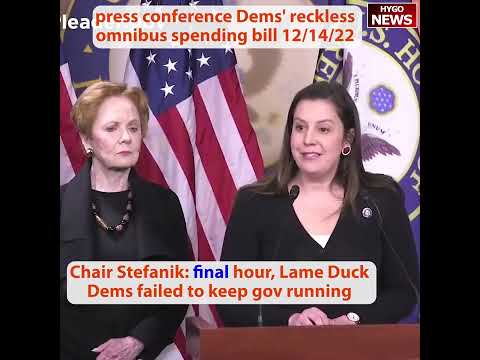
House Republican Conference Chair Stefanik: “Biden Inflation” Causing “Most Expensive Christmas in History” — Dems Failed Basic Duty to Govern
On 12/19/2022, House Republican Conference Chair Elise Stefanik delivered remarks criticizing Democrats for end-of-session negotiations that excluded Republicans. “The holiday season is in full swing and Americans are still paying more for just about everything due to Biden inflation. The skyrocketing price of goods, travel and services will make this the most expensive Christmas in history,” Stefanik said. She accused Democrats of failing basic governance: “Democrats controlling government in the final hours trying to keep the lights on in one party rule. They have failed to do their most basic duty to govern.” Stefanik said Republicans had been “cut out of these negotiations since day one” and pledged that the incoming House Republican majority would “hold the line” against “Democrats spending wish lists that pushes trillions of taxpayer dollars to fund their far left radical agenda.”
The Political Context
Stefanik’s December 19, 2022 remarks came at a specific political moment:
End of lame duck session — Congress’s final weeks before new Congress.
117th Congress ending — With Democratic majorities.
118th Congress approaching — Republicans taking House majority.
Appropriations negotiations — For omnibus spending.
Political positioning — For incoming Republican leadership.
Biden administration — Working with Democratic Congress.
The timing was critical. Democrats had weeks remaining of majority power. Republicans were preparing to take over House control in January. End-of-session negotiations would set spending levels and policy priorities that Republicans would inherit.
”Most Expensive Christmas in History”
Stefanik opened with inflation framing. “The holiday season is in full swing and Americans are still paying more for just about everything due to Biden inflation. The skyrocketing price of goods, travel and services will make this the most expensive Christmas in history,” Stefanik said.
The “most expensive Christmas” framing was politically effective:
Universal relatability — Everyone celebrated holidays.
Specific economic claim — About holiday costs.
“Biden inflation” attribution — Crediting administration with problem.
Emotional framing — Christmas specifically.
Concrete examples — Goods, travel, services.
The framing mirrored Republican messaging throughout 2022. Inflation had been a major political issue that Republicans had effectively attributed to Biden policies. By Christmas 2022, this messaging had been sustained for many months.
”Biden Inflation” Attribution
The “Biden inflation” phrasing was politically calculated:
Personal attribution — To the President.
Policy blame — For economic conditions.
Memorable label — For use in advertisements.
Consistent messaging — Across many Republican speakers.
Contrast with administration framing — Which blamed global factors.
Whether Biden’s policies had caused inflation was economically contested:
Republican view — American Rescue Plan and other spending caused inflation.
Administration view — Global factors (pandemic, Russia, etc.) caused inflation.
Economist views — Mixed, with multiple factors contributing.
Public perception — Varied by partisan identification.
The “Biden inflation” branding reflected Republican messaging discipline. Democrats had their own framing (“Putin inflation”). Both framings were simplifications of complex economic dynamics but served political purposes.
”One Party Rule”
Stefanik characterized Democratic majorities. “Democrats controlling government in the final hours trying to keep the lights on in one party rule,” Stefanik said.
“One party rule” was politically loaded:
Emphasized Democratic control — Of Presidency, Senate, House.
Suggested imbalance — Single party dominance.
Implied problematic governance — From unified control.
Contrasted with bipartisan ideal — Mixed government.
Set stage for new Republican check — Incoming House.
The “one party rule” was technically accurate for 2021-2022. Democrats had controlled all three elected federal bodies. The 2022 midterms had broken this by giving Republicans the House. But Stefanik’s framing positioned the Democratic control as problematic rather than simply electoral outcome.
”Failed to Do Their Most Basic Duty”
Stefanik accused Democrats of governance failure. “They have failed to do their most basic duty to govern,” Stefanik said.
The “failed to govern” claim had various foundations:
Immigration crisis — Ongoing border issues.
Inflation persistence — Economic challenges.
Various policy failures — From Republican perspective.
Incomplete legislation — Various promises unfulfilled.
End-of-session rush — Last-minute processes.
The specific “basic duty” Democrats had failed varied by speaker:
Passing appropriations on time — Chronic congressional issue.
Addressing the border — Republican priority.
Controlling inflation — Economic management.
Supporting law enforcement — Republican framing.
Protecting energy security — Republican priority.
Democrats had their own framing of what they had accomplished. The failure/success dichotomy was partisan interpretation rather than objective measurement.
”Cut Out of Negotiations”
Stefanik accused Democrats of exclusion. “Democrats cut House Republicans out of these negotiations since day one,” Stefanik said.
The “cut out” framing raised questions about the legislative process:
Lame duck context — When party in power often pursued priorities.
Minority party role — In ongoing negotiations.
Bipartisan expectations — For major legislation.
Process concerns — How negotiations were conducted.
Political positioning — For incoming Republican majority.
The specific complaint was about final appropriations negotiations. Whether Republicans had been genuinely “cut out” depended on perspective:
Democrat view — Republican positions considered but rejected.
Republican view — Democratic priorities prevailing without consultation.
Process reality — Mixed consultation and unilateral action.
Both parties typically claim they were excluded when legislation doesn’t match their priorities. The “cut out” framing was rhetorical rather than procedural analysis.
”Running Up the Tab”
Stefanik criticized Democratic spending. “The lame duck Democrats spent the last two years running up the tab on the backs of hardworking American families,” Stefanik said.
“Running up the tab” was folksy framing for deficit and inflation criticism:
Deficit spending — Government borrowing.
Inflation effects — From spending and other causes.
Taxpayer burden — On working families.
Middle-class framing — Burden on hardworking Americans.
Emotional resonance — Family-focused.
Republican messaging had consistently attacked Democratic spending throughout 2022. “Running up the tab” fit this pattern while using accessible language.
”Electing a New House Republican Majority”
Stefanik noted election results. “The American people have just spoken and rejected this radical agenda by electing a new House Republican majority,” Stefanik said.
The election interpretation was politically convenient:
Republican House victory — Was a fact.
“Rejection of radical agenda” — Interpretive framing.
“The American people have just spoken” — Democratic mandate claim.
2022 results — Complex to interpret.
The 2022 midterm results were actually more nuanced than Stefanik’s framing suggested:
Republicans won House — By narrow margin.
Democrats held Senate — Unexpectedly.
Democratic popular vote — Approximately equal to Republicans.
Historical comparison — Modest Republican gains for midterm.
Not a landslide — Despite expectations.
Claiming a clear “rejection” of Democratic agenda required selective interpretation. But Stefanik’s framing was common among Republican leaders who wanted to claim strong 2022 mandate.
”Hold the Line”
Stefanik pledged Republican opposition. “As the clock runs out on Democrats one party rule in Washington, House Republicans will hold the line,” Stefanik said.
“Hold the line” messaging positioned Republicans as:
Opposition force — To Democratic priorities.
Fiscal conservatives — On spending.
Voter champions — Representing public.
Unified caucus — Disciplined opposition.
Defenders of traditional values — Against “radical” agenda.
The “hold the line” framing set expectations for Republican House leadership. When the 118th Congress convened in January 2023, Republicans would be expected to oppose major Democratic initiatives.
”Spending Wish Lists”
Stefanik characterized Democratic spending proposals. “We will oppose Democrats spending wish lists that pushes trillions of taxpayer dollars to fund their far left radical agenda,” Stefanik said.
The “wish lists” framing:
Dismissed seriousness — Of Democratic proposals.
Emphasized scale — Trillions of dollars.
Political characterization — “Far left radical.”
Taxpayer focus — Emphasizing public cost.
Opposition stance — Clear position.
“Trillions of taxpayer dollars” captured Republican concerns about federal spending levels. By late 2022, federal debt had exceeded $31 trillion. Republicans had been positioning fiscal discipline as a priority.
Whether Democratic spending was “far left radical” was partisan interpretation. The American Rescue Plan, infrastructure, CHIPS Act, and Inflation Reduction Act had passed with varied levels of Republican support. Characterizing these bills as uniformly radical overlooked their specific provisions and political coalitions.
The Stefanik Role
Elise Stefanik’s role as House Republican Conference Chair made her statements particularly important:
Third-ranking House Republican — After Speaker and Leader.
Communication leadership — On Republican messaging.
Caucus management — Coordinating Republican positions.
Media engagement — Frequent appearances.
Rising star — Potential future leadership.
Her statements represented the Republican Conference’s official position. When Stefanik criticized Democrats, she wasn’t speaking as an individual member but as the voice of the Republican caucus.
The Upcoming Power Shift
The timing of Stefanik’s remarks was strategic. With Republicans taking House control in January:
Current session would end — With Democratic spending decisions.
New session would begin — With Republican majority.
Expectations were setting — For Republican governance.
Political positioning — For upcoming fights.
Framework establishment — For 2023-2024 politics.
Stefanik’s comments set the tone for what incoming Republican House governance would emphasize: fiscal restraint, border security, opposition to “radical” agenda, and accountability for Biden administration. These themes would shape the next two years of House politics.
The Bipartisan Negotiation Reality
Despite Stefanik’s “cut out” framing, bipartisan negotiations did occur. The omnibus spending bill that eventually passed in December 2022 included:
$1.7 trillion total — Comprehensive spending package.
Ukraine aid — Military and humanitarian.
Border funding — Various provisions.
Defense increases — Supported by both parties.
Various policy provisions — From both sides.
Electoral Count Reform — Bipartisan priority.
The bill passed with some Republican support in both chambers. Republicans who voted for it faced criticism from their own caucus. Stefanik’s positioning as opposed to the package was consistent with her role but didn’t reflect the entire Republican response.
Key Takeaways
- House Republican Conference Chair Elise Stefanik delivered remarks attacking end-of-2022 Democratic governance.
- She framed the economic situation as “Biden inflation” producing “the most expensive Christmas in history.”
- Stefanik accused Democrats of failing “their most basic duty to govern” during “one party rule.”
- She claimed Republicans had been “cut out of these negotiations since day one.”
- Stefanik interpreted the 2022 midterm elections as American rejection of “radical agenda.”
- She pledged that incoming House Republicans would “hold the line” against “Democrats spending wish lists.”
- Her remarks set the political tone for Republican House governance beginning January 2023.
Transcript Highlights
The following is transcribed from the video audio (unverified — AI-generated from audio).
- The holiday season is in full swing and Americans are still paying more for just about everything due to Biden inflation.
- The skyrocketing price of goods, travel and services will make this the most expensive Christmas in history.
- Democrats controlling government in the final hours trying to keep the lights on in one party rule.
- They have failed to do their most basic duty to govern.
- Democrats cut House Republicans out of these negotiations since day one.
- The American people have just spoken and rejected this radical agenda by electing a new House Republican majority.
Full transcript: 167 words transcribed via Whisper AI.