 HYGO News
 Hawley Destroys Allstate Exec Fiato: '$4.6B Profits, CEO $26M, Ms. Miguel Got Paltry Sum'; McKinsey 'Delay, Delay, Delay' Strategy; 1998, Katrina, Sandy Pattern
Hawley Destroys Allstate Exec Fiato: “$4.6B Profits, CEO $26M, Ms. Miguel Got Paltry Sum”; McKinsey “Delay, Delay, Delay” Strategy; 1998, Katrina, Sandy Pattern
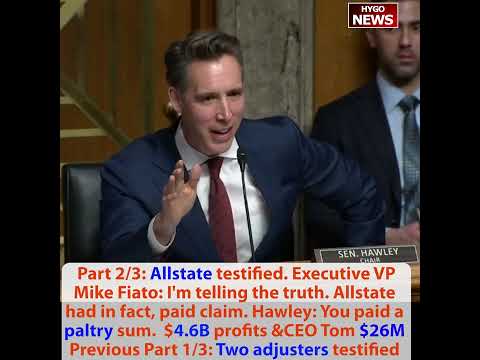
In a scorching May 13, 2025 Senate subcommittee exchange, Chairman Josh Hawley dismantled Allstate Chief Claims Officer Mike Fiato’s denials of systematic claim manipulation. After adjusters had testified under oath about being instructed to “alter factual findings, delete material, and sometimes include items that were false,” Fiato insisted: “Some of what you heard today was not accurate… That’s not what we do.” Hawley responded with Allstate’s financial reality: “Fiscal year 24, Allstate had $64 billion in revenue, 12% above previous year. $4.6 billion in profits. CEO Tom Wilson paid $26 million. Ms. Miguel can’t get her claim paid out, but Tom Wilson gets $26 million.” Hawley traced the pattern back to a McKinsey strategy from the 1990s: “Sit and wait. Delay, delay, delay. Good hands are boxing gloves.” And he cited precedents from 1998, Katrina 2007, and Superstorm Sandy showing the same alleged pattern.
The Fake Apology
Hawley opened by comparing the State Farm executive’s apology to Fiato’s non-apology.
“You don’t have any regrets about Ms. McGall’s case,” Hawley said. “Mr. Keating apologized to Mr. Vertel and promised to work with him to resolve his case. Thank you for that, Mr. Keating. I didn’t hear anything to that extent from you, Mr. Fiato. So you think Allstate handled it just fine?”
Fiato tried to thread the needle: “No, I stated in my statement that I regret that Ms. McGall is unhappy with the…”
Hawley cut him off: “Yeah, well, that’s like saying, ‘I’m sorry, you’re unhappy,’ right? That’s, ‘I apologize, but I don’t apologize.’”
The distinction mattered. A true apology would acknowledge that Allstate had done something wrong and commit to making it right. Fiato’s formulation — regretting that Ms. McGall was “unhappy” — accepted only that the customer had a feeling, not that the company had behaved wrongly. It was the classic non-apology apology: the form of contrition without the substance.
Hawley pushed: “Would you like to apologize to her now?”
Fiato: “Maybe I just misunderstood her.”
Fiato eventually gave a conditional not-quite-apology directed at “Ms. McGall” (apparently conflating with Miguel): “Hi, Ms. McGall. I’d like to say I want to make sure that we get your claim resolved to your satisfaction.”
He then offered Allstate’s corporate motto: “We live and breathe our motto, our customer’s worst day needs to be our best.”
Hawley delivered the devastating response: “I have to tell you, Mr. Fiato, based on the testimony I’ve heard today, based on the witness statements I’ve taken from witnesses, it sounds like to me that it really ought to be amended to say that our customer’s worst day is your big profit opportunity."
"Institutionalized Fraud”
Hawley laid out the accusation.
“We’ve just heard testimony here, sworn testimony from multiple adjusters, that your company ordered them to delete or alter damage estimates to reduce payouts and to make you profits,” Hawley said. “It sounds to me like you’re running a system of institutionalized fraud.”
Fiato disputed: “Yeah, that would be a correction. That’s not what we do.”
Hawley pressed: “So you have never ordered, y’all state has never asked an adjuster to change an assessment on their report.”
Fiato pivoted to a technical explanation: “When we review an adjuster’s estimate, most often for authority requests. So most adjusters have an amount of financial authority that they can settle claims up to without having to…”
Hawley interrupted: “Now, wait a minute. That’s not what they testified to. That’s not what they just testified to.”
Fiato’s response had been evasive. By describing normal “authority request” processes — where adjusters with lower settlement authority had to seek approval for larger payouts — Fiato was implying that any Allstate review was merely procedural. The adjusters’ testimony had been different: reviews were being used to push estimates down, not just to approve them.
Hawley summarized what the adjusters had said: “One adjuster had only ever worked for you over years in the industry and he said he was repeatedly directed by you, by your company, Allstate to change factual findings, to delete material in his reports, to alter his reports, to make them factually incorrect, all with the purpose of driving down the award and padding your profits.”
Fiato: “I disagree with this statement.”
The $26 Million CEO vs. Ms. Miguel
Hawley’s most devastating material was the financial comparison.
“I have to notice that your profits have never been better,” Hawley said. “I mean, they’re really quite extraordinary.”
He laid out the numbers: “Fiscal year 24, Allstate had $64 billion in revenue. That’s 12% above the previous year. You made $4.6 billion in profits and your CEO, Tom Wilson last year was paid $26 million.”
He made the contrast sharp: “Now, Ms. Miguel can’t get her claim paid out, but Tom Wilson, whoever the heck he is, gets $26 million.”
He asked the rhetorical question: “Do you just not, do you not have the money to pay people like Ms. Miguel? Why is she not a priority, but Tom Wilson’s salary is?”
Fiato: “We’ve paid Ms. Miguel’s claim.”
Hawley’s response was the signature line: “No, you didn’t. You have given her a paltry sum.”
The financial comparison was politically potent. Allstate had $4.6 billion in profits, meaning the company had ample resources to pay legitimate claims. The CEO was paid $26 million, meaning the company had ample resources for executive compensation. But Ms. Miguel — whose independent assessment showed $497,000 in damage — had been offered approximately $40,000. The company was not poor. It was wealthy enough to pay its CEO $26 million and generate $4.6 billion in profits. The refusal to pay Ms. Miguel legitimately was not about resources. It was about choices.
The Whistleblower Report
Hawley then introduced a whistleblower statement beyond the testifying adjusters.
“Listen to another piece of testimony from another witness,” Hawley said. “This is a whistleblower report that has come into us.”
He read from the report: “‘I’ve dedicated my entire adult life to the claims adjusting world in numerous roles. I worked for Pilot and Allstate for 12 years. As an independent adjuster, I work claims all over the country regularly throughout the years and I have watched the progression and controlling nature of claims worsen progressively. Allstate created an internal review team with the sole purpose of making sure claims were paid as low as possible.’”
He continued the quote: “‘Allstate reviewers instructed adjusters to alter and delete factual findings in their estimates to drive down the cost of the claim. The alterations and deletions were often factually wrong.’”
He cited a specific incident: “‘During Hurricane Isaac in 2012, an email was sent out that no adjuster could buy a roof no matter the damage present.’”
The “no adjuster could buy a roof” instruction was a specific, falsifiable claim. If Allstate had actually sent such an email, it represented direct written evidence that the company was systematically refusing to pay for roof replacement regardless of the actual damage. Such blanket instructions would violate the individual claim assessment that insurance policies promise.
Hawley made the pattern clear: “This looks like a pattern. This is someone who’s not even involved in this case in Hurricane Helene. We’ve heard from person after person, all this testimony is on the record. It sounds to me like your company is running a racket and you’re making more than you ever have.”
The McKinsey Strategy
Hawley then introduced the historical context.
“This really all goes back to a strategy that your company pioneered with the McKinsey company back in the 90s,” Hawley said.
He summarized the strategy: “You went to McKinsey and asked them, how can we get rich? And McKinsey gave you this advice. Sit and wait. They said, delay, delay, delay. It’s a zero sum economic game. There can only be one winner and the winner is going to be Allstate. It’s not going to be the policy holders.”
He cited another element: “And then good hands are boxing gloves. McKinsey suggests Allstate make a low offer on a claim. Like you did to Ms. Miguel. Then if the policy owner has the temerity to protest, you go after them hard, just like you did to her.”
The McKinsey strategy Hawley was referencing — sometimes called the CCPR (Claims Core Process Redesign) initiative — had been documented in extensive litigation and regulatory proceedings. The “good hands are boxing gloves” phrase was particularly notorious, transforming Allstate’s famous “You’re in good hands” marketing slogan into an acknowledgment that the hands were actually adversarial.
The strategy elements were:
- Delay: Extend the claim timeline to pressure policyholders financially
- Deny: Initially reject claims or portions of claims
- Defend: Aggressively litigate against policyholders who challenged decisions
- Low-ball: Offer amounts substantially below actual damage assessments
- Divide: Separate claims into components to reduce individual payouts
Fiato’s response was predictable: “That report is over 25 years old.”
Hawley was not satisfied: “And you’ve implemented it to the T in those 25 years.”
The Litigation Pattern
Hawley traced the history of Allstate’s alleged misconduct.
“As early as 1998, Allstate was sued because adjusters had multiple times reported changes to policies. This is as back far back as the 1998 earthquake. Allstate was sued because reports have been changed to indicate that damage was unrelated to the earthquake and thus not reimbursable by the homeowners policy.”
He cited Katrina: “Or how about Hurricane Katrina in 2007? In 2007, a federal grand jury found that Allstate had altered adjustment and engineering reports to defraud homeowners and the federal government.”
He cited a specific finding: “They also found, a judge also found that Allstate had paid $3 million, $2.8 to be exact, to hire a forensic company that falsified engineering reports.”
He cited Sandy: “Then there was Superstorm Sandy, where Allstate was accused of engaging in widespread falsifying of engineering reports to benefit insurers.”
He made the pattern clear: “I mean, it just goes on and on and on. But what’s amazing is it’s exactly what these two gentlemen said is still happening at your company.”
The consistency across 25+ years of litigation was damning. The same allegations — altering reports, hiring forensic firms to produce favorable engineering assessments, systematically underpaying claims — had been made by different plaintiffs in different disasters across different decades. The pattern was not isolated incidents. It was corporate strategy.
Particularly striking was the federal element in Katrina: Allstate had allegedly falsified reports not just to defraud homeowners but also to defraud the federal government. By mischaracterizing wind damage (covered by private homeowner policies) as flood damage (covered by federal flood insurance), Allstate could shift claims costs onto federal taxpayers while keeping premiums from homeowners.
The Retaliation Confrontation
Hawley raised the Millican retaliation issue.
“Let me ask you, do you ever engage in retaliation for employees who come before committees like this one or who raise objections to what you’re doing to the fraud that you’re engaged in? Would you ever retaliate?”
Fiato: “The answer would be, of course not.”
Hawley cited Millican’s testimony: “Well, we just heard sworn testimony from Mr. Millican that you have retaliated against him, that he has been informed by Allstate that he is not going to be doing any further work.”
He pressed: “Did you tell Mr. Millican that he won’t be doing any further cases with Allstate?”
Fiato: “Not that I’m aware of.”
Hawley pressed further: “Have Allstate done that against any other employee?”
Fiato: “I can’t answer that question. I can only answer what I’ve done.”
Hawley cited the litigation history: “You’ve been sued multiple times in court after court after court for retaliation. You’ve been sued for fraud successfully time after time after time.”
Fiato Won’t Disclose His Own Salary
The final exchange was the most personal.
“What do you make?” Hawley asked. “I mean, what do you make a year? Your CEO makes $26 million a year. What do you make?”
Fiato deflected: “I’m not comfortable discussing that in this forum.”
Hawley’s response was sharp: “Why not? I mean, I wouldn’t be comfortable either if you are represented a company like this.”
Hawley’s closing was direct: “I think your testimony here today is pretty shameful, just like I think your company’s behavior is pretty shameful.”
The refusal to disclose his own compensation fit the broader pattern of Fiato’s testimony: transparency about profits only when forced, denial of documented patterns, non-apology apologies to victims. His unwillingness to state his own salary — while representing a company making $4.6 billion in profits and paying its CEO $26 million — was its own commentary on what Allstate was prepared to defend.
Key Takeaways
- Allstate FY24: $64B revenue (+12%), $4.6B profits, CEO Tom Wilson paid $26M — while Ms. Miguel offered $40K for $497K damage.
- Hawley: “Your motto should be ‘our customer’s worst day is your big profit opportunity.’”
- McKinsey strategy from 1990s: “Delay, delay, delay. Good hands are boxing gloves. Make low offer, go after them hard if they protest.”
- Litigation pattern: 1998 earthquake, Katrina 2007 (federal grand jury found falsified reports), Sandy — same allegations repeatedly.
- Fiato denied retaliation against Millican despite Millican’s sworn testimony; refused to disclose own salary.