 HYGO News
 4155 pages Omnibus spending bill: take five 24-hour work days to read, Bible only 1200 pages long
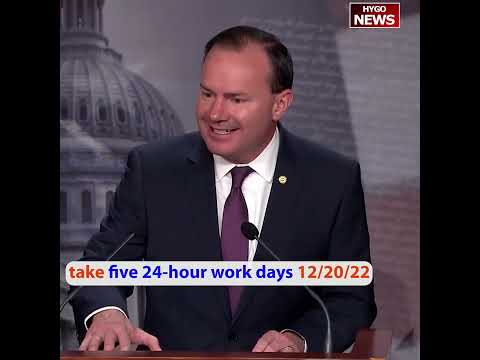
Senator: Reading the 4,155-Page Omnibus Would Take Five Straight 24-Hour Days at 120 Words Per Minute — Bible Is Only 1,200 Pages
On 12/22/2022, a Republican senator delivered vivid remarks putting the 4,155-page omnibus spending bill into perspective through speaking-speed calculations. “I speak on average about 120 words per minute when I speak on the Senate floor,” the senator said. “At that pace, it would take me five straight days. And by days, I don’t mean eight hour workdays or 10 or 12 hour workdays. I mean 24 hour workdays. Five straight 24 hour periods consecutively, back to back, without so much as a bathroom break, and certainly no opportunity for sleeping, nothing other than reading.” The senator compared the bill’s length to the Bible: “The Bible is a long book. It’s 1200 pages long.” The calculation underscored how impossible genuine review of the bill was before the scheduled vote.
The Reading Time Calculation
The senator made the abstract concrete through calculation:
120 words per minute — Senator’s speaking rate.
4,155 pages — Bill length.
Approximately 350 words per page — Typical legislation.
Approximately 1.45 million words — Total bill content.
12,090 minutes — At 120 words per minute.
201.5 hours — Converted to hours.
Approximately 5 days — Of 24-hour reading.
The math was sobering:
5 straight 24-hour days — Of pure reading.
No breaks — For food, sleep, bathroom.
Continuous attention — Impossible in practice.
Comprehension separate — From just reading.
Multiple readings needed — For genuine understanding.
Even this calculation understated the challenge. The senator was measuring simple reading time, not comprehension time. Legal and policy text requires:
Slower reading — For complex language.
Re-reading — For unclear provisions.
Cross-referencing — Between sections.
Analysis — Of implications.
Expert consultation — On specific areas.
Actual review of 4,155 pages of legislation would require far more than five 24-hour days.
The Bathroom Break Detail
The senator’s specific imagery was memorable. “Five straight 24 hour periods consecutively, back to back, without so much as a bathroom break, and certainly no opportunity for sleeping, nothing other than reading,” the senator said.
The absurd specificity made the point:
No bathroom break — Physical impossibility.
No sleeping — Cognitive impossibility.
Nothing other than reading — Single activity.
Consecutive — Without pause.
24 hour periods — Back to back.
Nobody could actually read 4,155 pages in five consecutive 24-hour periods. The specificity emphasized that even in theoretical best-case scenarios, the task was impossible.
The Bible Comparison
The senator made a religious comparison. “The Bible is a long book. It’s 1200 pages long,” the senator said.
The Bible comparison was strategic:
Known long book — Universally recognized.
1200 pages — Substantial but finite.
Religious significance — Cultural weight.
Readable in lifetime — Many people do.
Omnibus dwarfs Bible — By 3.5x.
Saying the omnibus was 3.5 times longer than the Bible made the length viscerally understandable:
Not comparable to any book — Most people have read.
Longer than major reference works — By significant margin.
Approaching encyclopedia — In scope.
Beyond human capacity — For quick review.
Designed for specialists — Not citizens or members.
”Interesting and Full of Stories”
The senator observed. “Which the Bible is actually interesting and full of stories that you can follow, much more interesting than…,” the senator said, with the transcript cutting off.
The comparison was humorous:
Bible is interesting — Engaging content.
Omnibus is not — Dry legislation.
Stories — Narrative structure.
Followable — For regular readers.
Omnibus opposite — Legal/technical language.
This humor served serious purpose. Legislation is harder to read than narrative text. The Bible, even at 1,200 pages, is engaging enough that many people read it completely over time. The omnibus, at 4,155 pages, is:
Legal language — Formal and precise.
Cross-referenced — To other laws.
Technical subjects — Throughout.
Specific provisions — Often unclear.
Administrative detail — Often meaningless in isolation.
Even skilled legal readers would take longer per page on legislation than on narrative text. The senator’s five-day calculation understated the actual review time needed.
The Democratic Implications
The senator’s vivid demonstration illustrated democratic deficiencies:
Members can’t review — Before voting.
Citizens definitely can’t review — Either.
Experts needed — Beyond normal members.
Transparency limited — By length alone.
Accountability reduced — From meaningful review.
Democratic governance requires that legislators:
Understand what they vote on — Minimum requirement.
Represent constituents — Based on understanding.
Explain votes — To those they represent.
Accept accountability — For decisions.
Make informed judgments — Not blind approvals.
When bills exceed human capacity to read, these requirements fail. Legislators vote based on:
Leadership recommendations — Rather than analysis.
Staff summaries — Not full text.
Partisan cues — From party.
Lobbyist summaries — From interested parties.
Political calculations — About specific provisions.
The 4,155-page omnibus essentially required this kind of non-review voting. The senator’s point was that this wasn’t democratic governance — it was approval of leadership decisions.
The Historical Context
Legislation had grown dramatically in length over time:
1900 era — Brief legislation.
Mid-20th century — Growing complexity.
1970s-1980s — Major bills longer.
21st century — Massive bills routine.
Modern era — Omnibus packages standard.
Various factors drove the growth:
Legal complexity — More areas of law.
Specific provisions — More detail.
Interest group influence — Specific language.
Executive agency scope — Growing.
Constitutional federal role — Expanded.
Administrative state — Requiring detailed text.
Whatever the causes, the effect was that bills had become unreadable in normal time frames. Congress had adapted by:
Committee specialization — Expertise in specific areas.
Staff expansion — For analysis.
Leadership direction — On big picture.
Party discipline — For voting patterns.
Interest group engagement — On specific provisions.
These adaptations allowed Congress to function but reduced individual member engagement with specifics.
The Specific Provisions Concern
Beyond the reading time, the 4,155-page bill contained specific provisions:
Appropriations — For all federal agencies.
Policy riders — Included or excluded.
Earmarks — Member-specific spending.
Administrative changes — Agency-specific.
Emergency provisions — Various funding.
Tax provisions — Possibly included.
International provisions — Foreign aid.
Many specific provisions affected specific constituencies. Without detailed review, members voted on:
Provisions they didn’t know about — At all.
Provisions they misunderstood — Partially.
Provisions affecting constituents — Without awareness.
Provisions they would have opposed — If aware.
Provisions they would have supported — If aware.
The reality was that specific provisions received attention only through:
Media coverage — Highlighting specific items.
Political opposition — Flagging concerns.
Lobbyist advocacy — For specific interests.
Leadership briefing — On priority items.
Constituent outreach — On local items.
Most provisions received no specific review. They became law through inclusion in the massive package.
The Reform Proposals
Various reform proposals had been suggested for legislative process:
Single-subject bills — Each bill one topic.
Reading requirements — Minimum time before vote.
Page limits — Maximum bill length.
Member sponsorship — Individual provision attribution.
Public posting — Before votes.
Cost scoring — For all provisions.
None of these reforms had been implemented. The omnibus pattern continued because:
Leadership preferred it — For control.
Short-term convenience — Overrode long-term concerns.
Political calculations — Favored large packages.
Process changes — Face institutional resistance.
Reform consensus — Difficult to achieve.
The Specific 2022 Context
The December 2022 omnibus had specific features:
$1.7 trillion total — Largest ever.
4,155 pages — Unusually long.
End-of-year timing — Maximum pressure.
Divided government transition — Upcoming Republican House.
Specific policy riders — Various inclusions.
Earmarks returned — After hiatus.
Each of these features made 2022 specific case particularly problematic. But the general pattern of unreadable bills had been building for years.
The Member Experience
For individual senators, the 4,155-page omnibus meant:
Leadership briefings — On key provisions.
Staff analysis — Of specific concerns.
Political guidance — On voting patterns.
Party discipline — For caucus unity.
Ultimate decision — Based on summary.
Few senators could claim meaningful engagement with the full text. Voting “yes” or “no” reflected:
Leadership position — Mostly.
Specific provisions — Sometimes.
Constituent concerns — Occasionally.
Personal priorities — Rarely.
Full text analysis — Almost never.
The Public Communication
For the public, 4,155 pages meant:
Media coverage — Of specific provisions.
Partisan framing — Of overall bill.
Scattered attention — To individual items.
No comprehensive understanding — Possible.
Political positioning — Dominating information.
Citizens couldn’t possibly read or understand the bill. They relied on:
News coverage — Selective.
Partisan messengers — Their trusted source.
Specific issues — Affecting them personally.
Overall reactions — To dollar amounts.
Political context — For evaluation.
The democratic ideal of informed citizens engaging with legislation was essentially impossible for bills like the omnibus.
Key Takeaways
- A Republican senator calculated that reading the 4,155-page omnibus would take five consecutive 24-hour days at 120 words per minute.
- The senator compared the bill’s length to the Bible: 1,200 pages — making the omnibus 3.5 times longer.
- The calculation assumed no breaks for bathroom, sleep, or anything other than reading.
- The vivid demonstration illustrated how impossible meaningful review was before the scheduled vote.
- The length meant members voted based on leadership recommendations, staff summaries, and partisan cues rather than understanding of specifics.
- The pattern reflected deeper structural issues in how Congress had evolved to handle massive legislation.
- Democratic governance requires meaningful review, which was effectively impossible for the omnibus at its scale.
Transcript Highlights
The following is transcribed from the video audio (unverified — AI-generated from audio).
- I speak on average about 120 words per minute when I speak on the Senate floor.
- At that pace, it would take me five straight days.
- By days, I don’t mean eight hour workdays or 10 or 12 hour workdays. I mean 24 hour workdays.
- Five straight 24 hour periods consecutively, back to back, without so much as a bathroom break, and certainly no opportunity for sleeping, nothing other than reading.
- The Bible is a long book. It’s 1200 pages long.
- The Bible is actually interesting and full of stories that you can follow, much more interesting than…
Full transcript: 168 words transcribed via Whisper AI.