 HYGO News
 4155 pages and to vote, GOPs' fault holding up government
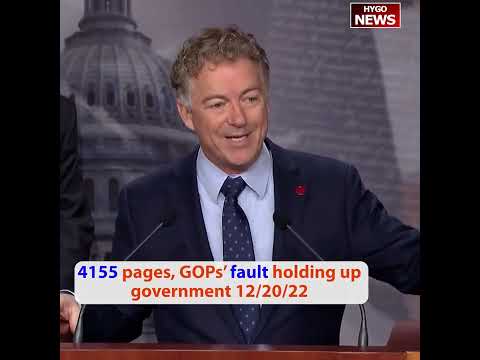
Republican Senator Challenges Omnibus Process: “4,155 Pages” Released at 1:30 AM, Conservatives Blamed for “Holding Up Government”
On 12/22/2022, a Republican senator delivered critical remarks on the 4,155-page omnibus spending bill, questioning the process and the narrative that conservatives objecting to rushed process were responsible for “holding up government.” “Brought with me the Omdi, 4,155 pages. When was it produced? In the dead of the night, 1:30 in the morning when it was released,” the senator said. “Now, people argue that it’s conservatives fault. You don’t have the Christmas spirit. Somehow you’re holding up government. Well, whose job is it to produce this?” The senator laid out the timeline showing Congress had nearly 10 months to prepare but waited until the last moment. “What’s the clamor? The clamor is to vote. Vote now. Let’s get it done. Why are you standing in the way of spending?”
The Page Count
The senator emphasized the bill’s size. “Brought with me the Omdi, 4,155 pages,” the senator said.
The 4,155 pages represented:
Massive scope — Comprehensive government spending.
Impractical review — For individual members.
Complex content — Including policy provisions.
Single vote — On entire package.
Must-pass framing — To avoid shutdown.
By carrying the physical copy to the floor or podium, the senator made the abstract “4,155 pages” tangible. A visible stack of thousands of pages drove home the impossibility of meaningful review.
The 1:30 AM Release
The timing criticism was specific. “In the dead of the night, 1:30 in the morning when it was released,” the senator said.
The middle-of-night release pattern:
Reduced public attention — When released overnight.
Limited media coverage — Of immediate release.
Minimum review time — For members.
Strategic timing — By congressional leadership.
Process legitimacy — Questioned.
The pattern wasn’t unique to this bill. Major legislation often emerged overnight to minimize opposition mobilization. But the specific 1:30 AM timing was notably extreme.
The “Conservatives’ Fault” Narrative
The senator addressed the political narrative. “Now, people argue that it’s conservatives fault. You don’t have the Christmas spirit. Somehow you’re holding up government,” the senator said.
The “conservatives holding up” narrative:
Democratic messaging — About process concerns.
Media coverage — Adopting similar framing.
Political pressure — On conservative senators.
Christmas spirit framing — Invoking holiday.
Shutdown threat — As motivator.
The narrative placed blame for potential dysfunction on those objecting to process rather than on those creating the rushed situation. This inverted normal accountability:
Process designers — Escaped responsibility.
Process objectors — Assigned blame.
Reasonable concerns — Characterized as obstruction.
Normal deliberation — Treated as delay.
”Whose Job Is It?”
The senator asked the fundamental accountability question. “Well, whose job is it to produce this? The people in charge of spending, the people in charge of both of the parties,” the senator said.
The accountability framing:
Constitutional responsibility — Of appropriators.
Both party leadership — Implicated.
Committee process — Had been available.
Regular order — Abandoned.
Blame assignment — To responsible parties.
The senator was essentially pointing out that the people complaining about “holding up government” were the same people who had caused the rushed situation. If leadership had completed appropriations on time, the current crisis wouldn’t exist.
The Timeline
The senator laid out the factual timeline. “When did they know that this would be necessary? Well, it’s in the law, September 30th. You got nine months, almost 10 months to produce a plan, to have a spending plan,” the senator said.
The timeline components:
Fiscal year start — October 1, 2021 for FY22.
Normal deliberation — 9-10 months available.
Committee markup — Could have proceeded.
Regular appropriations — Possible approach.
Conference committees — Could have resolved differences.
Floor action — Could have occurred.
None of these normal processes had fully played out. The result was rushed end-of-year legislation with limited review. But this wasn’t inevitable — it was a choice made by congressional leadership.
”They Voted Themselves 90 More Days”
The senator described the CR pattern. “They weren’t ready on September 30th, so they voted themselves 90 more days. They weren’t ready last week either, so they voted themselves another week,” the senator said.
The self-extension pattern:
Missed September 30 deadline — Despite months of preparation.
90-day CR granted — By themselves.
Missed December deadline — Again.
Additional week — Granted.
Final night release — Emerged.
This pattern was circular. Congress gave itself more time to complete work, then didn’t complete work, then needed more time. Each extension became a new deadline that would be missed.
”Now We Have It at 1:30 in the Morning”
The senator captured the culmination. “And now we have it at 1:30 in the morning this morning,” the senator said.
The culmination:
Months of delay — Finally produced result.
1:30 AM release — Worst possible timing.
Limited review time — Before vote.
Massive scope — 4,155 pages.
Urgent pressure — To approve quickly.
The pattern represented complete failure of regular order. Congress had produced legislation through the worst possible process — combining delay, bulk, late release, and pressure to pass.
”What’s the Clamor?”
The senator exposed the paradox. “But what’s the clamor? The clamor is to vote. Vote now. Let’s get it done. Why are you standing in the way of spending?” the senator said.
The paradox:
Months of inaction — Without urgency.
Last-minute production — Creates urgency.
Pressure on objectors — Rather than producers.
Normal concerns — Labeled as obstruction.
Process criticism — Called anti-government.
The dynamic was politically absurd. People who had caused the rushed situation demanded rapid approval from people who had been excluded from the process. The demand was treated as reasonable and the objection treated as obstructionist.
The Process Critique
The senator’s critique was fundamentally about process:
Regular order — Abandoned.
Committee work — Bypassed.
Member review — Impossible.
Public scrutiny — Eliminated.
Amendment process — Constrained.
Bipartisan deliberation — Limited to leadership.
Each element of the normal process had been skipped or compressed. The result was:
Leadership-driven decisions — Rather than member-driven.
Limited oversight — From rank-and-file.
Reduced accountability — For specific provisions.
Lobbyist advantage — Over general members.
Bipartisan leadership — At expense of members.
The “Standing in the Way” Framing
The senator rejected the “standing in the way” framing:
Normal process — Not obstruction.
Review requests — Not anti-government.
Time for analysis — Not delay.
Fiscal discipline — Not dysfunction.
Constitutional duty — To oversight.
The reversal of responsibility — where those demanding more time were called obstructionists rather than those causing the rush being called irresponsible — was the core concern.
The Structural Problem
The senator’s specific bill objection reflected a structural problem:
Congressional capacity — Declining for regular order.
Leadership power — Increased over process.
Member influence — Reduced by circumstances.
Bipartisan leadership deals — Dominant over member priorities.
Rank-and-file marginalization — Chronic.
Citizen oversight — Minimal.
This structural problem had persisted across multiple congresses and administrations. Both parties had contributed when in power. The pattern had become self-reinforcing.
The Conservative Position
The senator was expressing a specific conservative position:
Process integrity — As priority.
Fiscal restraint — Over bipartisan deals.
Regular order — For accountability.
Member authority — Over leadership.
Public transparency — For democracy.
Not all Republicans shared these priorities. Some Republicans were satisfied with leadership deals that included their priorities. The senator’s position represented a specific conservative subset focused on process and fiscal concerns.
The Democratic Response
Democrats faced counter-arguments:
Government funding needed — To prevent shutdown.
Last-minute reality — Of end-of-year legislation.
Historical patterns — Across parties.
Specific provisions — Included from both sides.
Negotiation requirements — Compromising with minority.
Time constraints — Inherent to end of session.
Democrats could argue that:
Some process dysfunction — Was inevitable.
Fiscal year end — Created pressure.
Bipartisan deals — Required compromise.
Specific priorities — Mattered more than process.
Republican objections — Were political theater.
Both sides had arguments. The truth probably involved responsibility for both sides — leadership for creating the rush, minority for exploiting it politically.
The Christmas Framing
The senator mentioned Christmas. “You don’t have the Christmas spirit,” the senator paraphrased critics.
The Christmas framing:
Political pressure — Through holiday timing.
Emotional appeal — About spirit.
Shutdown threat — Before holiday.
Family disruption — For military and workers.
Public messaging — Shaping sentiment.
Using Christmas to pressure congressional action was manipulative. The urgency wasn’t about Christmas spirit — it was about leadership-created deadline pressure. But the framing affected public reception of the debate.
The Eventual Outcome
Despite the senator’s objections and similar Republican criticism, the omnibus passed:
Senate approval — December 22.
House approval — December 23.
Biden signed — Same day.
$1.7 trillion total — Comprehensive.
Various provisions — Both party priorities.
Mixed support — Not pure partisan.
The bill’s passage demonstrated that process criticism couldn’t overcome bipartisan leadership commitment plus shutdown fear. Even senators genuinely concerned about process couldn’t organize sufficient opposition to force procedural changes.
The Broader Pattern
The December 2022 omnibus fit broader patterns:
Annual repetition — Similar process yearly.
Bipartisan complicity — In process failures.
Reform resistance — From leadership.
Voter disconnection — From specific provisions.
Media cycle repetition — Of similar stories.
No real accountability — For process failures.
Senators objecting to the process in December 2022 would likely face similar objections in December 2023 and December 2024. Without structural reform, the pattern would continue.
Key Takeaways
- A Republican senator criticized the 4,155-page omnibus spending bill released at 1:30 AM.
- The senator laid out the timeline: Congress had nearly 10 months to produce appropriations but waited until the last moment.
- Despite causing the rushed situation, leadership blamed conservatives for “holding up government” when they objected.
- The senator rejected the “standing in the way of spending” framing as inverting normal accountability.
- The criticism reflected structural problems in congressional appropriations that had persisted across administrations.
- Despite the objections, the omnibus passed with leadership support from both parties.
- The pattern was likely to repeat in subsequent years without structural reform.
Transcript Highlights
The following is transcribed from the video audio (unverified — AI-generated from audio).
- Brought with me the Omdi, 4,155 pages. When was it produced? In the dead of the night, 1:30 in the morning when it was released.
- Now, people argue that it’s conservatives fault. You don’t have the Christmas spirit. Somehow you’re holding up government.
- Well, whose job is it to produce this? The people in charge of spending, the people in charge of both of the parties.
- It’s in the law, September 30th. You got nine months, almost 10 months to produce a plan.
- They weren’t ready on September 30th, so they voted themselves 90 more days.
- What’s the clamor? The clamor is to vote. Vote now. Let’s get it done. Why are you standing in the way of spending?
Full transcript: 159 words transcribed via Whisper AI.