 HYGO News
 $4.9T Build Back Broke, Build Back Bankrupt, $80B IRS funding & 87K new IRS agents
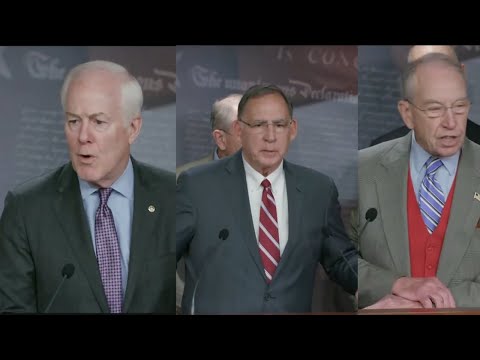
GOP Senators Warn Build Back Better Would Unleash 87,000 New IRS Agents to Target Small Businesses and Ordinary Americans
On 12/14/2021, GOP Senators John Cornyn, Chuck Grassley, and John Boozman held a press conference warning that the Build Back Better Act would grant $80 billion in mandatory funding to the IRS and provide an estimated 87,000 new IRS agents. The senators argued the supersized IRS would target small businesses and ordinary Americans rather than large corporations, and raised concerns about past IRS abuses targeting conservatives and routine leaks of confidential taxpayer information.
”Build Back Broke, Build Back Bankrupt, Build Back Bad”
Senator Grassley opened by mocking the bill’s name. “Democrats, and they’re building back better, or building back broke, or building back bankrupt, or building back bad, whatever you want to call it, are making extravagant promises that really are incredible,” Grassley said. “In other words, you can’t believe it.”
Grassley noted that his office had received 11,000 emails from constituents opposing the IRS provisions. “We still have to be very fearful of the additional money going to the IRS,” Grassley said.
The $10,000 Bank Account Threshold
Senator Boozman explained how the expanded IRS surveillance would work in practice. “Once your checking account reaches a threshold of $10,000 worth of activity, then all of your information is going to start going to the IRS,” Boozman said. “To put that in perspective, the average family’s checking account activity is about $61,000. So that’s virtually everybody.”
The original threshold had been set at just $600 before being raised to $10,000 following public backlash. But Boozman argued even the higher threshold would capture nearly every American family. “The idea of your financial transactions at that point going to the IRS is wrong,” he said. “That’s your business, unless they have evidence that you’ve done something wrong.”
Small Businesses as Targets
Boozman warned that the expanded IRS would disproportionately target small businesses rather than large corporations. “Everybody wants to take on the big corporations, but they got enough to defend themselves,” he said. “But it’s easy for the IRS to take on small business because it’s easier to pay than it is to pay to defend yourself.”
He noted that small business audits had already increased 50% in 2021. “Democrats’ attitude toward small business is that somehow if you’re a small business person, you’re a tax cheat, we’re going to go after you,” Boozman said.
Revenue Claims vs. CBO Reality
Grassley challenged the Democrats’ revenue projections for the IRS expansion. “Estimated at one time is going to bring in $700 or $800 billion,” Grassley said. “CBO looks at it, it’s only going to bring in $200 billion.”
He tied this to the broader credibility problem with the bill’s cost claims. “Why would you trust someone who says that a $3 trillion spending bill costs zero?” Grassley asked. “Why would you trust them? And why would you trust this army that the Democrats are calling for in their weaponized or supersized IRS?”
Past Abuses and Data Security
Grassley raised the history of IRS abuses targeting conservatives, referencing the scandal during the Obama administration when the IRS singled out conservative groups applying for tax-exempt status. “We already know the abuses that have occurred in the past where conservatives in particular were targeted by the IRS,” Grassley said.
He also flagged routine leaks of confidential taxpayer information to the press. “We see that confidential information by law is leaked routinely to the press,” Grassley said. “It’s not supposed to be that way.”
Boozman raised cybersecurity concerns about centralizing Americans’ financial data at the IRS. “Once you centralize that information, the IRS, the rest of our agencies are notorious for actually making sure that that information is not breachable,” he said. “So instead of it being disseminated all over the country at various banks, all of a sudden it goes to one centralized location and that’s a recipe for the Chinese, the Russians, whoever, for some industrious hacker to get that information.”
The “Courtesy Disconnect”
Boozman described the absurdity of the IRS’s current customer service. “You get on the phone, you try and call them, they’ll answer about 40% of the time,” he said. “If you are fortunate enough where they answer the phone, it’s not uncommon at all to be put on hold for an extended period of time. They actually have a thing after about 45 minutes — they have what they call a ‘courtesy disconnect,’ where they hang up on you because they’re trying to preserve your time.”
He shared a story from a meeting with accountants. “One of them, literally important case trying to get through — the IRS won’t see you in person. All of this is done by phone. Important case, was on the phone for four hours. They tried to hang up on her and she literally broke into tears.”
Bipartisan History of Defunding the IRS
Boozman noted that reduced IRS funding was not a partisan issue. “Since 2010 there’s been a reduction in funding of IRS. That’s been done on a very bipartisan basis,” he said. “Those were Democrat and Republican administrations and Congresses. This has not been a partisan issue. Both Democrats and Republicans have agreed they’ve done a lousy job and that’s why they’ve chosen not to fund them.”
Key Takeaways
- The Build Back Better Act included $80 billion in mandatory IRS funding and an estimated 87,000 new IRS agents.
- The $10,000 bank account reporting threshold would capture virtually every American family, whose average checking account activity is $61,000.
- CBO estimated the IRS expansion would bring in only $200 billion — less than half the administration’s claim of $700-$800 billion.
- Small business audits had already increased 50% in 2021, and senators warned the expanded IRS would disproportionately target small businesses over corporations.
- Senators cited past IRS abuses targeting conservatives and routine leaks of confidential taxpayer information as reasons to oppose the expansion.
Transcript Highlights
The following is transcribed from the video audio (unverified — AI-generated from audio).
- Once your checking account reaches a threshold of $10,000 worth of activity, then all of your information is going to start going to the IRS. The average family’s checking account activity is about $61,000. So that’s virtually everybody.
- They’re going to hire 87,000 new agents. Part of those agents are going to be looking at that information, again at a cost of $80 billion.
- Everybody wants to take on the big corporations, but they got enough to defend themselves. It’s easy for the IRS to take on small business because it’s easier to pay than it is to pay to defend yourself.
- Why would you trust someone who says that a $3 trillion spending bill costs zero? Why would you trust them?
- They actually have a thing after about 45 minutes — they have what they call a courtesy disconnect, where they hang up on you because they’re trying to preserve your time.
- We already know the abuses that have occurred in the past where conservatives in particular were targeted by the IRS.
Full transcript: 1066 words transcribed via Whisper AI.