 HYGO News
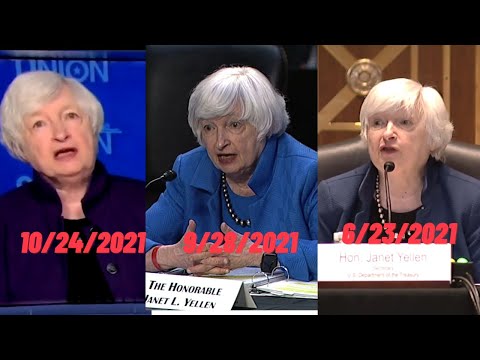
 What did Janet Yellen say about inflation on 10/24/21, on 6/23/2021 and on 9/28/2021?
What Did Janet Yellen Say About Inflation? A Timeline of Shifting Predictions
This video compiles Treasury Secretary Janet Yellen’s statements about inflation across multiple appearances in 2021, documenting how her predictions shifted as rising prices defied the administration’s initial assurances. The compilation tracks Yellen’s testimony from June 2021, when she predicted inflation would return to 2% by late that year, through October 2021, when she acknowledged it would remain elevated well into 2022. Alongside Yellen’s own evolving forecasts, the video captures sharp questioning from Senator John Kennedy (R-LA), who pressed the Treasury Secretary on the gap between her predictions and reality.
June 2021: Yellen Predicts 2% by Year’s End
In June 2021, during testimony before the Senate, Yellen was asked by Senator Kennedy whether she expected inflation to continue at the 5% year-over-year rate that had been reported the previous month. Yellen’s answer was confidently reassuring: she said she thought inflation would be closer to 2% by late 2021 or early 2022.
Kennedy reminded Yellen of an earlier prediction she had made during a previous committee appearance. “Madam Secretary, when you were here last and we all look forward to you coming, I ask you to tell me what you thought inflation would be at the end of this year and you told me 2%,” Kennedy said. “Do you still stand by that prediction?”
Yellen acknowledged that the 2% target was no longer realistic for 2021. “Clearly inflation this year is going to be above 2%. Just the experience so far this year makes that clearly true, but I think we are seeing monthly inflation rates taper off,” she said.
When Kennedy pressed for a specific number, Yellen revised her forecast upward: “Probably closer to 4%.” But she maintained that the underlying causes were temporary supply bottlenecks that would resolve themselves.
Kennedy Presses on the Federal Reserve’s Actions
Kennedy then shifted to the Federal Reserve’s behavior, which he argued contradicted Yellen’s reassurances. He noted that the Fed had recently signaled it might need to raise interest rates sooner and faster than originally anticipated, and that it had raised the interest rate on excess reserves.
“When the Federal Reserve says, or even certain members, they say nothing to worry about here, nothing to see, but by the way, we’re probably going to have to raise interest rates sooner and faster than we thought,” Kennedy said. “And when I see them raise the interest rate on excess reserves to get money out of the money supply, that tells me they’re worried about inflation.”
Yellen attempted to characterize the excess reserves rate increase as “a purely technical adjustment” and declined to comment on Federal Reserve policy. Kennedy was not persuaded.
“Nobody’s clairvoyant. A lot of these experts that you talked about never called the recession in ‘08-‘09,” Kennedy said. “A lot of these experts at the Federal Reserve, what if they’re wrong?”
Kennedy delivered his core argument by connecting inflation to the administration’s promise not to raise taxes on middle-class Americans: “The President has been adamant that he’s not going to raise taxes on middle class Americans. He’s allowing that to happen right now because inflation, prices are rising higher than wages. And 5% inflation is a tax. It’s a tax on food. It’s a tax on energy. It’s a tax on everything.”
October 2021: The Prediction Shifts to Mid-2022
By October 24, 2021, Yellen’s forecast had moved significantly. In a public appearance, she was asked when she expected inflation to return to the 2% range that is considered normal. Her answer reflected the reality that her earlier predictions had been overtaken by events.
“On a 12-month basis, the inflation rate will remain high into next year because of what’s already happened. But I expect improvement by the middle to end of next year — second half of next year,” Yellen said.
The shift was stark. In June, Yellen had predicted inflation would be near 2% by late 2021. By October, she was acknowledging it would remain elevated through the first half of 2022 at a minimum. The “second half of next year” target meant the administration’s inflation timeline had slipped by roughly a year from its original projection.
Yellen Disagrees with Larry Summers
Yellen was also asked during her October appearance to respond to warnings from Larry Summers, who had served as Treasury Secretary under President Obama. Summers had been publicly warning since early 2021 that the Biden administration’s spending plans risked triggering sustained inflation, a position that put him at odds with the White House.
Yellen dismissed Summers’s concerns directly. “I don’t think we’re about to lose control of inflation,” Yellen said. She characterized the Build Back Better spending as being spread over 10 years, though she did not directly address whether that spending would contribute to inflationary pressure.
The disagreement between Yellen and Summers became one of the defining economic debates of the Biden administration’s first year. Summers argued that the combination of massive fiscal stimulus, supply chain disruptions, and labor market tightness created conditions for persistent inflation. Yellen and other administration officials maintained that price increases were driven by temporary, pandemic-related supply bottlenecks that would resolve as the economy normalized.
The Pattern: Revise, Reassure, Repeat
The compilation video highlighted a pattern that critics would return to repeatedly in subsequent months. In each appearance, Yellen acknowledged that her previous prediction had been too optimistic, offered a revised timeline, and then assured questioners that inflation would eventually return to normal. The 2% prediction became 4%, the late-2021 timeline became mid-2022, and the characterization of inflation as “transitory” gave way to more hedged language about “uncertainty.”
By the time the video was published in late October 2021, annual inflation as measured by the Consumer Price Index had reached 6.2% — more than three times the level Yellen had initially predicted. The gap between official forecasts and lived economic reality became a central issue in the political debate over the Biden administration’s spending agenda, with Republicans arguing that the administration had either miscalculated or deliberately minimized the inflation risk to advance its legislative priorities.
Kennedy’s framing of inflation as a hidden tax on working Americans proved to be one of the most durable political arguments to emerge from the 2021 economic debate, one that would be invoked repeatedly in the 2022 midterm elections and beyond.
Key Takeaways
- Treasury Secretary Yellen predicted in June 2021 that inflation would return to approximately 2% by late that year, then revised to “probably closer to 4%,” and by October 2021 acknowledged it would remain elevated through the first half of 2022.
- Senator Kennedy pressed Yellen on the disconnect between her reassurances and the Federal Reserve’s actions, arguing that rate hike signals and excess reserve adjustments showed the Fed was more worried about inflation than the administration admitted, and that “5% inflation is a tax on food, on energy, on everything.”
- Yellen dismissed fellow Obama-era Treasury Secretary Larry Summers’s warnings about losing control of inflation, but the CPI would reach 6.2% by October 2021, more than three times her original prediction.