 HYGO News
 Powell On Inflation: "It's Probably A Good Time To Retire" The Word "Transitory", Toomey, Yellen
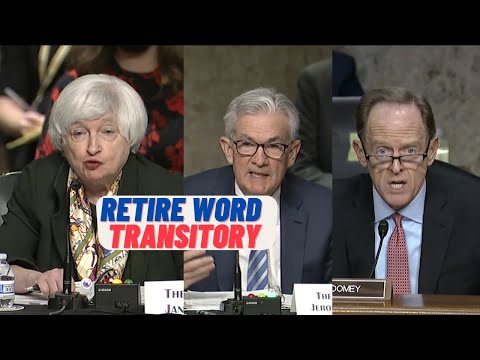
Powell Retires “Transitory”: Fed Chair Tells Toomey It’s Time to Drop the Word as Inflation Runs at 4.1% and Accelerating
On November 30, 2021, Federal Reserve Chairman Jerome Powell made the admission that marked a turning point in the inflation debate. Under questioning from Senator Pat Toomey (R-PA) at a Senate Banking Committee hearing alongside Treasury Secretary Janet Yellen, Powell acknowledged that “the word transitory has different meanings to different people” and said “I think it’s probably a good time to retire that word and try to explain more clearly what we mean.” The concession came after Toomey laid out the damning trajectory: core PCE inflation was running above 2 percent over the past five years, nearly 3 percent over the past two years, and 4.1 percent over the past year — “above target, has been above target, and it’s accelerating.” Toomey also challenged Powell on the Fed’s continued purchase of $35 billion in mortgage-backed securities per month during a housing affordability crisis and pressed Yellen on stablecoin regulation and international tax treaty authority.
”Everything’s Transitory. Life Is Transitory.”
Toomey opened his questioning with a philosophical observation that cut through months of Washington euphemism. “Now, I know you believe this is transitory, but everything’s transitory. Life is transitory,” he said.
He then posed the question the administration had been evading for months: “How long does inflation have to run above your target before the Fed decides maybe it’s not so transitory?”
Toomey provided the data himself. Under the Fed’s “flexible average inflation targeting” framework, the inflation target remained at 2 percent averaged over an unspecified time frame. But the numbers told a clear story of an institution falling behind:
- Core PCE (the Fed’s preferred inflation metric) was running above 2 percent over the past five years
- Nearly 3 percent over the past two years
- 4.1 percent over the past year
“So it’s above target. It has been above target. And it’s accelerating,” Toomey summarized. “And yet the Fed has maintained an extraordinary emergency monetary policy stance.”
He delivered his assessment: “Looks to me like this framework appears to be a weakening of the Fed’s commitment to stable prices.”
Powell’s Concession
Powell’s response was the most significant shift in the administration’s inflation messaging since Biden had taken office. He began by acknowledging the reality: “You’re absolutely right. Inflation has run well above 2 percent for long enough that if you look back a few years, inflation averages 2 percent. So I think we can say that that is taken.”
He added important context: “It was not the case going into this episode. It would have been many years since we had inflation at 2 percent.” This was a tacit acknowledgment that the “average” in average inflation targeting had been doing heavy lifting — the Fed had tolerated above-target inflation partly because inflation had run below target for years before the pandemic.
Then came the headline: “I think the word transitory has different meanings to different people. To many, it carries a sense of short-lived. We tend to use it to mean that it won’t leave a permanent mark in the form of higher inflation. I think it’s probably a good time to retire that word and try to explain more clearly what we mean.”
The statement was carefully constructed. Powell was not admitting that inflation was permanent or that the Fed had been wrong. He was conceding that the word “transitory” — which the administration, the Fed, and the Treasury had repeated for months as their primary defense against inflation criticism — had become a liability because the public understood it to mean “short-lived,” while the Fed used it to mean something narrower and more technical.
But the practical effect was unmistakable: the Fed chair was publicly abandoning the talking point that had anchored the entire administration’s economic messaging throughout 2021.
$35 Billion in Mortgage Purchases During a Housing Crisis
Toomey’s second line of attack was more specific and arguably more consequential. He pointed out the contradiction between the Fed’s monetary policy and the housing market reality.
“It still strikes me as just extraordinary that the economy has long past recovery. We’re in a full-blown expansion. Unemployment’s down to 4.6. We have record-high asset prices,” Toomey said.
He then zeroed in on housing: “Housing is leading the way to the point where in many markets, houses are just unaffordable for many people. And yet the Fed’s going to purchase $35 billion in mortgage-backed securities in December alone and scheduled to continue purchasing mortgage-backed securities for months on end.”
The argument was straightforward: the Fed was actively inflating housing prices by purchasing tens of billions in mortgage-backed securities each month, even as Americans were being priced out of homeownership. The purchases were a legacy of the pandemic emergency response, but the emergency had long since passed for the housing market, which was experiencing record prices and intense competition.
“I would strongly urge you to reconsider the pace of the tapering,” Toomey said — pushing the Fed to accelerate its withdrawal from asset purchases rather than maintaining the gradual timeline Powell had outlined.
The Debt Ceiling and Democratic Accountability
Toomey used a portion of his time to address the debt ceiling debate that was running concurrently with the inflation discussion. He cut through what he characterized as political theater: “Our Democratic colleagues can raise the debt limit all by themselves anytime they want. And there’s nothing Republicans could do to stop them. The tools have been available to them all year long. And in fact, Republicans have offered to expedite the process.”
He identified the political calculation behind Democrats’ refusal to use reconciliation: “There is only one reason that our Democratic colleagues refuse to use reconciliation to raise the debt limit. And that is because they would have to specify the amount of debt they want to inflict on the American economy. They want to avoid accountability for this terrible spending spree they’re engaged in by obfuscating and not specifying a dollar amount.”
The argument reframed the debt ceiling standoff not as Republican obstruction but as Democratic avoidance — choosing to force a bipartisan vote rather than take sole responsibility for the debt level their spending agenda required.
Yellen, Stablecoins, and International Tax Treaties
Toomey also engaged Treasury Secretary Yellen on two issues. He challenged the President’s Working Group recommendation that all payment stablecoins be required to be issued by depository institutions only, arguing that the “fundamentally different designs” of various stablecoins “suggest that there might be different regulatory approaches.” Yellen defended the blanket approach, arguing that all stablecoins with stable value relative to fiat currency “have the potential to be used as a means of payment” and that this function was “really what depository institutions guarantee.”
On international taxation, Toomey raised what he called “the most significant international tax change in 100 years” — Pillar One of the Biden administration’s international tax agreement. He argued that implementing it would require modifications to every existing bilateral tax treaty and that those modifications “must be approved by two-thirds of the Senate.” He noted that Yellen had previously said Treasury had “yet to determine whether a treaty will be needed or not” and warned: “The Executive Branch cannot ignore the Senate on a matter that is clearly our constitutional responsibility.”
Key Takeaways
- Powell told Toomey “it’s probably a good time to retire” the word “transitory” after acknowledging inflation was running at 4.1% over the past year and accelerating, marking the Fed’s abandonment of the talking point that had anchored the administration’s economic messaging throughout 2021.
- Toomey challenged the Fed’s continued $35 billion monthly purchase of mortgage-backed securities during a housing affordability crisis, noting the economy was in “a full-blown expansion” with 4.6% unemployment and record asset prices while “houses are just unaffordable for many people.”
- Toomey said Democrats could raise the debt ceiling “all by themselves anytime they want” through reconciliation but refused because “they would have to specify the amount of debt they want to inflict on the American economy,” and warned Yellen that the Biden international tax agreement would require Senate treaty approval that the administration appeared to be trying to bypass.