 HYGO News
 VP Vance Introduces Colby for Under Sec of Defense: 'He Saw Around Corners Nobody Else Was Seeing'
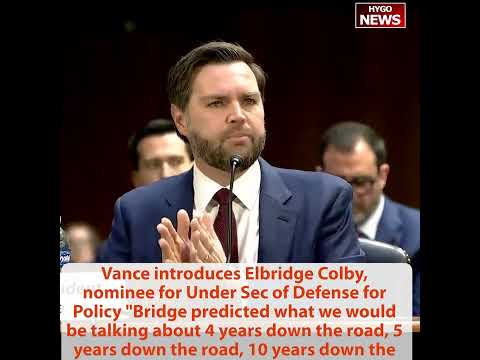
VP Vance Introduces Colby for Under Sec of Defense: “He Saw Around Corners Nobody Else Was Seeing”
Vice President JD Vance personally introduced Elbridge Colby before the Senate Armed Services Committee on March 4, 2025, describing the Under Secretary of Defense for Policy nominee as someone who “saw around corners that very few other people were seeing around” and who “predicted what we would be talking about four years, five years, ten years down the road.” Vance praised Colby’s willingness to work across the aisle and his focus on rebuilding the defense industrial base to counter China. Colby delivered an opening statement pledging to pursue “a foreign and defense policy that realistically protects and advances all American security, freedoms, and prosperity” while adapting alliances to be “stronger and more sustainable.”
Vance: “He Saw Around Corners”
Vance opened his introduction by describing a personal relationship with Colby that predated both of their government careers.
“I’ve had many conversations with Bridge before I was a United States Senator, certainly before I was the Vice President of the United States, where in so many ways Bridge predicted what we would be talking about four years down the road, five years down the road, ten years down the road,” Vance said. “He saw around corners that very few other people were seeing around.”
The “seeing around corners” metaphor captured what Vance viewed as Colby’s defining intellectual quality: the ability to identify emerging strategic threats before they became conventional wisdom. Colby had been one of the earliest and most prominent voices arguing that the United States needed to prioritize the China threat, reduce its military commitments in Europe and the Middle East, and rebuild its defense industrial base for great-power competition.
Vance acknowledged that Colby’s record included positions that had generated opposition across the spectrum. “That doesn’t mean he’s always right about every issue, or that you’ll agree with him on every issue,” Vance said. “And I say that to both the Democrats and the Republicans on the committee.”
He framed the disagreements as a feature rather than a bug. “If you look at his long career in defense policy, he has said things that, frankly, alienated Democrats and Republicans. He’s also said things that I think both Democrats and Republicans would agree with,” Vance said.
The Bipartisan Appeal
Vance made a direct pitch to Democratic senators on the committee.
“To my Democratic friends, I think you’ll also find he’s a person who can actually work across the aisle,” Vance said. “He obviously is a conservative. He obviously is the nominee of President Trump, and we nominated him because we think he’s going to do a great job. But I think you’ll find that he’s the kind of guy that you can engage in meaningful conversation, whatever your agreement or disagreement with his views.”
The appeal was significant because the Under Secretary of Defense for Policy was one of the most consequential positions in the Pentagon. The role shaped the strategic direction of American defense policy, guided alliance relationships, and influenced decisions about which threats to prioritize and which military capabilities to develop. Getting bipartisan support for the nominee would give Colby’s policy agenda greater institutional stability.
Vance drew a character portrait: “You need good people in government. You need people who are going to tell you the truth, who are going to look you in the eye, who are going to disagree sometimes amicably, but actually be willing to have an important conversation — who you can trust to tell you what they actually think. And that’s the kind of person Bridge is.”
The Industrial Base: “The Defining Question”
Vance devoted the most substantive portion of his introduction to the defense industrial base, which he identified as an area of genuine bipartisan agreement.
“So much of this question of rebuilding the industrial base — I think it’s one of the few areas of genuine bipartisan agreement,” Vance said. “We may not always agree exactly how to do it, but I think everybody pretty much agrees that we have to build the industrial base in the United States that can support the national security policy of the next generation.”
He framed the challenge in terms of long-term planning. “Whether you have a Democrat or Republican president 20 years from now, you need to ensure that the troops who are under the command of that commander-in-chief actually have the weapons systems necessary to support themselves and to accomplish the mission,” Vance said.
He argued that the solution was not simply more money. “That’s not a simple matter of throwing money at the problem. That’s not a simple matter of saying we need to buy more weapons,” Vance said. “It also goes deeply into questions of procurement. How are we buying those weapons? How are we engaging with the technologists of the 21st century?”
Vance then articulated the strategic logic that underpinned the technology-first approach. “We’re never going to beat China in a war of population. They have 1.3, 1.4 billion people, and we’ve got just north of 300 million,” he said. “But what we can do is actually have the kind of technology that gives our troops and our people the advantage over the long haul.”
He pushed for procurement reform that would welcome innovation. “That means not just buying more weapons — that means being smart about how we buy weapons in a way that enhances our technological edge and ensures that upstarts, not just the big five incumbents, but upstarts can participate in the process of procurement and of giving our troops the weapons systems that they need,” Vance said.
The reference to “upstarts” versus “big five incumbents” signaled the administration’s intent to break the monopoly that the five largest defense contractors (Lockheed Martin, Boeing, Raytheon, Northrop Grumman, and General Dynamics) held over Pentagon procurement. Opening the system to smaller, more innovative companies — including tech startups with capabilities in AI, drones, and cyber warfare — was a priority that aligned with both the DOGE efficiency agenda and the military modernization mission.
Colby’s Opening Statement
Colby delivered a statement that was both personal and strategic.
“It is an exceptional personal honor to appear before you today to be considered for the position of Under Secretary of Defense for Policy,” Colby said. He thanked Vance “for his exceptionally kind introduction and his confidence.”
He introduced his family: wife Susanna and sons Orlando and Thomas, seated behind him, along with parents Jonathan and Susan.
Colby then articulated his strategic vision. “It is my great hope that we can get through the coming years peacefully, with strength, in ways that put us and our alliances on a stronger and more sustainable footing,” he said.
He made four commitments to the committee:
First: “I am deeply committed to a foreign and defense policy that realistically protects and advances all American security, freedoms, and prosperity.”
Second: “I am willing and ready to engage with those who disagree with me and adapt my views based on persuasive arguments and the facts.”
Third: “I value our alliances deeply, even as I think they must be adapted.”
Fourth: “I love our great country and will put its interests first and foremost.”
The third commitment — valuing alliances “even as I think they must be adapted” — was the most strategically significant. Colby was known for arguing that existing alliance structures, particularly NATO, needed to evolve to reflect the shift in the primary threat from Russia to China. His pledge to value alliances while adapting them signaled that the administration would not abandon allies but would demand they carry more weight.
Colby closed with a pledge: “If confirmed, I pledge to strive with every fiber to meet the grave responsibilities of this important office with judgment, commitment, and determination.”
Key Takeaways
- VP Vance said Colby “saw around corners that very few other people were seeing” and “predicted what we would be talking about 4, 5, 10 years down the road.”
- He argued the defense industrial base needed reform beyond “throwing money at the problem,” emphasizing technology over population in the competition with China’s 1.4 billion people.
- Vance pushed for procurement reform to let “upstarts, not just the big five incumbents” compete for defense contracts, aligning military modernization with the innovation economy.
- Colby pledged a policy that “realistically protects” American interests and said he valued alliances “deeply, even as I think they must be adapted.”
- Vance told both parties: “You need people who are going to tell you the truth, who are going to look you in the eye” — characterizing Colby as someone who had “alienated Democrats and Republicans” with honest assessments.