 HYGO News
 Tricks & Gimmicks, Tax Hikes, Dangerous Doublespeak on Build Back 'Broke' Bill Isn't Fooling Anyone
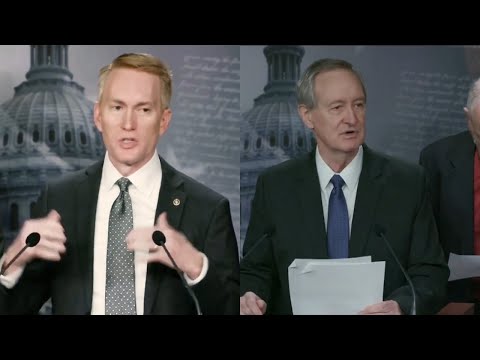
GOP Senators Expose Budget Tricks and Tax Hikes in Build Back Better Bill, Warn of $4.9 Trillion True Cost
On 12/7/2021, Senators Mike Crapo and James Lankford held a press conference to expose what they called the dangerous tax-and-spend policies Democrats were proposing in their Build Back Better bill. Armed with CBO data and independent budget analyses, the senators argued that the bill’s true cost was being hidden through budget gimmicks and that its tax increases would hurt American workers, manufacturers, and global competitiveness.
The True Cost: $4.5 to $5 Trillion
Senator Crapo presented charts comparing three independent analyses of the bill’s actual cost. While the CBO scored the bill as written — with all its gimmicks — at $1.7 trillion, both the Penn Wharton Budget Model and the Committee for a Responsible Federal Budget (CRFB) scored the bill based on what Democrats themselves had said: that the policies were intended to be permanent.
“Penn Wharton comes out at a total cost for the bill at $4.6 trillion. The CRFB comes out at $4.9 trillion,” Crapo said. “They are several hundred billion dollars apart, but both clearly show that the full cost of the bill, the true cost of the bill without gimmicks, is above $4.5 trillion and approaching $5 trillion.”
Even using the gimmicky scoring, Crapo noted, the bill still added to the deficit. “Remember the claim that there’s zero cost here? Even if you take the bill with its gimmicks, it’s got $400 billion of deficit according to CBO. And if you don’t take the gimmicks, it’s got $2.7 trillion of deficit under the Penn Wharton study and $2.8 trillion of deficit under the CRFB study.”
Budget Gimmicks Exposed
Crapo laid out specific gimmicks Democrats used to hide the bill’s true cost. “The Democrats’ reckless spend and tax spree relies on a number of budget gimmicks in an attempt to hide the true cost of its misguided policies,” he said. Among the tricks:
The child tax credit and earned income tax credit provisions were set to expire after just one year, despite Democrats consistently saying the policies were “intended to be permanent.” The SALT deduction giveaway was front-loaded while corresponding offsets were back-loaded. And the boost in IRS funding was “estimated to generate less than half of what the administration claims” — and even that did not formally score under CBO rules.
“There is no single year in which all tax provisions in the bill will be in full effect at the same time,” Crapo noted.
Lankford: “Great Idea, You Go First”
Senator Lankford zeroed in on the bill’s shifting justification and its international tax provisions. “It’s interesting to me the number of times that I hear the story change as this bill moves through the House and now comes over to the Senate,” Lankford said. “This massive bill that’s sitting out there that’s now almost $2 trillion with around $400 billion in additional debt — originally was all about sustaining our economy. Then this very hot inflation continues to rise and now suddenly it is, well, this is going to help us fight inflation. And now we’re dealing with unemployment issues. And so now the Democrats’ line changed. Well, now it’s going to help us with employment issues.”
“In reality, what’s happening is they’re trying to spend more, they’re trying to tax more, and they’re going to make a bad situation even worse,” Lankford said.
On the international tax provisions, Lankford drew a colorful comparison. “They’re raising the rate for companies doing business internationally here in the United States. And what they’re literally doing is saying, we’re going to raise the rate here and every other country around the world promises in the future they will also raise the rate,” he said. “Honestly, that reminds me of when I was in middle school around a group of guys that all came up with a bad idea and all the guys would look at each other and say, ‘Great idea, you go first.’”
Manufacturing and Jobs at Risk
Lankford warned that the book minimum tax in the bill would particularly hurt manufacturing businesses. “This book tax has been tried in the past and has been set aside. This doesn’t help. And it actually discourages investment,” he said. “Without question, it will hurt manufacturing businesses the most, who have the opportunity to be able to write off new equipment and new expansion. Which means less purchasing of new equipment, less purchasing of new facilities and less expansion, less jobs. That’s exactly the wrong direction for us to go in this tax policy.”
Even the Tax Policy Center, which Lankford noted “generally leans toward the Democrats’ side,” acknowledged how harmful the book minimum tax would be for capital investment in the United States.
The Tax Credit for Reporters
Lankford highlighted what he called a particularly brazen maneuver. “They’re saying to reporters across the entire country, don’t look at CBO score, don’t look at any of the outside groups and how they’ve scored,” Lankford said. “By the way, we’re doing a new tax credit for reporters. Just look at that. Examine the new tax credit for reporters that, hey, we’re going to help you out and ignore all the rest of the data.”
“Quite frankly, I don’t think even reporters are going to fall for something that blatant,” he added.
Who Really Pays
Crapo noted that the bill’s more than $800 billion in tax increases on American companies would ultimately fall on workers. “Study after study shows that these corporate, so-called corporate taxes, fall mostly on labor and capital. That’s on workers, jobs, salaries and benefits, and on investors, retirees and pensioners,” Crapo said. “International tax increases would overwhelmingly hit American companies operating globally, not their foreign competitors, giving China yet again another advantage competitively.”
Lankford pointed to what he called “doublespeak” in the Democrats’ claim to be soaking the rich. “In their proposal next year, three-fourths of the people that make a half a million dollars or more, their taxes actually go down. While the people that make a smaller amount, just a fraction of those actually see their taxes decrease,” Lankford said.
Key Takeaways
- The true cost of the Build Back Better bill was $4.5 to $4.9 trillion according to Penn Wharton and CRFB, far above the CBO’s $1.7 trillion score of the gimmick-laden text.
- Even with gimmicks, the CBO scored a $400 billion deficit; without gimmicks, the deficit was $2.7 to $2.8 trillion.
- The bill’s child tax credit and earned income tax credit provisions were set to expire after one year despite Democrats saying they were intended to be permanent.
- The book minimum tax would disproportionately hurt American manufacturers by eliminating write-offs for new equipment and expansion.
- The bill included a tax credit for reporters while Democrats urged the media to ignore CBO and independent budget scores.
Transcript Highlights
The following is transcribed from the video audio (unverified — AI-generated from audio).
- Originally it was all about sustaining our economy. Then this very hot inflation continues to rise and now suddenly it is, well, this is going to help us fight inflation. In reality, what’s happening is they’re trying to spend more, they’re trying to tax more, and they’re going to make a bad situation even worse.
- They’re raising the rate for companies doing business internationally saying, we’re going to raise the rate here and every other country around the world promises in the future, they will also raise the rate. Honestly, that reminds me of when I was in middle school around a group of guys that all came up with a bad idea and all the guys would look at each other and say, great idea, you go first.
- Remember the claim that there’s zero cost here? Even if you take the bill with its gimmicks, it’s got $400 billion of deficit according to CBO.
- By the way, we’re doing a new tax credit for reporters. Just look at that. Examine the new tax credit for reporters that, hey, we’re going to help you out.
- Without question, it will hurt manufacturing businesses the most who have the opportunity to be able to write off new equipment and new expansion, which means less purchasing of new equipment, less purchasing of new facilities and less expansion, less jobs.
- Even the Tax Policy Center, which generally leans toward the Democrats’ side, has acknowledged how harmful the book minimum tax would be for capital investment in the United States.
Full transcript: 1692 words transcribed via Whisper AI.