 HYGO News
Durham on Comey, McCabe and the FBI Brass Who Wouldn't Talk: 'They Refused to Be Interviewed' (June 21, 2023)
James Comey was out promoting a new mystery novel [3]. But the fired FBI director would not sit down with the special counsel examining how his bureau investigated the 2016 Trump campaign. Neither would his former deputy, Andrew McCabe.
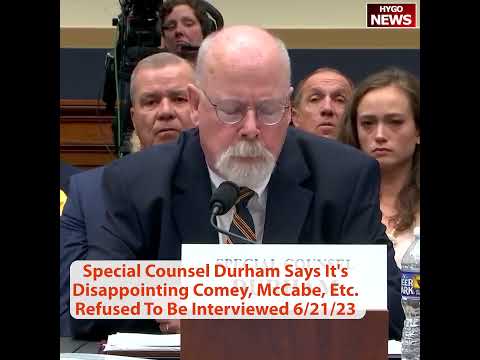
Pressed by Rep. Dan Bishop, R-N.C., on why he never forced them to talk, Special Counsel John Durham told the House Judiciary Committee on June 21, 2023, that the refusals stung: “It is as disappointing, perhaps more disappointing to me and my colleagues that these people would not agree to be interviewed. I know some of them had a lot to say publicly. They refused to be interviewed by our folks” [1]. The video above shows Durham’s answer. Quotes from the hearing are from the official transcript, Serial No. 118-28 [1].
”Seems Inexplicable to Me”
Bishop, a former state legislator from the Charlotte area [10], used his five minutes to press Durham on gaps in the report. At the end, he read off the names of the people who would not cooperate.
“As I go through your report and look, there are people who declined to be interviewed, not only Dolan, Danchenko, Comey, McCabe, Priestap, Strzok, Page, Glenn Simpson, among others. Seems inexplicable to me that you didn’t compel their testimony. Can you explain that?” Bishop asked [1].
Durham said he would not discuss any one person “because I don’t want to violate any rules,” but he laid out what he called “the general kinds of considerations that go into these things” [1].
Who Said No
Durham’s report spells out the refusals [2]:
- James Comey, the FBI director who oversaw the Trump-Russia investigation, code-named Crossfire Hurricane, “declined through counsel to be interviewed by the Office.” His lawyer said Comey had already testified in congressional hearings and been interviewed by other government bodies “on all matters relating to Crossfire Hurricane.”
- Andrew McCabe, Comey’s deputy, “through his counsel, did not agree to be interviewed by the Office even after we offered to narrow the scope of subjects to be asked about.”
- Peter Strzok and Bill Priestap, two top FBI counterintelligence officials, each agreed to discuss the FBI’s Alfa Bank inquiry but “otherwise declined to be interviewed by the Office on matters related to his role in the Crossfire Hurricane investigation.”
- Glenn Simpson, co-founder of Fusion GPS, the opposition research firm hired to compile the Steele dossier [3][4], “declined to be interviewed by the Office.”
- Kevin Clinesmith, the FBI lawyer who pleaded guilty to altering an email, “otherwise declined to be interviewed by the Office or cooperate with our investigation.”
Durham told Bishop that his team never got to Igor Danchenko, the dossier’s primary subsource, either. Danchenko was represented by counsel, Durham said, and “we did not arrive at a point where we could interview Mr. Danchenko” [1].
Why He Didn’t Subpoena Them
Durham said a prosecutor cannot simply haul in a witness and make him talk.
“The only way in which you can compel as it were a person’s testimony would be to get a court order after somebody asserted their Fifth Amendment privilege,” he said. A grand jury subpoena, he explained, “doesn’t give a Federal prosecutor the authority to simply force people to talk about things that the prosecutor … might be interested in.” It requires an active grand jury investigation and a reasonable belief that the witness has relevant information. Otherwise, he said, “you run up against claims of grand jury abuse or claims of trying to set a perjury trap or other bad faith reasons. So, you can’t just subpoena people to make them talk” [1].
Then there was the memory problem. Prosecutors weigh whether a witness who has “repeatedly said, I don’t recall, I don’t remember” will say anything new, Durham said. He pointed to a sensitive piece of classified intelligence the lawmakers had seen: “Mr. Comey was asked about that in a Congressional hearing under oath, and he didn’t recall” [1].
Durham did not say which intelligence he meant. But Comey had faced a similar question at a Senate Judiciary Committee hearing on Sept. 30, 2020. Chairman Lindsey Graham, R-S.C., asked him about a Sept. 7, 2016, intelligence referral to Comey and Strzok about Hillary Clinton purportedly approving “a plan concerning U.S. Presidential candidate Donald Trump and Russian hackers hampering U.S. elections.” “That doesn’t ring any bells with me,” Comey said. “That’s a pretty stunning thing that it doesn’t ring a bell,” Graham replied, Fox News reported [4].
”Disappointed All Day Long”
Bishop was not the only Republican frustrated. Later in the hearing, Rep. Tom Tiffany, R-Wis., asked why Durham never interviewed Priestap about Crossfire Hurricane. Durham said Priestap would talk only about Alfa Bank: “As previously indicated, we were disappointed with some of these decisions on the part of high-ranking members of the FBI not to cooperate” [1].
“Yes, we’re very disappointed also,” Tiffany shot back. “I keep hearing this term, disappointed all day long” [1].
Senate Republicans had raised the same question a month earlier. In a May 2023 letter first obtained by the Washington Examiner, Sens. Chuck Grassley, R-Iowa, and Ron Johnson, R-Wis., told Durham that “it seems odd that individuals would be allowed to avoid fully cooperating with your office, particularly given your authority to compel testimony and records.” They asked whether he had subpoenaed Comey, McCabe, Strzok, Priestap, Clinesmith and Simpson, and if not, why not [3].
The Danchenko Questions
Bishop also pressed Durham on Danchenko’s secret status as a paid FBI informant. Durham said he learned it from Danchenko’s informant file, “probably halfway through” the period from May 2019, when his inquiry began, to October 2020, when Danchenko stopped serving as a confidential human source [1].
Bishop noted that the FBI signed Danchenko up as a source on March 7, 2017, after his early 2017 interviews with agents, in which, Bishop said, he could not corroborate the dossier. The next day, Bishop said, the FBI finalized talking points for briefing congressional leaders that repeated dossier claims. He asked why the report did not mention them. “I’m aware that there were talking points,” Durham said [1].
By the Numbers
- More than 190 subpoenas and 7 search warrants: Durham’s investigation, according to Grassley and Johnson [3].
- More than 2,800 subpoenas and nearly 500 search warrants: Special Counsel Robert Mueller’s investigation, for comparison [3].
- 6 officials and witnesses: the senators’ list of people who refused or limited their cooperation [3].
- Sept. 7, 2016: the date of the CIA’s referral memo to the FBI on the “Clinton Plan” intelligence, addressed to Comey and Strzok [3].
- About 3 1/2 years: how long Danchenko served as a confidential human source for the FBI, from March 2017 to October 2020, according to Bishop’s questions and Durham’s answers [1].
What Happened Next
- The annex comes out: On July 31, 2025, Grassley, by then chairman of the Senate Judiciary Committee, released the formerly classified appendix to Durham’s report. It details the reported Clinton campaign plan to tie Trump to Russia and what Grassley called the FBI’s failure, “under the leadership of then-Director James Comey,” to investigate it [5].
- Comey charged: On Sept. 25, 2025, a federal grand jury indicted Comey on two counts, false statements and obstruction of a congressional proceeding, tied to his Sept. 30, 2020, testimony to Congress. “I’m innocent,” Comey said [6]. A judge dismissed the case in November 2025 after ruling that the interim U.S. attorney who brought it had been unlawfully appointed, and the Justice Department appealed [7]. At a Sept. 15, 2026, hearing, the appeals judges sounded skeptical of the government’s position [8].
- The ‘grand conspiracy’ probe: A federal investigation based in Fort Pierce, Florida, has issued dozens of subpoenas and scrutinized Comey and former CIA Director John Brennan, among others. Joseph diGenova, who had been running the inquiry for the Justice Department, resigned in September 2026, and no charges had been filed, Fox News reported [9].
- Bishop moves on: Bishop lost a 2024 race for North Carolina attorney general. The Senate confirmed him as deputy director of the Office of Management and Budget on March 26, 2025, by a 53-45 vote [10].
For more from the same hearing, see how Rep. Matt Gaetz, R-Fla., grilled Durham over the Mueller team’s wiped phones, how Rep. Hank Johnson, D-Ga., tried to call Michael Sussmann innocent and how Rep. Jerry Nadler, D-N.Y., tallied up the probe.
Sources
- GovInfo: Hearing on the Report of Special Counsel John Durham, House Judiciary Committee, Serial No. 118-28 (June 21, 2023)
- U.S. Department of Justice: Report on Matters Related to Intelligence Activities and Investigations Arising Out of the 2016 Presidential Campaigns (Durham report, May 12, 2023)
- Washington Examiner via The Denver Gazette: Durham pressed for not making Comey, McCabe, Strzok, and others fully cooperate with investigation (May 24, 2023)
- Fox News: Comey says new information that Hillary Clinton drummed up Russia controversy to vilify Trump ‘doesn’t ring a bell’ (September 30, 2020)
- Senate Judiciary Committee: Newly declassified appendix to Durham report sheds additional light on Clinton campaign plan to falsely tie Trump to Russia and FBI’s failure to investigate (July 31, 2025)
- Fox News: Comey indicted for alleged false statements, obstruction of congressional proceeding (September 25, 2025)
- Fox News: DOJ appeals dismissal of James, Comey criminal cases in long-shot legal gamble (December 22, 2025)
- Washington Examiner: Fourth Circuit worried Trump’s US attorney appointments unlawfully cut out Senate (September 15, 2026)
- Fox News: Prosecutor Joseph diGenova resigns from DOJ role investigating Trump-Russia probes (September 10, 2026)
- WFAE: Bishop confirmed as deputy director of OMB (March 26, 2025)