 HYGO News
 Sonoma County Evacuation, Nixle Alerts not Amber Alerts
Sonoma County Evacuation, Nixle Alerts not Amber Alerts
In October 2017, during one of the deadliest wildfire events in California history, Sonoma County officials made a controversial decision not to send out mass emergency alerts to cellphones. As the video description noted, “Sonoma County could have sent out an emergency mass-blast alert to every cellphone in the region, but chose not to, saying the overkill alarm would have hampered emergency efforts.” With 15 dead in Sonoma County alone and 400 people listed as missing, the decision drew intense scrutiny.
Body Camera Footage of the Evacuation
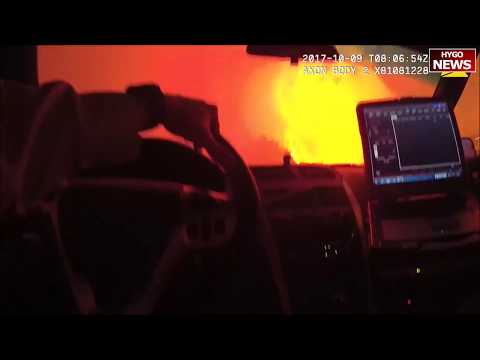
The video opens with harrowing body camera and radio footage of Sonoma County deputies conducting door-to-door evacuations during the fire. Deputies are heard shouting: “This is the mandatory evacuation order. Leave your homes. Sonoma County Sheriff’s Office, mandatory evacuation order, leave your homes.”
The urgency of the scene is clear from the radio traffic. Deputies carried out disabled residents who could not walk: “Sheriff 1, stand 4, we’re doing a carry out.” In one sequence, deputies struggle with the physical difficulty of moving a disabled woman while fire advances: “Watch your leg, watch your leg, watch your leg.” Nearby, houses were already engulfed: “Hold up, hold up. There’s a house on fire. Let’s go.”
The situation deteriorated rapidly. Radio calls captured the panic: “Sheriff 1, stand 4, we need to make a priority evacuation now. Mark West Springs area.” Deputies on the hill realized they had to abandon their position: “Copy, we all have to evacuate the hill, so we’re coming off now.” At one point, a deputy reported that Mark West was “nearly impossible at this point.”
Why Sonoma County Did Not Send Mass Alerts
The sheriff’s office explained their reasoning in a press conference captured in the video. The sheriff stated: “I was there that night when this fire was going on. I was there by midnight. We had people stacked in Larkfield trying to evacuate and they couldn’t get out because of the gridlock into 101.”
His concern was about the consequences of triggering a county-wide alert: “This county is heavily populated in that 101 corridor. And had we had people come from all directions into that corridor, I’m concerned we would have had more deaths of people in their cars trying to get out.”
County spokeswoman Jennifer Larocque had also defended the decision: “It would cause unnecessary evacuations and delays for emergency vehicles reaching people in areas in need of help. In order not to slow down response to people actually in need of help, we chose not to send the notice.”
Instead, Sonoma County used Nixle alerts, with the first electronic message sent at 10:51 p.m., and a system called SoCo Alerts. But these required people to sign up. Deputies also conducted old-fashioned evacuations: “We had deputies out there walking unincorporated areas and areas we serve, knocking on doors and letting them know to evacuate.”
The Dispatch Overload Problem
The sheriff addressed the practical reality of emergency communications during the fire: “There were 300 calls per hour coming to our dispatch center. That overloaded them. We sent out a message to 100,000 people. We’re going to get 3,000 calls. The radio traffic never stopped that night. All they were doing was trying to get deputies to houses that needed to be evacuated. And that was more important.”
He noted the fire had destroyed much of the communications infrastructure: “It burned telephone poles and hard lines. It burned cell phone towers, 73 cell phone towers. And that fire moved so quickly that it overran first responders.”
When asked whether panic was justified during a wildfire, the sheriff acknowledged the tension: “I’ve also heard people say that if you were concerned for panic, if there ever was a time for panic, isn’t it during a wildfire? Yeah, but panic is what gets people killed if you panic everybody who come out onto the roads.”
Additional Context from Full Remarks
The sheriff acknowledged that neighboring Lake County made a different choice and sent mass alerts to all cell users, crediting that decision with zero fire deaths. But he pushed back on the comparison: “I don’t think you compare Lake County to Sonoma County. Very different areas.”
Sonoma County had 290,000 Nixle subscribers against a total population of roughly 500,000. The sheriff was pushing for more adoption: “I want everybody on SoCo Alert.” He explained the difference between the systems: “We use Nixle Alerts for a wide range of things. SoCo Alert is more for emergencies. So SoCo Alert is like the emergency broadcast system.”
The video also showed the massive scale of the firefighting operation at the Sonoma County fairgrounds base camp, with nearly 4,500 firefighters deployed, mobile kitchen units, supply depots, and communications infrastructure. A fire official gave a walkthrough of the facility: “The firefighters come in here in the morning. They get their briefing. They get fed. They get their supplies.” The base camp included tents for sleeping, fuel stations, water supplies, showers, and employee support services — all at the Sonoma County Fairgrounds.
Key Takeaways
- Sonoma County deliberately chose not to send mass Amber Alert-style warnings during the October 2017 wildfires, fearing that a county-wide alert would cause gridlock on Highway 101 and lead to more deaths from traffic than from fire.
- Body camera footage showed deputies conducting desperate door-to-door evacuations, carrying disabled residents and retreating from advancing flames, while radio traffic revealed how overwhelmed the system became with 300 calls per hour to dispatch.
- The decision remains controversial: neighboring Lake County sent mass alerts and reported zero fire deaths, but Sonoma officials argued the two counties were not comparable and that overloading an already strained communications system would have cost lives.