 HYGO News
 Hawley tears into AG Garland's Memo Targeting School Board Protesters
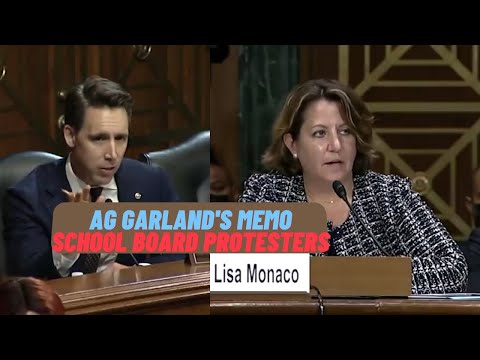
Hawley Tears Into AG Garland’s Memo Targeting School Board Protesters
On October 5, 2021, Senator Josh Hawley (R-MO) confronted Deputy Attorney General Lisa Monaco during a Senate Judiciary Committee hearing over Attorney General Merrick Garland’s controversial memo directing the FBI and Justice Department to address what Garland described as “the rise in criminal conduct directed toward school personnel.” Hawley accused the administration of using the FBI to silence parents who showed up at local school board meetings to oppose critical race theory and mask mandates, calling the memo unprecedented in American history. The exchange became one of the most widely viewed moments of the hearing, as Hawley demanded Monaco define the line between protected speech and the “harassment and intimidation” referenced in Garland’s directive.
An Unprecedented Use of Federal Power
Hawley opened his questioning by placing the Garland memo in historical context with a sharp comparison. “Practically every day brings new reports about this administration weaponizing the federal bureaucracy to go after political opponents. Frankly, I don’t think we’ve ever seen anything like it in American history,” he said. “I mean, for those of us who miss the McCarthy era, I guess this president is intent on bringing it to us.”
He then asked Monaco directly: “Are you aware of any time in American history when an attorney general has directed the FBI to begin to intervene in school board meetings, local school board meetings?”
Monaco pushed back on the characterization: “I’m not aware, and I’m not aware that that, and that is not going on.”
But Hawley was not interested in the administration’s framing of the memo. He wanted to establish a simple fact: that the federal government had never before inserted itself into local school board proceedings in this manner, and that Monaco could not cite a single precedent for the action.
”Is Waiting to Express One’s View Harassment and Intimidation?”
The central exchange of the hearing came when Hawley pressed Monaco to define the terms used in Garland’s memorandum. The one-page memo had instructed U.S. attorneys and FBI field offices to convene meetings with state and local law enforcement to address threats against school personnel, but it also referenced “harassment” and “intimidation” without defining those terms.
“Is parents waiting sometimes for hours to speak at a local school board meeting to express concerns about critical race theory or the masking of their students, particularly young children — is that in and of itself, is that harassment and intimidation?” Hawley asked. “Is waiting to express one’s view at a school board meeting harassment and intimidation?”
Monaco responded that “the attorney general’s memorandum made quite clear, spirited debate is welcome, is a hallmark of this country.”
Hawley rejected that characterization. “If all due respect, it didn’t make it quite clear. It doesn’t define those terms, nor does it define harassment or intimidation,” he said. He noted that while everyone could agree that actual violence should not be condoned, the memo went further than addressing violence. “The memorandum covers more than violence. It talks about intimidation. It talks about harassment. So I’m asking you to draw some lines.”
He invoked First Amendment law directly: “We do this all the time in the First Amendment context. This is the substance of First Amendment law. So I expect that she’ll be available and willing to do it now. Tell me where the line is with parents expressing their concerns.”
Monaco’s Defense: Threats and Open Communication
Monaco attempted to narrow the scope of the memo, arguing that it was focused on criminal threats and violence rather than protected speech. She compared it to the FBI’s existing role in responding to threats against members of Congress and election officials.
“The Attorney General’s memorandum simply asked the U.S. Attorney Community, the FBI, and their counterparts to ensure that state and local law enforcement has an open line of communication to report threats, whether they happen in the context of election officials being threatened, whether they happen in the context of members of Congress being threatened, which the FBI responds to on a regular basis, as is appropriate,” Monaco said. “The job of the Justice Department is to address criminal conduct.”
Hawley was unmoved by the comparison. He pointed to what was happening on the ground in his own state and across the country: parents waiting for hours at school board meetings, sometimes having those meetings ended before they could speak because, as he put it, “the school board doesn’t want to hear it.”
“And now parents are told that if they wait and they express their views, that they may be investigated for intimidation,” Hawley said. “I don’t know who’s telling them that, Senator,” Monaco replied. “The job of the Justice Department is to investigate crimes.”
The Chilling Effect on Parents’ Rights
Hawley built his argument around the concept of a “chilling effect” on protected speech, a well-established doctrine in First Amendment jurisprudence. He argued that regardless of whether the Justice Department intended to target parents engaged in peaceful protest, the mere issuance of the memo would discourage parents from exercising their rights.
“If this isn’t a deliberate attempt to chill parents from showing up at school board meetings for their elected school boards, I don’t know what is,” Hawley said. “I mean, I’m not aware of anything like this in American history. We’re talking about the FBI. You’re using the FBI to intervene in school board meetings. That’s extraordinary.”
He framed the issue in terms of multiple constitutional rights simultaneously: “I think parents across this country are gonna be stunned to learn, stunned, that if they show up at a local school board meeting, by the way, where they have the right to appear and be heard, where they have the right to say something about their children’s education, where they have the right to vote, and you are attempting to intimidate them. You are attempting to silence them. You are attempting to interfere with their rights as parents and yes, with their rights as voters.”
Hawley Demands the Attorney General Testify
Hawley concluded his questioning with a direct statement that he found the entire enterprise dangerous and a demand that the committee hear from Garland himself.
“This is wrong. This is dangerous. And I cannot believe that an Attorney General of the United States is engaging in this kind of conduct,” Hawley said. “And frankly, I can’t believe that you are sitting here today defending it.”
He turned to the committee chairman: “Mr. Chairman, we need to have a hearing on this subject. We need to hear from the Attorney General himself. He needs to come here, take the oath, sit there, and answer questions. We have never seen anything like this before in our country’s history. And frankly, I want to say, I think it is a dangerous, dangerous precedent.”
The Garland memo had been issued in response to a letter from the National School Boards Association that likened some parent protests to a form of domestic terrorism. That letter was later disavowed by many state school board associations, and the NSBA itself eventually apologized for the language it had used. The controversy became a major flashpoint in the broader national debate over parental rights in education that dominated American politics through 2021 and 2022.
Key Takeaways
- Senator Hawley confronted Deputy AG Lisa Monaco over Garland’s memo directing the FBI to coordinate with local law enforcement on threats to school personnel, calling it an unprecedented use of federal power with no historical parallel and comparing it to the McCarthy era.
- Hawley pressed Monaco to define “harassment and intimidation” in the context of parents attending school board meetings, arguing the memo’s undefined terms created a chilling effect on protected First Amendment speech.
- Monaco defended the memo as addressing criminal threats comparable to those against members of Congress, but Hawley demanded AG Garland personally testify, declaring “this is wrong, this is dangerous” and that the administration was “attempting to silence” parents and “interfere with their rights as voters.”