 HYGO News
 Schumer on Trump's EU deal: hype up, exaggerate ALWAYS LIES; Dem Beto O'Rourke Trump & Hitler
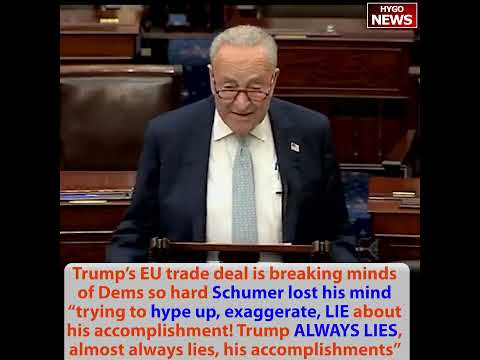
Schumer on Trump’s EU deal: hype up, exaggerate ALWAYS LIES; Dem Beto O’Rourke Trump & Hitler
Senate Minority Leader Chuck Schumer characterized the Trump EU trade deal as “a $90 billion per year tax hike on American families … Donald Trump is, as usual, trying to hype up, exaggerate, and lie about his accomplishments.” Pete Buttigieg, the former Transportation Secretary and 2020 presidential candidate, said he is open to endorsing socialist NYC mayoral nominee Zohran Mamdani: “If he’s going to be working to deliver efficient government, that’s something very interesting to me” — despite noting Mamdani “is further left than I am.” Beto O’Rourke delivered the Hitler-Trump comparison: “It took Adolf Hitler only 53 days to destroy German democracy … In the six months since Donald Trump has been sworn in, we have been born witness to him defying federal judges … dismantling congressionally chartered agencies.” New Jersey Democrat Mikie Sherrill endorsed Mamdani’s agenda, then tried to walk it back.
”A $90 Billion Per Year Tax Hike”
Schumer’s framing of the EU deal. “Over the weekend, Donald Trump announced a new trade deal with the European Union. It will result in a $90 billion per year tax hike on American families. When you raise tariffs, the American families pay for it.”
The “tariffs are a tax on American families” framing is the standard Democratic position on tariff policy. The theory: tariffs raise the price of imported goods. Higher import prices get passed through to consumers. Consumers pay more. Therefore tariffs are an indirect tax on households.
Schumer’s $90 billion annual figure would require specific assumptions about pass-through rates, import volume reductions, and substitution effects. The actual data, as Bessent has been documenting, is that tariff pass-through to consumer prices has been far more muted than Democratic projections predicted. Foreign manufacturers, exporters, and retailers have been absorbing most of the tariff cost rather than passing it through.
“$90 billion tax on American families in this tariff deal with the European Union.”
That framing will be circulated by Democratic-aligned media regardless of the pass-through data. The simple claim — tariffs are taxes on families — is accessible and politically resonant even if empirically overstated.
”Trump Always Lies About His Accomplishments”
“Donald Trump is, as usual, trying to hype up, exaggerate, and lie about his accomplishments.”
“Always lies” is Schumer’s characterization. The Democratic playbook on Trump economic announcements has been consistent: dispute the characterization, dispute the numbers, dispute the magnitude of the accomplishment.
The challenge for Schumer is that the EU deal was jointly announced by Trump and von der Leyen. Von der Leyen publicly confirmed the $750 billion energy commitment, the $600 billion investment, the zero-tariff European market access, and the flat 15% rate. Schumer is not disputing individual components. He is using the “hype and exaggerate” framing to discount the overall significance.
Buttigieg on Mamdani
The segment pivoted to Pete Buttigieg, the former Transportation Secretary, on endorsing Zohran Mamdani. “Would you endorse him? Say Big Ten Approach. I don’t agree with him about everything, but I endorse him.”
“Big Tent Approach” is the Democratic coalition framing — accepting candidates whose specific policy views differ from one’s own in the interest of keeping the coalition together.
“He hasn’t asked me to endorse him. I’m not really a player in New York City municipal politics. But I’ve talked to him about it. You would talk to him about it.”
Buttigieg is hedging. He is not formally endorsing, but he is in conversation with Mamdani. Whether a formal endorsement emerges depends on the politics over the coming months.
”Further Left Than I Am”
“I was talking the other day to a Democratic member of Congress representing part of New York City who said to me, essentially what you’re saying, Mom Donnie in many ways is the future. He knew how to campaign. He’s doing everything right. There’s a lot to learn from him. And this lawmaker said, I haven’t endorsed him yet because I have a lot of Orthodox Jews in my district. What do you make of that contradiction?”
That is a significant passage. Buttigieg is reporting that Democratic members of Congress privately view Mamdani as “the future” — the direction the party should move. But those same members are not endorsing publicly because their districts include Orthodox Jewish constituents who would be offended by a Mamdani endorsement given his positions on Israel and Palestinian statehood.
“Yeah, I mean, again, it’s kind of distinguishing between tactics and ideology. And I would say he’s further left than I am. But also, I think that what he’s been able to do is something that our party ought to learn from.”
“Further left than I am” is Buttigieg’s acknowledgment of ideological distance. But Buttigieg is framing Mamdani’s political tactics — how he campaigns, how he positions, how he mobilizes — as worth learning from regardless of the ideological substance.
“Will you support Mom Donnie in the general election? You know, if he’s the Democratic candidate, which it sounds like he is, I assume I will.”
Buttigieg confirming he will support Mamdani in the general. That is a material commitment from a senior national Democrat.
“You know, if he’s going to be working to deliver efficient government, that’s something very interesting to me.”
Beto O’Rourke’s Hitler Framing
Beto O’Rourke, the former Texas congressman and 2020 presidential candidate, delivered the kind of framing that mainstream Democratic politicians have traditionally avoided. “It took Adolf Hitler only 53 days to destroy German democracy.”
That is the opening sentence. O’Rourke is beginning with Hitler and working forward.
“And at every turn, in those 53 days, every time he defied the German constitution, every time he exceeded his lawful authority, every single time he tried to run past the rule of law, the German press, the German politicians, and most importantly, the German public, did far too little, far too late.”
The Weimar Germany parallel. O’Rourke is arguing the German public failed to resist Hitler’s consolidation of power, and the same risk exists in America now if the public fails to resist Trump’s consolidation.
“In 53 days, he went from a buffoonish thug who could barely hold power to the undisputed master and dictator of the German people.”
“Buffoonish thug” is a Hitler characterization that is also frequently applied to Trump by Trump’s critics. O’Rourke is using the parallel explicitly — Hitler’s rapid consolidation is, in his framing, a template for what Trump is doing.
”In the Six Months Since”
“In the six months since Donald Trump has been sworn in, we have been born witness to him defying federal judges, a co-equal branch of government, dismantling congressionally chartered agencies and departments, colluding with corrupt public officials and through his executive actions, trying to dispense with the congressional safeguards, the constitutional protections that have kept us up until now a nation of laws and not of kings.”
That is the specific indictment. Four categories:
- Defying federal judges (court-ordered injunctions that the administration has contested or worked around)
- Dismantling congressionally chartered agencies (USAID reorganization, various agency reshaping)
- Colluding with corrupt public officials (unspecified but presumably referring to political allies)
- Dispensing with congressional safeguards (executive action beyond what critics believe Congress has authorized)
Each of those categories has a factual basis in specific administration actions. Whether those actions constitute the “destroying democracy” equivalent O’Rourke is invoking is the interpretive question. Conservative and liberal legal scholars disagree on whether specific administration actions exceed constitutional authority or whether they represent legitimate executive power.
”Nation of Laws and Not of Kings”
That framing is deliberately weighted. “Nation of laws and not of kings” is the founding-era rhetorical contrast. Monarchs rule by personal will. Republics rule by law. O’Rourke is arguing Trump is moving the United States from the latter toward the former.
The counter-framing, from the administration’s perspective: the Constitution vested specific authorities in the presidency. Trump is exercising those authorities. The opposition’s characterization of lawful executive action as monarchy is itself the kind of rhetorical escalation that destabilizes democratic discourse.
Both framings have adherents. The specific actions Trump has taken will be litigated in federal courts. Those courts will determine whether the actions exceed constitutional authority. That judicial determination, not O’Rourke’s rhetorical characterization, will be the operative legal reality.
Mikie Sherrill’s Walk-Back
New Jersey Representative Mikie Sherrill, running for governor, endorsed Mamdani’s agenda and then tried to walk it back. “Democrat Mikie Sherrill endorsed Zohran Mamdani’s communist agenda. Now, she’s trying to walk it back. Her policies are too dangerous for New Jersey.”
The pattern — initial alignment with Mamdani followed by distancing — reflects the political challenge progressive Democrats face with his specific record. The policies that appeal to the progressive base (rent freezes, free buses, government-run groceries) have political liabilities when scrutinized by general-election voters.
Sherrill’s walk-back is an admission that her initial embrace of Mamdani’s positions was politically unsustainable for a general-election candidate in New Jersey. That walk-back itself becomes evidence — for the administration’s critics of the Mamdani model — that the progressive agenda cannot win general-election voters when its details are understood.
The Democratic Party’s Mamdani Problem
The common thread across this segment: the Democratic Party is divided on how to handle the Mamdani phenomenon. Buttigieg is embracing. Sherrill is distancing. House Democratic Leader Jeffries (in earlier segments) has remained pointedly non-committal.
The party’s 2026 midterms and 2028 presidential cycle will be shaped by how this internal debate resolves. If Mamdani loses the general election, the moderates’ caution will be vindicated. If Mamdani wins and governs successfully, the progressives’ embrace will be vindicated. Neither outcome is yet determined.
Meanwhile, Trump’s accomplishments — trade deals, peace ceasefires, economic data — continue to accumulate. Schumer’s “hype and exaggerate” framing and O’Rourke’s Hitler comparison are the Democratic responses to those accomplishments. Whether those responses land with voters who are experiencing the economic benefits of the administration’s policies is the open political question.
Key Takeaways
- Sen. Chuck Schumer attacked the EU deal as “a $90 billion per year tax hike on American families” — claiming Trump “always lies” about his accomplishments.
- Pete Buttigieg said he would support Zohran Mamdani in the general election despite acknowledging Mamdani is “further left than I am” — citing interest in “efficient government.”
- Buttigieg reported that a Democratic congressman privately called Mamdani “the future” while declining to endorse publicly because of Orthodox Jewish constituents.
- Beto O’Rourke invoked Hitler: “It took Adolf Hitler only 53 days to destroy German democracy … In the six months since Donald Trump has been sworn in, we have been born witness to him defying federal judges, a co-equal branch of government, dismantling congressionally chartered agencies.”
- New Jersey Democrat Mikie Sherrill endorsed Mamdani’s agenda and is now walking it back — revealing the political liability of the progressive policies in general-election contexts.