 HYGO News
 Rep Maxine Waters tells Bessent to 'shut up', Bessent: Can you maintain some level of dignity?
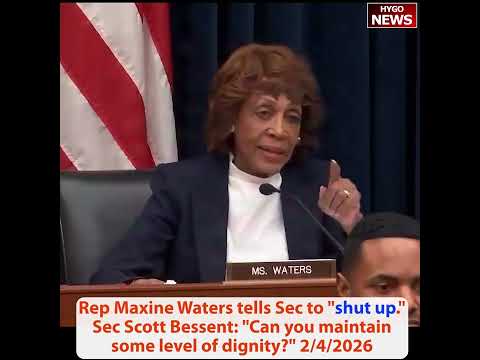
Rep Maxine Waters tells Bessent to “shut up”, Bessent: Can you maintain some level of dignity?
Treasury Secretary Scott Bessent endured a chaotic House Financial Services Committee hearing where Democratic lawmakers repeatedly interrupted him and told him to “shut up.” Representative Maxine Waters (D-CA), ranking Democrat, commanded Bessent to stop speaking when he tried to answer her questions. Bessent responded with a pointed “Can you maintain some level of dignity?” Bessent fact-checked Waters multiple times — on housing inflation (the 10-20 million Biden-era migrants drove housing cost surge), on lumber (at five-year low), and on tariffs (the San Francisco Federal Reserve’s 150-year data shows tariffs do not cause inflation). Representative Gregory Meeks (D-NY) came unglued, calling Bessent Trump’s “flunky.” Representative Ritchie Torres (D-NY) pressed whether Bessent would commit to ending tariffs on products without domestic substitutes or national security rationale — Bessent responded that would be “the definition of foolish in a negotiation.” Torres criticized tariffs on bananas, Bessent noted tariffs enabled leverage for broader negotiations with Colombia and Brazil. The hearing featured multiple moments where Democratic members refused to allow Bessent to answer their own questions, with Chairman ordering regular order repeatedly. Waters: “Can you shut up?” Bessent: “Can you maintain some level of dignity?” Bessent: “Adding 10-20 million new people demanding housing is what caused a great deal of housing inflation for working Americans — so you and the Biden administration should be ashamed.” Bessent to Torres: “That would be the definition of foolish in a negotiation.”
Waters “Shut Up”
Representative Maxine Waters (D-CA) commanded Bessent to stop speaking.
“Can you shut up? Look at the housing stock of working Americans.”
Waters cutting off the Treasury Secretary. A congresswoman telling a Cabinet secretary to “shut up” — extraordinary breach of professional decorum.
Bessent’s response was composed. “And can you maintain some level of dignity?”
The devastating counter. A request for basic professional behavior. Bessent elevating the exchange while Waters lowered it.
Time Expires
“Gentleman’s time has expired. On behalf of your gentleman, I take that as a no. You do not want to answer that question. I take that as a no.”
Waters framing Bessent’s attempted answer as refusal. The standard hostile-witness technique — interrupt, run time, then claim the witness refused to answer.
“For a seven billion, I’m asking you to do your responsibility as secretary of the Treasury. You do not. Mr. Mates, will you? The time has expired.”
Waters’ final sharp words as her time ran out.
Chair Intervention
“You cannot erase what you did in 2016. He’s the one that went past your time, Mr. Chairman. He did not answer my question. Order was made. He had six seconds left to try to answer your question. It was a yes or no answer.”
The chair — noting that Bessent had six seconds remaining when interrupted. The framework — Waters ran the clock by interrupting rather than Bessent running it by filibustering.
“I asked him, will he? No, it was a yes or no. The chair recognized this. The chairman recognized this. The chairman recognized this.”
Waters repeating her frustration.
Meeks Meltdown
Representative Gregory Meeks (D-NY) joined the attack.
“Stop covering for the president. Well, stop being his flunky.”
Meeks calling Bessent a “flunky” — a demeaning term for subordinate.
“And gentlemen, gentlemen. He’s talking to me. I’m responding to that 10,000 and six trip to Venezuela. Why don’t you stop covering for the president? Don’t be a flunky. Work for the American people.”
Meeks’ specific reference unclear — “10,000 and six trip to Venezuela” appears to be transcription artifact. The attack framework — Bessent as Trump’s flunky, Meeks as working for the people.
The reality — cabinet officials serve the president. Treasury Secretary is an executive branch position. Bessent’s job is implementing Trump’s agenda.
Venezuela Leverage
“Do you realize that we use the leverage to bring down terrorists from other countries to take down non-terrorist?”
The question garbled but the concept — tariff leverage to achieve non-trade policy objectives including counter-terrorism and regime pressure.
“Tariffs on bananas gave you leverage? Yes, with Columbia, with Brazil. I think congressmen, you’re being very naive with negotiating.”
The specific example. Tariffs on Colombian and Brazilian agricultural products (including bananas) provided leverage for:
- Colombian cooperation on drug enforcement
- Brazilian climate/deforestation compliance
- Trade concessions
- Diplomatic coordination on Venezuela
Bessent calling Democratic framework “naive with negotiating.” Democrats view tariffs narrowly as tax on imports. Bessent views them as multi-purpose leverage.
Banana Reindustrialization
“I mean, we were promised reindustrialization. A tariff on bananas did not lead to domestic banana production.”
Democratic critique — tariffs promised to bring manufacturing back, but banana tariffs don’t produce domestic bananas (climate makes domestic banana production non-viable).
“It simply made bananas more expensive for American businesses and consumers.”
“It has led to other countries negotiating in a more fulsome manner.”
Bessent’s response — banana tariffs were never intended to produce domestic bananas. They were intended as negotiating leverage. The leverage worked.
Torres Challenge
Representative Ritchie Torres (D-NY) pressed further.
“Are you willing to commit to no longer imposing tariffs on any product that has neither a domestic substitute nor a national security rationale?”
Torres’ proposal — limit tariffs to products with domestic substitutes or national security justification. No tariffs on bananas, coffee, other commodities America doesn’t produce.
“That would be the definition of foolish in a negotiation.”
Bessent’s blunt response — limiting tariff options would destroy negotiating leverage. Even tariffs on non-substituted products provide pressure.
The asymmetric negotiation framework — U.S. leverage through ability to tax anyone’s exports. Removing categories reduces leverage without strategic gain.
Investor Letter
Torres cited Bessent’s past.
“To investors raising concerns about the impact of tariffs, writing that quote, tariffs are inflationary. Did you say that at that time?”
Bessent had written to investors expressing concern tariffs would prove inflationary.
“Yes, and no. No. Okay. Thank you. Okay. We have a New York Times article that agrees that you said that.”
Bessent acknowledging the past position.
“Then last summer, when you testified before a Senate committee, you said in our quote, there is no inflation. Tariffs are not being passed on to consumers. You were quite definitive and even claim that critics had quote, tariff derangement syndrome.”
Torres pointing to Bessent’s later position — tariffs not being passed through to consumers.
“Well, those comments are at odds with the statement you made to investors that tariffs are inflationary.”
Torres framing this as contradiction.
Tariff Inflation Data
“Again, I want to be clear. So just let me ask you, are tariffs inflationary? Yes or no?”
“According to the San Francisco Federal Reserve with 150 years of data, tariffs do not cause inflation. San Francisco Federal Reserve Congress won.”
Bessent citing authoritative source — San Francisco Fed research examining 150 years of tariff and inflation data. The finding: tariffs do not cause inflation.
The historical pattern:
- Tariffs temporarily raise prices of imported goods
- Market adjusts through substitution or domestic production
- Overall inflation unaffected
- Revenue benefit to federal government
Bessent’s position evolved with data. His past letter reflected conventional economic thinking. Empirical data changed his view.
Coffee and Bananas
“Well, last November, as the Trump administration finally began to realize that affordability issues in America are not at hopes, you told Fox News that the government was going to reduce tariffs on goods like coffee and bananas. And that doing so would quote, bring the prices down very quickly.”
Torres pointing to Trump administration’s selective tariff reductions.
“Mr. Secretary, why was that announcement even necessary? If tariffs aren’t inflationary, and as you and the president like to say or paid for by foreign countries, a tariff on coffee or bananas shouldn’t raise the price of either for a more expensive country.”
Torres’ logical challenge — if tariffs don’t cause inflation and are paid by foreign countries, why reduce them to lower prices?
Bessent’s response (truncated from transcript) would likely argue:
- Specific commodity prices can temporarily reflect tariff pass-through
- Overall inflation unaffected (the Fed study)
- Selective reductions on imports lacking domestic substitutes produces price benefit without sacrificing negotiating leverage
- Political flexibility on specific commodities while maintaining broader tariff framework
Housing Inflation
Bessent’s bigger point on housing. “Adding 10-20 million new people demanding housing, Congresswoman, is what caused a great deal of housing inflation for working Americans.”
The Biden-era migration framework:
- Estimated 10-20 million new arrivals during Biden presidency
- Housing demand surged
- Supply remained constrained
- Home prices and rents inflated
- Working-class Americans priced out
“So you and the Biden administration should be ashamed.”
Bessent’s attack — Democratic housing inflation was policy-driven. Waters personally accountable.
Lumber Status
“Lumber is at a five-year low.”
Bessent noting lumber — five-year price low. The input cost for construction is down, supporting new home affordability.
“You don’t get to talk!!!”
Waters’ response to the fact check. Another “shut up” style interruption.
Significance
The hearing captured the Democratic tactical approach in oversight hearings — interrupt, shout, refuse to allow substantive answers, then claim witnesses refused to answer.
Bessent’s countervailing approach — remain composed, request dignity, cite data when possible, and let Democratic rudeness speak for itself.
The substantive wins for Bessent:
- Housing inflation connection to Biden migration
- San Francisco Fed data on tariff inflation
- Tariff leverage for non-trade objectives
- Lumber at five-year low
Maxine Waters telling a Treasury Secretary to “shut up” became the viral moment. The image of Democratic decorum collapsing — a cabinet member asked if she could maintain dignity — reinforced Republican framing of Democratic unfitness for governance.
Key Takeaways
- Waters to Bessent: “Can you shut up?” — Bessent response: “Can you maintain some level of dignity?”
- Bessent on housing: “Adding 10-20 million new people demanding housing, Congresswoman, is what caused a great deal of housing inflation for working Americans — so you and the Biden administration should be ashamed.”
- Bessent to Torres on tariff limitations: “Are you willing to commit to no longer imposing tariffs on any product that has neither a domestic substitute nor a national security rationale? That would be the definition of foolish in a negotiation.”
- Bessent on tariff inflation: “According to the San Francisco Federal Reserve with 150 years of data, tariffs do not cause inflation.”
- Bessent on banana tariffs: “Tariffs on bananas gave you leverage? Yes, with Columbia, with Brazil. I think congressmen, you’re being very naive with negotiating … It has led to other countries negotiating in a more fulsome manner.”