 HYGO News
 Resolution not support earmarks? But $9.8B earmarks: Democrats are getting $5.4B earmarks
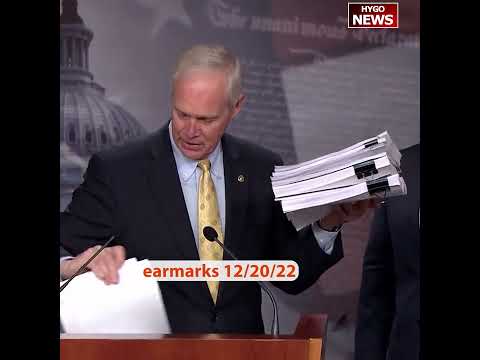
Senator: Omnibus Contains $9.8 Billion in Earmarks — Democrats Get $5.4B, Republicans $4B+ Despite Conference Resolution Against Them
On 12/22/2022, a Republican senator detailed the extensive earmarks contained in the omnibus spending bill and announced an amendment to eliminate them all. “The amendment that I’ll be asking for and that Senator Schumer agreed to last week would be to eliminate all the earmarks. And I’ve got my own prop here. So that’s the entire omnibus. This is the language on earmarks only,” the senator said, holding physical documents. “There are, let me get the exact numbers, $9.8 billion worth of earmarks. Thousands of individual projects here. Both Democrat and Republican, it’s an interesting note on the Republican side. We actually have a conference resolution that we don’t support earmarks. Well, we’re supporting over $4 billion worth, Democrats are getting $5.4 billion worth of earmarks.” The senator called earmarks “the gateway drug to the massive deficit spending, to the mortgaging of our children’s future.”
The Physical Prop
The senator used visual demonstration. “I’ve got my own prop here. So that’s the entire omnibus. This is the language on earmarks only,” the senator said.
The physical comparison:
Entire omnibus — 4,155 pages.
Earmarks-only language — Presumably substantial subset.
Visual impact — Showing scope.
Media-friendly — For clips and coverage.
Tangible criticism — Not just abstract.
Physical props in congressional remarks often serve to:
Make abstract concepts tangible — For audiences.
Generate media attention — With visual elements.
Demonstrate commitment — Through preparation.
Create memorable moments — For coverage.
Communicate scope — Through physical size.
The $9.8 Billion Total
The senator cited specific numbers. “There are, let me get the exact numbers, $9.8 billion worth of earmarks. Thousands of individual projects here,” the senator said.
The earmarks totaled:
$9.8 billion — Total value.
Thousands of projects — Many specific items.
Both parties — Getting allocations.
Individual provisions — Each with specific purpose.
Member-directed spending — Targeting home districts/states.
Earmarks had been controversial for decades:
Pre-2011 era — Regular earmarks, various abuses.
Ban period — 2011-2021.
Resumption — Under new rules.
2022 activity — Continued.
Current bill — Significant levels.
The modern earmarks had transparency requirements that previous versions had lacked:
Sponsor disclosure — Required.
Purpose disclosure — Required.
No member interest — Attestation.
Public posting — Online.
Specific procedures — For inclusion.
But earmarks remained controversial because they:
Allocated federal spending — To specific locations.
Bypassed competitive processes — For grants.
Served member political interests — Re-election.
Reduced merit-based spending — Among recipients.
Increased total spending — Arguably.
The Partisan Distribution
The senator detailed the distribution. “Democrats are getting $5.4 billion worth of earmarks,” the senator said.
The math:
$5.4 billion — Democratic earmarks. $4.4+ billion — Republican earmarks. $9.8 billion total — Combined. Majority advantage — Democrats slightly more.
Democrats in majority typically received larger shares. The distribution was:
Roughly proportional — To majority control.
Both parties participating — Despite criticism.
Bipartisan practice — In current system.
Individual member benefits — Crossing party lines.
Negotiated allocations — Through leadership.
The Republican Conference Resolution
The senator highlighted an irony. “On the Republican side, we actually have a conference resolution that we don’t support earmarks. Well, we’re supporting over $4 billion worth,” the senator said.
The Republican position had contradictions:
Conference resolution — Against earmarks.
Member behavior — Taking earmarks.
Leadership position — Varied.
Rank-and-file practice — Accepting allocations.
Stated values vs. actions — Disconnected.
This contradiction undermined Republican credibility on fiscal discipline. If the official party position was against earmarks but individual members continued taking them, the position was rhetorical rather than operational.
The contradiction reflected:
Individual incentives — Members wanted home funding.
Collective position — Against process.
Leadership tolerance — For member flexibility.
Reform pressure — Not sufficient.
Political realities — Dominated principles.
The “Gateway Drug” Framing
The senator used strong language. “This is the gateway drug to the massive deficit spending, to the mortgaging of our children’s future,” the senator said.
The “gateway drug” metaphor:
Addictive framing — Comparing to drug dependence.
Escalation warning — From small to large spending.
Children’s future — Emotional appeal.
Mortgaging — Borrowing against future.
Moral judgment — Beyond political.
The framing suggested:
Earmarks enable larger spending — By building coalitions.
Members support bigger bills — To get their earmarks.
Fiscal discipline erodes — Through process.
Precedent matters — For future decisions.
Reform must be fundamental — Not incremental.
Critics of earmarks argued that individual earmarks weren’t themselves problematic in isolation. The problem was how earmarks affected overall spending dynamics by:
Building coalitions — For larger packages.
Providing leadership leverage — Over members.
Trading specific for general — Local for national.
Reducing scrutiny — Of overall bill.
Encouraging logrolling — Mutual support.
The Schumer Agreement
The senator referenced agreement with Senate Majority Leader. “The amendment that I’ll be asking for and that Senator Schumer agreed to last week would be to eliminate all the earmarks,” the senator said.
Schumer’s agreement was limited:
Allowed amendment — Procedurally.
Not support for passage — Of amendment.
Typical practice — Allowing minority amendments.
Vote likely to fail — As amendments often did.
Process accommodation — Without substantive yielding.
The agreement to allow the amendment was a procedural concession, not a policy change. Schumer could allow the amendment to be offered while expecting it to fail on a vote. This was common Senate practice for managing minority concerns without substantive effect.
The Amendment’s Chances
The amendment to eliminate all earmarks faced predictable outcomes:
Needed 50+ votes — For passage.
Bipartisan opposition — Likely.
Leadership opposition — From both parties.
Member opposition — Protecting earmarks.
Conservative support — From fiscal hawks.
Democratic opposition — Mostly.
The amendment would likely fail by substantial margin. Most senators had specific earmarks in the bill they wanted protected. Voting for elimination would remove their own constituent benefits.
The Earmarks Debate History
The earmarks history was complex:
1990s-2000s — Growing controversy.
“Bridge to Nowhere” — Iconic example.
Transparency reforms — Various attempts.
2011 earmark ban — Implemented.
Gradual return — 2021-2022.
Current status — With transparency rules.
The reforms had addressed some abuses but not eliminated the fundamental concerns. Even transparent earmarks:
Targeted specific locations — Not competitive.
Served political purposes — Re-election focused.
Affected spending dynamics — Bipartisan support.
Bypassed normal processes — Grant competition.
Added to total spending — Incrementally.
The Fiscal Hawks’ Position
The senator’s position reflected fiscal hawk Republicans:
Fiscal discipline — Core value.
Process reform — Needed.
Earmarks opposition — Principled.
Individual member practice — Problematic.
Deficit focus — Over local benefits.
This position was consistent but politically difficult. Fiscal hawks faced pressure:
From constituents — Wanting benefits.
From colleagues — Seeking support.
From leadership — Wanting coalition.
From party — Needing unity.
From reality — Of appropriations.
Maintaining pure anti-earmark position while being effective legislator was difficult. Many fiscal hawks ended up accepting some earmarks while criticizing the system.
The Overall Bill Context
The earmarks were $9.8 billion out of $1.7 trillion total:
Small percentage — Less than 1%.
Still significant — $9.8 billion is substantial.
Political symbolism — Beyond fiscal impact.
Process concerns — Beyond amount.
Precedent implications — For future bills.
Focusing on earmarks could be criticized as:
Minor issue — Compared to total.
Symbolic opposition — Rather than substantive.
Distraction — From larger concerns.
Feasible target — Because small.
Member-focused — Rather than policy-focused.
Or defended as:
Principled stand — On process.
Feasible target — For reform.
Precedent matters — For future.
Fiscal discipline example — Starting point.
Symbolic importance — For principles.
The “Children’s Future” Framing
The “mortgaging our children’s future” framing was emotional:
Generational concern — About debt.
Moral responsibility — To future generations.
Current spending costs — Passed forward.
Interest burden — Accumulating.
Limited future flexibility — From debt.
This framing resonated with fiscal conservative audiences. Whether earmarks specifically affected “children’s future” was disputed, but the broader concern about federal debt was legitimate.
The U.S. federal debt had reached approximately $31 trillion by late 2022. Concerns about:
Interest payments — Growing.
Future constraints — On spending.
Generational equity — Burden transfer.
Economic stability — Long-term.
Political choices — Narrowing.
Were genuine. The senator’s specific earmarks focus was one aspect of broader debt concerns.
The Outcome
The amendment to eliminate earmarks predictably failed. The omnibus passed with earmarks included. The senator’s stand was recorded but didn’t change the outcome.
This pattern would continue. Individual senators objecting to specific provisions rarely succeeded in removing them when leadership of both parties supported the overall package. Reform would require more fundamental changes to process and dynamics.
Key Takeaways
- A Republican senator detailed that the omnibus contained $9.8 billion in earmarks across thousands of projects.
- Democrats received $5.4 billion; Republicans received over $4 billion, despite a Republican conference resolution against earmarks.
- The senator announced an amendment to eliminate all earmarks, with Schumer agreeing to allow the amendment vote.
- The senator called earmarks “the gateway drug to the massive deficit spending, to the mortgaging of our children’s future.”
- The contradiction between Republican conference resolution and member practice undermined party credibility on fiscal discipline.
- The amendment was likely to fail due to bipartisan member interest in protecting earmarks for their districts.
- The specific earmarks were small (less than 1%) relative to the $1.7 trillion total bill.
Transcript Highlights
The following is transcribed from the video audio (unverified — AI-generated from audio).
- The amendment that I’ll be asking for and that Senator Schumer agreed to last week would be to eliminate all the earmarks.
- That’s the entire omnibus. This is the language on earmarks only.
- There are, let me get the exact numbers, $9.8 billion worth of earmarks. Thousands of individual projects here.
- On the Republican side, we actually have a conference resolution that we don’t support earmarks.
- Well, we’re supporting over $4 billion worth, Democrats are getting $5.4 billion worth of earmarks.
- This is the gateway drug to the massive deficit spending, to the mortgaging of our children’s future.
Full transcript: 138 words transcribed via Whisper AI.