 HYGO News
 Rep. Summer Lee: 'Black Millionaires Qualify for Reparations Too -- No Slave Ancestry Needed'; Buttigieg: 'MS-13 Member Isn't a Criminal'; Hillary Flip
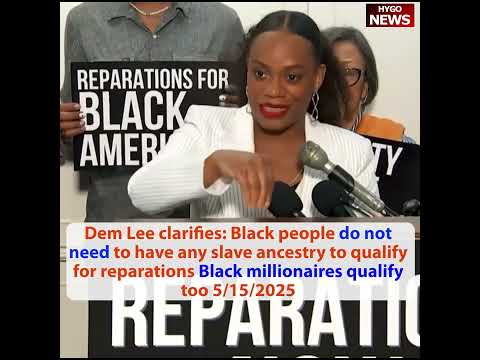
Rep. Summer Lee: “Black Millionaires Qualify for Reparations Too — No Slave Ancestry Needed”; Buttigieg: “MS-13 Member Isn’t a Criminal”; Hillary Flip
Multiple Democratic positions converged in May 2025. Rep. Summer Lee clarified her reparations bill: “Whether a Black American was able to break into the middle class or not, they are not excluded from reparations. Black millionaires qualify. It doesn’t matter as to what economic level.” 1.4 million illegal immigrants remained on Medicaid, with Democrats opposing Trump’s removal efforts — despite Hillary Clinton on tape saying: “We certainly don’t want [illegals] having the same benefits that American citizens are entitled to have.” Pete Buttigieg launched his shadow 2028 campaign defending Kilmar Abrego Garcia: “No one person gets to decide that you’re a criminal.” Rep. Yassamin Ansari introduced the Persian Gulf Act to prohibit renaming to “Arabian Gulf.” Al Green filed another impeachment resolution — “nobody noticed."
"Black Millionaires Qualify Too”
Rep. Summer Lee (D-PA) offered remarkable clarification on the reparations bill’s scope.
“Exactly what does your resolution really aim for?” an interviewer asked. “Is it that Black Americans of a certain economic level are being targeted? Is it everyone?”
Lee was direct: “Basically, it doesn’t matter as to what economic level. It’s pretty much all Black Americans.”
The interviewer pressed on lineage: “What about those individuals of any race that have a lineage going back to slave America?”
Lee was clear: “It doesn’t matter.”
She explained the logic: “Whether or not a Black American — a Black descendant of American chattel slavery — was able to break into the middle class, they are still — and they were able to do that despite the harms, despite the passing injustices done to them. So they are not excluded from the reparation and the remedies therein.”
She rejected the ancestry requirement: “When we think about who traces their lineage back, that is again a debate that is used to try to silence the rest of this movement. It’s a distraction tactic.”
She explained the reasoning: “If they are descendants of Jim Crow policies in this country, they are the direct descendants and current living recipients of that harm.”
She expanded the grievances: “If they are living today, then we are still harmed by inequitable funding schemes of public schools. We’re still harmed by being Black or brown or poor and living nearer to environmental hazards. If you are Black in this country right now, you are still less likely to be able to acquire a loan. The interest rates are still higher. We are still discriminated because of our hair, because of our names.”
Lee’s clarifications were politically devastating for the reparations argument. The traditional case for reparations had rested on compensating specifically for slavery — descendants of American slaves receiving payments as restitution for the uncompensated labor of their ancestors. Lee was explicitly rejecting this framework.
Under Lee’s definition:
- A Black immigrant from Nigeria who arrived last year would qualify
- A Black millionaire CEO would qualify equally with a poor Black American
- A Black person without any documented slave ancestry would qualify
- A white descendant of American slaves would not qualify
This transformed the reparations proposal from compensation for specific historical harm into race-based wealth transfer regardless of individual circumstances. It made the bill explicitly about race rather than about slavery’s consequences.
The political problem was obvious. Most Americans supported some form of reparations in theory when framed as compensation for specific historical injustices. Support collapsed when the framing shifted to race-based payments to wealthy individuals without demonstrable connection to slavery. Lee’s clarification moved the proposal from the first framing (where it had some political viability) to the second (where it had almost none).
1.4 Million on Medicaid
The Medicaid illegal immigrant enrollment story continued.
The narrator noted: “There are 1.4 million illegal immigrants on Medicaid — and Democrats are trying to stop President Trump from fixing it.”
The video then cut to archival Hillary Clinton footage: “As to illegal aliens, we agree with you that we do not think the comprehensive health care benefits should be extended to those who are undocumented workers and illegal aliens.”
Clinton continued: “We do not want to do anything to encourage more illegal immigration into this country. We know now that too many people come in for medical care as it is. We certainly don’t want them having the same benefits that American citizens are entitled to have.”
The Hillary flip was politically devastating. In the clip, Clinton — speaking during her Senate tenure — articulated precisely the position Trump was now implementing. No comprehensive health care for illegal immigrants. No benefits equivalent to American citizens. No incentives for illegal immigration via medical benefits.
This had been standard Democratic position well into the 2010s. The shift to supporting taxpayer-funded health care for illegal immigrants was recent, reflecting the progressive wing’s takeover of Democratic immigration policy. Hillary Clinton’s earlier statement revealed how radically the party had shifted in less than two decades.
The 1.4 million figure was also significant. This was the specific number of illegal immigrants enrolled in Medicaid programs that DOGE had identified. Under Trump’s executive actions, federal Medicaid funding for these enrollees was being terminated, forcing states to either remove them from Medicaid or cover the costs through state-only funds.
California Governor Gavin Newsom had already announced he would remove illegal immigrants from California Medicaid rather than cover the cost through state funds. This confirmed what Trump had predicted: state Democrats would acknowledge reality when confronted with actual fiscal choices, even while national Democrats continued advocating for universal immigrant benefits.
Buttigieg Launches 2028 Campaign
Former Transportation Secretary Pete Buttigieg kicked off his 2028 presidential campaign with an illegal immigration defense.
At a Cedar Rapids town hall, Buttigieg was asked about criminal illegal aliens like Kilmar Abrego Garcia.
Buttigieg responded: “They’re saying like, ‘Oh, this guy, you know, he’s a criminal.’ The whole point is that no one person, least of all no one politician, gets to decide that you’re a criminal.”
He invoked process: “Who decides? We have a process. We have laws. That’s what due process is.”
He drew the conclusion: “You’re not a criminal because the head of the government of the country you live in says you’re a criminal.”
The response was factually absurd on multiple levels.
First, Garcia had in fact been adjudicated through the legal process. A federal judge had ordered him deported in 2019. Two separate judges had confirmed his MS-13 membership. The legal process had produced the conclusion that Garcia was a dangerous criminal who should be removed from the United States.
Second, the base premise — that Trump was unilaterally labeling people criminals — was false. The administration was enforcing existing immigration law against individuals who had been lawfully ordered deported. These were not Trump’s personal designations; they were court-adjudicated removals.
Third, Garcia’s specific conduct was criminal regardless of the adjudication:
- Illegal entry into the United States (a crime)
- Human trafficking (eight passengers in his vehicle during 2022 traffic stop)
- Alleged domestic violence (protective orders from his wife)
- MS-13 membership (designated foreign terrorist organization)
Buttigieg’s response was a masterclass in using procedural language to avoid substantive engagement. “Due process” was his shield against having to acknowledge the factual record about Garcia. The rhetorical positioning was that the administration was abusing power by applying labels, when in fact the administration was applying the conclusions that the legal system itself had already reached.
Persian Gulf Act
Rep. Yassamin Ansari (D-AZ) introduced legislation on naming.
“As the first Iranian-American Democrat elected to Congress, I can tell you that the Persian community in the United States and across the world is outraged at the attempt to change this historically significant name,” Ansari said.
She announced the legislation: “That is why today I am proud to introduce the Persian Gulf Act to prohibit any federal funds from being used to rename the body of water and prevent government documents from referring to the Persian Gulf by anything except the name.”
She concluded: “As Donald Trump acts only for himself, I will continue fighting against his corruption and for the American government.”
The Persian Gulf renaming question reflected the same dynamic as the Gulf of America renaming. Arab states — particularly Saudi Arabia and the UAE — had long preferred “Arabian Gulf” as the name of the body of water between the Arabian Peninsula and Iran. Iran — the heir to the Persian Empire — insisted on “Persian Gulf” as the historical and correct name.
The Trump administration had reportedly considered using “Arabian Gulf” or “Gulf of Arabia” in federal documents, particularly given the warm Gulf Arab relationships being developed during the Middle East trip. Ansari’s legislation would prevent such a change by prohibiting federal funds from being used for the renaming.
The political dynamics were interesting. Ansari was an Iranian-American Democrat; her primary concern was preserving an Iranian-friendly name. The Trump administration’s instinct was to prioritize relationships with Arab allies over the Iranian regime’s preferences. This created an opportunity for Ansari to legislate against a Trump priority.
Al Green Impeachment
Al Green filed another impeachment resolution.
“Al Green just filed impeachment articles, and nobody noticed,” the video narrator observed.
Green was heard: “Bringing to the attention of everyone, the countdown to impeachment, the countdown begins tonight.”
The “countdown to impeachment” would extend indefinitely, given that impeachment had no chance of passing the Republican-controlled House. Green had introduced similar resolutions during Trump’s first term before the Ukraine phone call that led to the actual impeachment, and was now continuing the pattern during the second term.
The fact that “nobody noticed” the new filing reflected the political reality. Symbolic impeachment resolutions from individual Democrats had become so routine that they no longer generated news coverage. They were filed for the symbolic act, entered into the Congressional Record, and then essentially disappeared. Without Republican cooperation to advance them, they accomplished nothing beyond allowing individual members to say they had introduced them.
Key Takeaways
- Rep. Summer Lee clarified: “Black millionaires qualify for reparations too. It doesn’t matter the economic level or whether they have slave ancestry.”
- Hillary Clinton on tape (pre-flip): “We certainly don’t want [illegals] having the same benefits that American citizens are entitled to have.”
- 1.4 million illegal immigrants on Medicaid; Newsom removing California’s after losing federal funding.
- Buttigieg launches 2028 campaign defending MS-13 member: “No one person gets to decide you’re a criminal” — ignoring that judges already had.
- Rep. Ansari introduced Persian Gulf Act to prevent Trump from using “Arabian Gulf” in federal documents.