 HYGO News
 Rep. Al Green Files H.Res.415 to Impeach Trump: 'Supreme Court Can't Stop Him, Republicans in House and Senate Won't Stop Him -- Congressional Court of Last Resort'; 'Authoritarian President Flouting Federal Court Orders, Separation of Powers, Due Process'; De Facto Dictator Framing
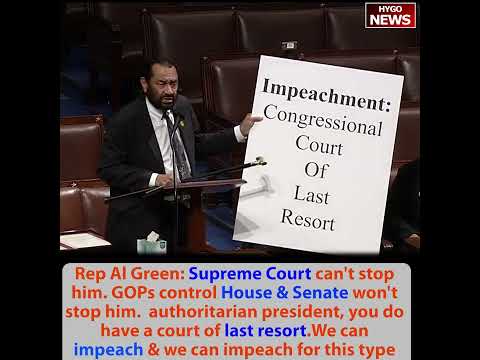
Rep. Al Green Files H.Res.415 to Impeach Trump: “Supreme Court Can’t Stop Him, Republicans in House and Senate Won’t Stop Him — Congressional Court of Last Resort”; “Authoritarian President Flouting Federal Court Orders, Separation of Powers, Due Process”; De Facto Dictator Framing
Rep. Al Green (D-TX) filed H.Res.415 in June 2025 to impeach President Trump, delivering impassioned House floor remarks. Green: “Supreme Court can’t stop him. Republicans who control the House and Senate won’t stop him. We have an authoritarian president. And when you have an authoritarian president, you do have a court of last resort. The Constitution, Article II, Section 4 of the Constitution, makes it explicitly clear that we can impeach, and we can impeach for this type of behavior, not in these exact words. Uses language that we are all familiar with, high crimes or misdemeanors, treason, bribery.” On the procedural framework: “Impeachment, and this congressional court of last resort is within the power of all 435 members of the House. Because the congressional court of last resort has to have a prosecutor. Any one of the 435 can become the prosecutor once you see that impeachable actions are taking place.” Green’s press release charged Trump with “condoning the flouting of federal court orders, flouting the separation of powers, undermining the independence of the federal judiciary, and flouting the constitutional mandate of due process - devolving our democracy into a de facto dictatorship with himself as the de facto dictator.”
The Al Green Impeachment Framework
Rep. Al Green’s approach to impeachment was characteristic and historic.
Green’s pattern:
- Previously filed impeachment articles against Trump 2017-2019
- Never succeeded in moving impeachment
- Considered outside Democratic mainstream
- Symbolic rather than strategic action
- Consistent advocacy
This filing (H.Res.415):
- New impeachment effort
- Specific substantive allegations
- Call for congressional action
- Appeal to broader Democratic coalition
- Activist-oriented approach
Why this mattered politically:
- Democratic Party strategic choice
- Embrace or distance from Green
- Signal to base
- Signal to moderates
- Political calculation
The Core Argument
Green’s floor speech laid out his reasoning.
“Supreme Court can’t stop him,” Green said.
He continued: “Republicans who control the House and Senate won’t stop him.”
He made the central claim: “We have an authoritarian president.”
He described the remedy: “And when you have an authoritarian president, you do have a court of last resort.”
He cited constitutional authority: “The Constitution, Article II, Section 4 of the Constitution, makes it explicitly clear that we can impeach, and we can impeach for this type of behavior, not in these exact words.”
He referenced the language: “Uses language that we are all familiar with, high crimes or misdemeanors, treason, bribery.”
The “Authoritarian President” Claim
Green’s characterization was politically charged.
What Green claimed:
- Trump was authoritarian
- Defied courts
- Didn’t respect separation of powers
- Demeaned judiciary
- Devolving democracy into dictatorship
The factual questions:
- Had Trump actually defied court orders?
- In what specific cases?
- With what consequences?
- Under what interpretation?
- With what evidence?
The underlying issue:
- Trump administration had followed court orders
- Had appealed unfavorable rulings
- Had sought reversals through legal process
- Had used constitutional mechanisms
- Not defying, but challenging
The Democratic framing:
- Challenges to court rulings = defiance
- Criticism of judges = attacks on judiciary
- Policy disagreements = constitutional violations
- Political speech = authoritarian behavior
- Standard presidential conduct = dictatorship
Article II, Section 4
Green’s constitutional citation was correct but limited.
Article II, Section 4: “The President, Vice President, and all civil Officers of the United States, shall be removed from Office on Impeachment for, and Conviction of, Treason, Bribery, or other high Crimes and Misdemeanors.”
Historical impeachments:
- Andrew Johnson (1868) - acquitted
- Richard Nixon (1974) - resigned before impeachment
- Bill Clinton (1998) - acquitted
- Donald Trump (2019) - acquitted
- Donald Trump (2021) - acquitted
The standards:
- “High Crimes and Misdemeanors” broadly defined
- Political as well as legal concept
- Requires House majority to impeach
- Requires 2/3 Senate to convict
- Practically very difficult
Why Green’s effort would fail:
- Republican House majority
- Republican Senate majority
- Would require bipartisan support
- Democratic Party not unified
- Political rather than legal action
The Specific Articles
Green’s press release listed allegations.
“Condoning the flouting of federal court orders”:
- What was alleged: Trump ignoring court rulings
- Actual conduct: Administration contested rulings through legal process
- Specific cases cited: Various immigration rulings, tariff rulings
- Trump’s actual approach: Appeal and seek reversal
- Different from “condoning flouting”
“Flouting the separation of powers”:
- What was alleged: Executive branch overreach
- Actual conduct: Normal executive authority
- Specific cases: Executive orders, policy decisions
- Trump’s actual approach: Constitutional authority claimed
- Different from “flouting”
“Undermining the independence of the federal judiciary”:
- What was alleged: Attacks on judges
- Actual conduct: Criticism of specific rulings
- Specific cases: Specific ruling critiques
- Trump’s actual approach: Public disagreement
- Different from “undermining independence”
“Flouting the constitutional mandate of due process”:
- What was alleged: Deportation procedures
- Actual conduct: Administrative due process
- Specific cases: Illegal immigrant deportation
- Trump’s actual approach: Existing legal framework
- Different from “flouting”
The Impeachment Framework
Green laid out the procedural structure.
“With such an authoritarian president, impeachment, impeachment, and this congressional court of last resort is within the power of all 435 members of the House.”
He described the process: “Because the congressional court of last resort has to have a prosecutor. A prosecutor, any one of the 435 can become the prosecutor once you see that impeachable actions are taking place.”
He continued: “Any one of us can become the prosecutor. The prosecutor will have what we will have called the equivalent of a grand jury. That will be the rest of the members of the House of Representatives.”
He specified flexibility: “435 of us, some of us can act as prosecutors. Doesn’t have to be one, can be more than one, can be many. As many as would want to sign a resolution to impeach.”
The “Congressional Court of Last Resort”
Green’s framing was rhetorically interesting.
What Green was saying:
- Courts can’t constrain Trump
- Republicans won’t constrain Trump
- Democrats must use impeachment
- Congress = final option
- Last defense of democracy
Why this was problematic:
- Impeachment isn’t automatic court substitute
- Requires bipartisan support to succeed
- Political rather than legal
- Limited Democratic minority power
- Essentially symbolic
The “court of last resort” framing:
- Suggests Democrats had been “first resort” courts failed
- Implies some hierarchy of redress
- Treats partisan impeachment as neutral remedy
- Uses judicial language for political act
- Rhetorical strategy
The practical reality:
- Green’s resolution had no chance of passage
- Democratic minority too small
- No Republican support
- Symbolic action
- Political messaging rather than genuine impeachment
The Prosecutorial Metaphor
Green’s “prosecutor” framing was notable.
The analogy Green drew:
- Member of Congress = prosecutor
- House of Representatives = grand jury
- Senate = trial court
- Evidence = impeachment articles
- Verdict = conviction or acquittal
Why this was misleading:
- Impeachment isn’t criminal prosecution
- Political process distinct from legal
- Different standards of evidence
- Different burdens of proof
- Different consequences
What impeachment actually is:
- Political mechanism for removing officials
- Not criminal prosecution
- Doesn’t require proof beyond reasonable doubt
- Requires political rather than legal judgment
- Political consequence is removal from office
Why the distinction matters:
- Legal framing suggests objectivity
- Political reality is partisan
- Standards differ dramatically
- Language shapes public perception
- Democratic rhetoric strategic
The “De Facto Dictator” Charge
Green’s “de facto dictator” framing was extreme.
What “de facto dictator” means:
- Exercises dictatorial power in practice
- Not formally a dictator
- Actually operating as one
- Despite constitutional framework
- Effective dictatorship
Why this was substantively wrong:
- Trump faced real constraints
- Courts had ruled against him multiple times
- Congress had opposed his agenda
- Media was hostile
- Elections remained competitive
The specific constraints Trump faced:
- Democratic minority in Congress
- Hostile media coverage
- Multiple court rulings against him
- Legal challenges ongoing
- Public criticism
What actual dictatorship looks like:
- No free press
- Political opposition imprisoned
- Elections rigged or abolished
- Courts serving ruler
- No meaningful dissent
The false equivalence:
- Trump pursuing constitutional authority ≠ dictatorship
- Winning elections ≠ dictatorship
- Executive orders ≠ dictatorship
- Policy disagreement ≠ authoritarianism
- Democratic rhetoric exaggerated
The Broader Democratic Response
The Democratic Party had to respond to Green’s action.
Democratic leadership position:
- Didn’t endorse Green’s articles
- Didn’t bring resolution to floor vote
- Preferred legal strategies
- Focused on 2026 midterms
- Strategic distancing
Why leadership didn’t endorse:
- Recognized futility of effort
- Avoided appearing extreme
- Focus on achievable goals
- Didn’t want Green attention
- Political calculation
The progressive base response:
- Supported aggressive action
- Wanted symbolic victory
- Frustrated with inaction
- Energized by confrontation
- Demanding bold steps
The political tension:
- Base wanting more aggression
- Leadership fearing overreach
- Green caught between
- Symbolic action without consequences
- Internal Democratic conflict
The Rhetorical Escalation
Green’s approach represented rhetorical escalation.
The pattern:
- Ordinary political disagreements
- Characterized as constitutional crises
- Routine executive actions as dictatorship
- Legal process as flouting
- Normal politics as authoritarian
Why this pattern was problematic:
- Desensitizes audience
- Undermines legitimate criticism
- Makes real crises harder to identify
- Polarizes political environment
- Damages constitutional discourse
The comparison problem:
- If Trump is dictator, what is actual dictator?
- If current politics is crisis, what is actual crisis?
- If routine actions are authoritarian, what is actual authoritarianism?
- Rhetorical inflation without substance
- Discourse degradation
The Political Positioning
Green’s action served specific political purposes.
For Green specifically:
- Maintained progressive credentials
- Energized base supporters
- Generated media attention
- Signaled political identity
- Built progressive reputation
For Democratic Party:
- Provided symbol for base
- Without requiring leadership commitment
- Allowed distance if needed
- Created optics of opposition
- Avoided actual political cost
For Republican narrative:
- Confirmed Democratic extremism
- Demonstrated party fracturing
- Supported “Democrats unhinged” framing
- Helped Republican political messaging
- Provided political fodder
The Constitutional Framework
Green’s impeachment effort raised constitutional questions.
What the Constitution provides:
- Impeachment mechanism (Article II, Section 4)
- Requires specific charges
- Requires House majority to impeach
- Requires Senate 2/3 to convict
- Political rather than legal process
What Green’s effort lacked:
- Specific criminal conduct
- Bipartisan support
- Realistic chance of success
- Substantive legal basis
- Strategic political framework
Why it was constitutionally problematic:
- Normalized impeachment for political reasons
- Reduced impeachment to political theater
- Undermined constitutional importance
- Established problematic precedent
- Damaged institutional credibility
The Historical Context
Recent impeachment history informed the analysis.
Trump 2019 impeachment:
- Specific allegations (Ukraine)
- Substantive investigation
- House action
- Senate acquittal
- Politically polarizing
Trump 2021 impeachment:
- January 6 events
- Emergency response
- House action
- Senate acquittal
- Historical significance
The pattern:
- Democrats impeaching Trump three times now
- Never succeeded in conviction
- Normalizes impeachment
- Diminishes institutional gravity
- Political weaponization
Why this mattered:
- Impeachment originally intended for serious misconduct
- Repeated impeachment normalizes as tool
- Politicized historical process
- Constitutional mechanism degraded
- Institutional damage
The Strategic Failure
Green’s approach was likely to fail.
Why it would fail:
- Republican House majority
- Republican Senate majority
- No bipartisan support
- Democratic leadership ambivalent
- Base-only appeal
What would happen:
- Resolution introduced
- Possibly debated
- Probably tabled or defeated
- Symbolic rather than substantive
- No actual consequence
The political cost:
- Democrats appear extreme
- Moderate voters alienated
- Electoral calculation hurt
- Media attention mixed
- Polarization increased
The missed opportunity:
- Could have focused on policy
- Could have built coalitions
- Could have proposed alternatives
- Could have engaged substantively
- Instead pursued symbolic action
The Contrast with Serious Opposition
Substantive opposition to Trump would look different.
What serious opposition would do:
- Build Democratic policy alternatives
- Engage with Republican moderates
- Focus on specific policy disagreements
- Use traditional legislative tools
- Work within system
What Green’s approach did:
- Rejected normal politics
- Bypassed legislative process
- Made symbolic gestures
- Burned political capital
- Achieved nothing substantive
The substantive opposition would include:
- Detailed policy alternatives
- Coalition building
- Legislative engagement
- Strategic patience
- Focus on achievable outcomes
Green’s approach represented:
- Political theater
- Symbolic protest
- Base mobilization
- Media attention
- Little actual influence
Key Takeaways
- Rep. Al Green files H.Res.415 to impeach Trump: “Supreme Court can’t stop him. Republicans won’t stop him.”
- “Congressional court of last resort” framing — any of 435 House members can be “prosecutor.”
- Charges: Flouting court orders, separation of powers, judicial independence, due process.
- “De facto dictator” characterization — rhetorically extreme, substantively unsupported.
- Effort virtually certain to fail given Republican majority; symbolic rather than substantive action.