 HYGO News
 Tara Palmeri Exposes Dem-to-Republican Convert Lindy Li: 'She Had Nothing Unique -- Just Photos and Me, Me, Me'; Political Entertainment Complex
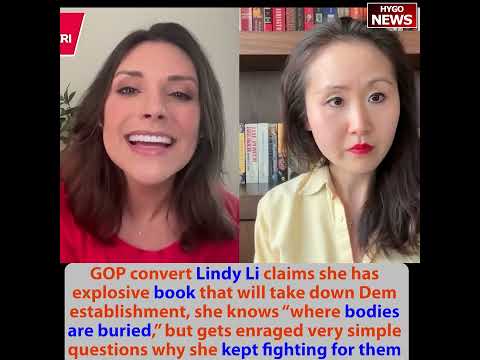
Tara Palmeri Exposes Dem-to-Republican Convert Lindy Li: “She Had Nothing Unique — Just Photos and Me, Me, Me”; Political Entertainment Complex
Journalist Tara Palmeri dissected Democrat-turned-Republican convert Lindy Li in May 2025, revealing a pattern that transcended Li specifically. Li had claimed to have explosive revelations about Biden’s decline and knowledge of “where the bodies are buried.” Palmeri explained: “She claimed firsthand knowledge, but when I asked what was unique, she said, ‘It’s about me, me, me, me. I have firsthand knowledge.’ But she talked to Valerie Biden and Ashley — all secondhand information.” When Palmeri pressed why Li had campaigned for the party she was now attacking, Li responded: “Politics is my entire life. What do I do without politics? Are you asking me to change my profession?” Palmeri’s assessment: “The story of Lindy Li is bigger than her — it’s about a particular type of person who can thrive in the political entertainment complex.”
The “Receipts” Question
Palmeri approached the interview with genuine curiosity, not a predetermined takedown.
“I actually just went into it thinking, ‘Well, who is she?’ because I’d never heard of her before,” Palmeri said. “She claims she has firsthand knowledge and access to what I think is clear to anyone — that there was a cover-up of Biden’s condition and an attempt to run him even though he wasn’t able to.”
She acknowledged partial credibility: “So she had some shreds of truth in it. But anyone could say that now.”
She asked the essential question: “What kind of information do you have that’s unique that isn’t already in the public domain right now?”
The answer revealed the problem: “She didn’t have anything unique to say.”
Palmeri continued: “She said that her book was being turned into a movie, which I found to be very hard to believe. It wasn’t being had in publish yet.”
She described the interview dynamic: “As I started talking to her, I just kept noticing little holes in her story, and I poked at it. And just the slightest poke caused an eruption and an outrage that I would dare question her narrative.”
The “receipts” claim was the critical weakness. Li had publicly positioned herself as someone with proof — documentary evidence of Democratic Party malfeasance, detailed knowledge of the Biden cover-up, insider information unavailable elsewhere. When pressed by a serious journalist, she had no specific evidence to present. She had photographs of herself with Biden and Harris — taken as a donor who had “raised money for the party” and been given access in exchange.
”About Me, Me, Me”
Palmeri captured Li’s self-focus in a single quote.
“I asked why is your story so unique from the many other stories that are out there about Biden and this period of time?” Palmeri recounted. “And she said, ‘It’s about me. It’s about me, me, me, me. I have firsthand knowledge.’”
Palmeri provided context: “She said, ‘I talked to the president’s sister Valerie Biden. I talked to Ashley. I have this.’ And they’re all on secondhand information.”
Palmeri’s follow-up question: “What is that information?”
The answer: “Nothing.”
The “me, me, me” self-centering was the telltale sign of a narrative built more on personality than on substance. Serious whistleblowers — people with genuine knowledge of wrongdoing — typically focused on the wrongdoing itself. Li’s pattern was the opposite: she focused on her role, her access, her journey, her importance. The actual information was vague; the narrative about herself was detailed.
The claim that Li had talked to “Valerie Biden” and “Ashley” (the former president’s sister and daughter-in-law respectively) was itself suspect. Even if those conversations had occurred, they would constitute secondhand information about Biden’s condition — relatives sharing impressions rather than medical assessments. Li was attempting to claim insider access that, on examination, was no more privileged than any donor or campaign volunteer would have experienced.
”Politics Is My Entire Life”
Perhaps the most revealing exchange concerned Li’s career.
Palmeri pressed on the consistency question: “You worked for the campaign.”
Li deflected: “I didn’t have a choice because I was a nobody. Has to work. You’re not getting it. Politics is my entire life.”
Palmeri persisted: “What do I do without politics?”
Li responded: “You don’t believe you’re doing — like should I become a teacher or something? Are you asking me to change my profession?”
Palmeri stated the principle: “I actually think that if you’re going to stand up and speak for other people as a surrogate, if you’re going to work for a campaign, and now you’re going to come out with a book — like, you should believe in what you’re saying. If you didn’t believe in it, then how are we supposed to believe you now?”
Li’s response was defiant: “This is my truth. Take it or leave it. I don’t need you, Tara Palmeri. I don’t need you to believe me. This is just my truth, and I have the receipts.”
The “politics is my entire life” admission was revealing. Li had campaigned for Biden and Harris not because of policy conviction but because it was her career. She now attacked Biden and Harris not because of a revelation about their unfitness but because the career incentives had shifted. Under Trump, criticizing Democrats was more profitable than supporting them.
The “should I become a teacher” deflection was telling. Li’s framing — that the only alternative to campaigning for Democrats was changing careers entirely — revealed a worldview in which consistent political convictions were not required, merely political employment. The conviction followed the employment, not the other way around.
”Political Entertainment Complex”
Palmeri placed Li in a broader phenomenon.
“The story of Lindy Li is bigger than her,” Palmeri said. “It’s about a particular type of person who can thrive in the political entertainment complex.”
She described the dynamic: “When she walks on the set of these — what I would call political entertainment shows — at this point, she is not questioned. She is like, ‘I’m going to burn down the establishment. I know where the bodies are buried’ — these vague platitudes. Calling the Democratic Party a cult. And there’s no facts to back it up. But she says, ‘I have receipts.’ There are no receipts.”
She clarified her position: “I am in no way trying to give the party a pass for this. I think that what happened with Biden is completely separate than what Lindy Li’s narrative now is.”
She cited the specific evidence: “Jamie Harrison, who is the head of the Democratic National Committee — he put forward a tweet last night showing Lindy Li in October 2024, just days before her conversion after Election Day 2024, asking to get on the photo line at an event with the vice president.”
She described the transformation: “She had a lot of pictures with the president and the vice president because she raised money for the party. And when you do that, you’re allowed into the White House and you get to take pictures. But she turned those pictures — and claims of a cover-up which happened — into a story that was all about her.”
The “political entertainment complex” framing captured a genuine phenomenon. Cable news, podcast networks, and streaming platforms had created a vast ecosystem of political commentary that rewarded controversy over accuracy. Personalities who could deliver strong takes — whether substantiated or not — earned regular bookings, book deals, and social media followings. The incentive structure favored confident claims over evidence-based analysis.
Li had found a niche in this ecosystem as a “recovering Democrat” who could denounce her former party from inside credibility. Her actual knowledge was thin, but her performance was compelling. As long as interviewers didn’t press for specifics, the narrative worked.
Key Takeaways
- Palmeri to Li: “What kind of information do you have that’s unique?” Li: “It’s about me, me, me, me.” Actual unique information: nothing.
- Li had campaigned for Biden/Harris. On consistency: “Politics is my entire life. Are you asking me to change my profession?”
- Jamie Harrison tweeted photos of Li asking for a VP photo line in October 2024 — days before her Republican “conversion.”
- Palmeri: “She claims she has receipts. There are no receipts.”
- The broader pattern: “The political entertainment complex rewards people who deliver strong takes without substance.”