 HYGO News
 Q: Record high, for 18 months you've said 'We're working on it' A: we have indeed executing on plan
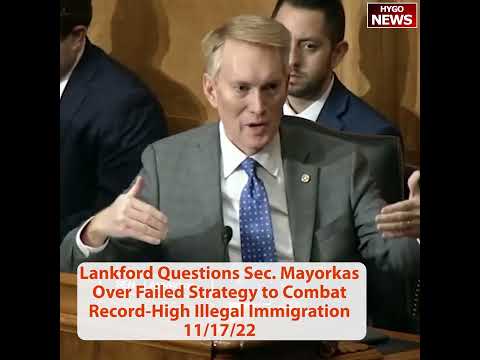
Senator: “For 18 Months You’ve Said ‘We’re Working On It’” — Mayorkas Has No Plan for Post-Title 42 Border Surge
On 11/20/2022, a senator confronted Department of Homeland Security Secretary Alejandro Mayorkas with a devastating timeline. “I’ve asked you the question: What happens when Title 42 goes away, and for 18 months you’ve said ‘we’re working on it,’” the senator said. Then came the urgent update: “Well, Judge Sullivan just stepped in and unilaterally canceled out Title 42.” The senator highlighted the administration’s contradictory legal positions — asking one court to extend Title 42 while asking another to cancel it. He demanded to know the plan for dealing with the expected mass migration once Title 42 ended. Mayorkas responded by citing a 35-day “orderly wind-down” the administration had requested, then claimed “we have indeed been executing on” a plan announced in April — a plan the senator was pointing out had not in fact prepared the country for the end of Title 42.
”For 18 Months You’ve Said ‘We’re Working on It’”
The senator’s framing captured months of frustration with Mayorkas. “I’ve asked you the question what happens when Title 42 goes away and for 18 months you’ve said we’re working on it,” the senator said.
Title 42 was the pandemic-era public health order that allowed Border Patrol to quickly expel migrants without standard asylum processing. It had been used by both the Trump and Biden administrations to manage border encounters during COVID-19. As the public health emergency wound down, legal challenges to Title 42 were mounting, and the Biden administration was facing the prospect of returning to normal asylum procedures at a time when border encounters were already at all-time highs.
The “18 months” timeframe was pointed. It represented the period during which the senator had been asking specific questions about the post-Title 42 contingency plan. For a year and a half, Mayorkas had responded with variations of “we’re working on it” — without ever producing a concrete, specific plan that could be evaluated by Congress or the public.
The “working on it” language was itself a problem. It implied continuous effort without committing to any particular outcome or timeline. A plan that was perpetually “being worked on” was one that could never be completed, evaluated, or held accountable. It was bureaucratic purgatory disguised as active engagement.
”Judge Sullivan Just Stepped In”
The senator then delivered the urgent update. “Well, Judge Sullivan just stepped in and unilaterally canceled out Title 42,” the senator said.
Judge Emmet Sullivan of the U.S. District Court for the District of Columbia had ruled on November 15, 2022, that Title 42 was unlawful — specifically, that the CDC had exceeded its authority by using public health powers to conduct what amounted to immigration enforcement. Sullivan’s ruling ordered Title 42 to end, though he later granted the administration’s request for a 35-day implementation delay.
The ruling meant that the theoretical future scenario — “what happens when Title 42 goes away” — was no longer theoretical. It was a near-term operational reality the Biden administration had to manage within weeks. The “working on it” period was over. Whatever plan had been developed during the 18 months of preparation was about to be tested.
The Contradictory Legal Positions
The senator then exposed a stunning administration contradiction. “We’re in this very odd situation right now where DHS is in one court asking to extend Title 42 a little longer and in another court asking to cancel Title 42 altogether,” the senator said.
The dual legal posture was genuinely contradictory. In Judge Sullivan’s courtroom, DHS had been asking for more time to wind down Title 42 — essentially acknowledging that ending Title 42 would create operational challenges the department wasn’t prepared to handle.
Simultaneously, in a separate case, DHS had been opposing Republican state attorneys general who were trying to preserve Title 42 to prevent the expected border surge. In that case, DHS was effectively arguing against the protection Title 42 provided.
The contradiction revealed the administration’s internal conflict. Operationally, DHS knew that ending Title 42 would create chaos — hence the request for more time to wind it down. Politically, the administration wanted Title 42 to end because progressive immigration advocates opposed the policy — hence opposing Republican efforts to preserve it. The two positions couldn’t be reconciled except by treating the courts as independent venues where the administration could take whichever position was convenient.
”What’s the Plan?”
The senator’s core question cut to the fundamental issue. “But we’re still waiting to try to figure out what happens now and how many people are about to cross the border. What’s the plan for dealing with this mass migration, illegal immigration coming now post Title 42?” he asked.
The question required a specific, actionable answer. How many additional border personnel would be deployed? What processing facilities would be used? What were the estimated daily encounter numbers the department was preparing for? Where would migrants be held during processing? How would the administration handle the expected surge at specific ports of entry?
These were questions with concrete answers — or they should have been, after 18 months of preparation. Mayorkas’s response would reveal whether those answers existed.
”Orderly Wind Down Period”
Mayorkas’s response began with the legal maneuvering rather than the operational planning. “Senator, what we requested of Judge Sullivan in the district court of DC was an orderly wind down period of 35 days, and which was unopposed and which was granted by the court,” Mayorkas said.
The “orderly wind down” language emphasized process over substance. The administration had asked for 35 days to implement the end of Title 42, and the court had granted the request. This was a procedural achievement, not an operational plan.
“What we are doing is precisely what we announced we would do in April of this year and we have indeed been executing on the…” Mayorkas continued — trailing off before completing the thought.
The reference to “what we announced we would do in April of this year” pointed to the administration’s previous post-Title 42 contingency plan. That plan had been announced but never implemented because Title 42 had remained in place longer than initially expected. Now that Title 42 was actually ending, the administration was claiming that its April plan would take effect.
The senator’s challenge was that the April plan had not prepared the country for the actual end of Title 42. Border encounters had continued at record levels even with Title 42 in place. The mechanisms that were supposed to replace Title 42 — expanded processing, Migrant Protection Protocols alternatives, asylum reform — had either not been implemented or had proven inadequate.
The Underlying Failure
The exchange revealed a fundamental failure of DHS preparation. After 18 months of congressional questioning about post-Title 42 planning, the department’s response to an imminent court-ordered end was to:
- Ask for more time (the 35-day wind down)
- Reference a previous plan (the April announcement)
- Claim ongoing execution (without specifying what was being executed)
None of these constituted an actual plan for managing the expected surge. “We’re asking for more time” is not a plan. “We announced something in April” is not a plan. “We’re executing” is not a plan unless you specify what is being executed.
Key Takeaways
- A senator confronted Mayorkas with the 18-month timeline of “we’re working on it” responses to questions about post-Title 42 planning.
- Judge Sullivan had just ruled to end Title 42, making the theoretical scenario an imminent operational reality.
- The senator exposed a DHS contradiction: asking one court to extend Title 42 while asking another to cancel it.
- Mayorkas responded with procedural references (the 35-day wind-down, the April announcement) rather than a specific operational plan.
- The Supreme Court eventually kept Title 42 in place until the COVID emergency formally ended in May 2023.
Transcript Highlights
The following is transcribed from the video audio (unverified — AI-generated from audio).
- I’ve asked you the question what happens when Title 42 goes away and for 18 months you’ve said we’re working on it.
- Judge Sullivan just stepped in and unilaterally cancelled out Title 42.
- DHS is in one court asking to extend Title 42 a little longer and in another court asking to cancel Title 42 altogether.
- What’s the plan for dealing with this mass migration, illegal immigration coming now post Title 42?
- What we requested of Judge Sullivan was an orderly wind down period of 35 days.
- What we are doing is precisely what we announced we would do in April of this year and we have indeed been executing on.
Full transcript: 163 words transcribed via Whisper AI.