 HYGO News
Kirby on the $6 Billion Iran Deal: 'It's Not Fungible. He's Just Wrong' (September 13, 2023)
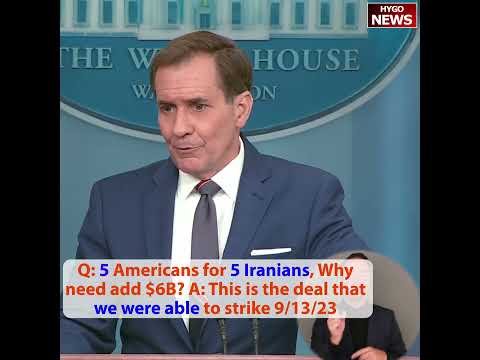
In September 2023, the Biden administration cleared the way for five Americans detained in Iran to come home by “issuing a waiver for international banks to transfer $6 billion in frozen Iranian money from South Korea to Qatar without fear of U.S. sanctions,” and by agreeing to release five Iranian citizens held in the United States, CBS News reported [5]. On September 13, John Kirby, the National Security Council’s coordinator for strategic communications, defended the deal at the White House briefing. A reporter asked why the United States needed to add $6 billion on top of the five Iranians. This video shows his answer. Quotes are from the official transcript published by the American Presidency Project [1].
Key Moments
”Why isn’t it a ransom payment?”
Earlier in the briefing, a reporter pressed Kirby: “I get that it’s not American taxpayer dollars, but it’s still $5 billion that had been frozen that was not available for use in any form by the Iranians. That $5 billion may be for humanitarian aid, but then it frees up $5 billion elsewhere to spend. So, how is that … not ransom payment?” Kirby answered: “First of all, you’re right, it’s not U.S. money. It’s Iranian money,” held in accounts set up so that U.S. partners could buy Iranian oil without being sanctioned. “Point number two: It’s not a blank check. They don’t get to spend it any way they want. It’s not $6 billion all at once. They will have to make a request for withdrawals for humanitarian purposes only” [1].
”This is the deal that we were able to strike”
“John, you just said that Iran was not going to do this for nothing. But didn’t they also get five Iranians?” another reporter asked. “They will get five Iranians as well,” Kirby said. “Then why did we need to add $6 billion on top of that?” “This is the deal that we were able to strike to secure the release of five Americans,” Kirby said. “It would be great, wonderful if we could just pick up the phone and call the mullahs and say, ‘Hey, we want our Americans back. Send them back on the next plane.’ But you and I both know that’s not going to happen, particularly with Iran.” He added: “Ask the families of those five Americans who’s getting the better end of it” [1].
”It’s not fungible. He’s just wrong.”
“President Raisi says it’s up to them how they use the money,” the reporter said. “He’s wrong,” Kirby answered. “How are you going to guarantee that?” the reporter asked. “Because once the money is — money is fungible.” “No, ma’am. No, ma’am. It’s not fungible. He’s just wrong. He’s just flat-out wrong,” Kirby said. He explained that the money would go to a Qatari bank, that Iran could request withdrawals only for humanitarian purposes, and that the funds would go “to qualified vendors to purchase and deliver the food, the medical supplies into Iran” [1].
Background: How the Deal Came Together
The outline of the exchange had been public since August 10, when four of the detained Americans were moved from prison to house arrest, NPR reported [2]. Secretary of State Antony Blinken signed the sanctions waivers in early September, “a month after U.S. and Iranian officials said an agreement in principle was in place,” and Congress was not notified of the waiver decision until the following Monday, according to CBS News and the Associated Press [5]. When the Americans were flown out, Tahbaz’s wife and Namazi’s mother, who had not been allowed to leave Iran, came with them [2].
Fact Check
- “It’s Iranian money.” Accurate. The $6 billion was Iranian oil revenue that had been frozen in South Korea [2][5].
- “Humanitarian purposes only.” That was the arrangement as described by U.S. officials: the money was to be held in Qatar for humanitarian purchases and could not be spent freely [1][2].
- “It’s not fungible.” Kirby’s answer addressed the restrictions on the account itself. It did not address the reporter’s underlying point, that humanitarian money from this account could free up other Iranian money for other uses [1].
- Was it ransom? Kirby said the deal was a negotiated exchange involving Iran’s own funds, not U.S. taxpayer money [1]. Critics, including many Republicans, said the transfer freed up resources for Iran [3].
What Happened Next
- The release: On September 18, 2023, the five Americans were freed, including Siamak Namazi, held since 2015, and Morad Tahbaz and Emad Shargi, both detained in 2018, NPR reported [2].
- The money frozen in place: After Hamas attacked Israel on October 7, the U.S. reached “a ‘quiet understanding’ with Qatar not to release any of the $6 billion in Iranian oil revenues,” CBS News reported; Deputy Treasury Secretary Wally Adeyemo informed House Democrats in a closed-door meeting [3]. The Associated Press described it as an agreement that Qatar would “not act on any request from Tehran for the time being,” stopping “short of a full refreezing” [4].
- Unspent: “None of the funds that have now gone to Qatar have actually been spent or accessed in any way by Iran,” Secretary of State Antony Blinken said on October 12 [4].
Sources
- The American Presidency Project: Press Briefing by Press Secretary Karine Jean-Pierre, Chair of the Council of Economic Advisers Jared Bernstein, and NSC Coordinator for Strategic Communications John Kirby (September 13, 2023)
- NPR: Iran frees Americans in a swap, gets access to oil money, release of Iranians in U.S. (September 18, 2023)
- CBS News: U.S. reaches “quiet understanding” with Qatar not to release $6 billion in Iranian oil revenues (October 12, 2023)
- AP via NPR: U.S. and Qatar agree to prevent disbursal of recently unfrozen Iranian funds (October 13, 2023)
- CBS News: U.S. clears way for release of $6 billion in frozen Iranian funds as part of prisoner swap deal (September 11, 2023)