 HYGO News
 KJP Refuses To Explain What Biden Meant When He Said 'Get Help From The Taliban'
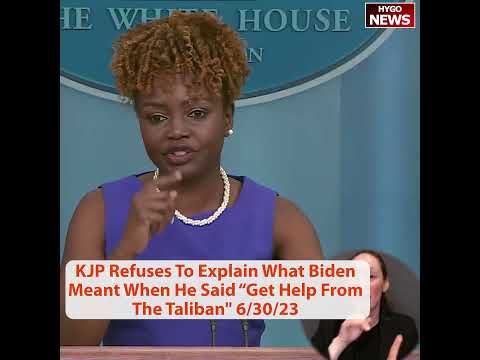
KJP Refuses to Explain What Biden Meant When He Said “Get Help From the Taliban”
On June 30, 2023, a reporter attempted to get White House Press Secretary Karine Jean-Pierre to explain one of President Biden’s most puzzling claims about Afghanistan: that he had said the U.S. would “get help from the Taliban.” Jean-Pierre cut the reporter off before they could finish the question, insisted she had already addressed the topic, and moved on to another reporter without providing any clarification. The exchange was the culmination of a briefing in which the White House proved unable or unwilling to explain Biden’s defiant claims about the Afghanistan withdrawal.
The Exchange
The confrontation came at the end of the White House briefing. Jean-Pierre had announced she was taking one final question: “All right, I’m going to take one last question, and try and call somebody I haven’t called on.”
A reporter interjected: “Karine, can we clarify about Afghanistan, please?”
Jean-Pierre immediately signaled she wanted to move on: “I mean, I don’t have anything else to add on Afghanistan.”
The reporter pressed forward, trying to ask a specific question about Biden’s remarks: “Can you just explain what the President said when he said, ‘I said we’d—’”
Jean-Pierre began talking over the reporter: “I just — I —”
The reporter finished: ”‘—get help from the Taliban’?”
Jean-Pierre’s response was dismissive and did not address the substance of the question: “I literally just — I literally just answered that question to your colleague. I’m trying to explain to you where I thought he was coming from. I literally just went into that.”
She then shut down the exchange entirely: “Okay. Go ahead. Go ahead. Go ahead.”
What Jean-Pierre Had Actually Said
The problem with Jean-Pierre’s claim that she had “literally just answered that question” was that she had not. Earlier in the briefing, when asked about Biden’s instruction to reporters to “read your press,” Jean-Pierre had admitted she had not heard Biden’s exact remarks and had offered only a vague speculation: “I think this is what he was referring to: He had to make a tough decision. Right? In the beginning of his administration, he had to make a tough decision.”
That answer addressed Biden’s general posture on the withdrawal decision. It did not address the specific claim that Biden had said the U.S. would “get help from the Taliban.” At no point during the briefing had Jean-Pierre explained what Biden meant by that assertion, why he believed it, or how it could be reconciled with the Taliban’s actual conduct since taking control of Afghanistan.
By claiming she had already answered the question, Jean-Pierre effectively refused to engage with the most controversial element of Biden’s remarks. The “get help from the Taliban” claim was the statement that most directly contradicted the reality on the ground in Afghanistan, and it was the one statement the White House refused to address.
Biden’s Original Claim
The question arose from Biden’s comments earlier that day. When asked if he admitted failure in Afghanistan, Biden had been defiant: “Remember what I said about Afghanistan? I said Al-Qaeda would not be there. I said it wouldn’t be there. I said we’d get help from the Taliban. What’s happening now? What’s going on? Read your press. I was right.”
Biden appeared to be suggesting that the Taliban had been cooperative or helpful to U.S. interests since the withdrawal. The claim was extraordinary. Since seizing control of Afghanistan in August 2021, the Taliban had imposed authoritarian rule, shut down women’s education, severely restricted women’s rights, dissolved democratic institutions, and been accused by United Nations monitoring teams of maintaining ties to terrorist organizations, including Al-Qaeda.
The most direct contradiction of Biden’s claim came in July 2022, when a U.S. drone strike killed Al-Qaeda leader Ayman al-Zawahiri in Kabul. Zawahiri had been living in a residential area of the Afghan capital under what appeared to be Taliban protection, a fact that demonstrated the Taliban were not merely failing to suppress Al-Qaeda but were actively sheltering its leadership.
Why the Question Mattered
The reporter’s question was not about general Afghanistan policy. It was specifically about the phrase “get help from the Taliban.” The claim was newsworthy because it suggested either that Biden had a fundamentally different understanding of reality in Afghanistan than the intelligence community and international observers, or that he was making statements that bore no relationship to the facts.
If Biden genuinely believed the Taliban had been helpful, that raised questions about what information he was receiving and how he was interpreting it. If he did not believe it but said it anyway, that raised questions about his willingness to make false claims about a matter involving American security and the lives of Afghan allies who were suffering under Taliban rule.
Jean-Pierre’s refusal to explain the comment left both possibilities open. By shutting down the question, the White House avoided having to either defend an indefensible claim or acknowledge that the President had said something that did not reflect reality.
The Broader Pattern
The exchange was part of a broader pattern during the June 30, 2023, briefing in which the White House was unable to explain or defend Biden’s statements about Afghanistan. Across multiple questions from different reporters, Jean-Pierre could not clarify what Biden meant by “read your press,” could not explain his claim about getting help from the Taliban, and would not say whether Biden accepted responsibility for the failures documented in the State Department’s after-action review.
The State Department review, released the same day, had found that the department failed to do enough planning before the collapse of the U.S.-backed government. The review blamed the administrations of both Trump and Biden for their efforts before and after the August 2021 departure from Kabul. The U.S. had evacuated an estimated 124,000 Afghans, but the process was chaotic and deadly, culminating in the deaths of 13 U.S. service members in a suicide bombing at Abbey Gate.
Republicans accused the Biden administration of refusing to take responsibility for intelligence failures and for the disastrous execution of the withdrawal. Jean-Pierre’s handling of the briefing reinforced that criticism. Each time a reporter asked a pointed question about Biden’s specific claims, Jean-Pierre either deflected to general talking points, claimed she had already answered the question, or shut down the exchange.
The Significance of the Cut-Off
Jean-Pierre’s decision to talk over the reporter and then move to another question was particularly notable. The reporter had barely begun to quote Biden’s words before Jean-Pierre interrupted. The speed of the interruption suggested that the press secretary recognized the question was difficult and wanted to prevent it from being fully articulated in the briefing room.
By saying “I literally just answered that question to your colleague” when she had not, Jean-Pierre created a false impression that the topic had been addressed. Anyone watching the briefing without having followed the earlier exchange closely might have accepted that claim at face value. But the earlier exchange had addressed a different comment entirely, and the “get help from the Taliban” claim had never been explained.
Key Takeaways
- A reporter asked KJP to explain Biden’s claim that he said the U.S. would “get help from the Taliban,” but Jean-Pierre cut the reporter off before they could finish the question and refused to answer.
- Jean-Pierre claimed she had “literally just answered that question,” but her earlier response addressed a different Biden comment and did not explain the Taliban claim at all.
- Biden had declared “I was right” about Afghanistan and claimed the U.S. would get help from the Taliban, a statement contradicted by the Taliban’s authoritarian rule and their sheltering of Al-Qaeda leader Zawahiri.
- The exchange was the final question of a briefing in which the White House repeatedly failed to explain Biden’s statements about the Afghanistan withdrawal.
- The State Department’s after-action review, released the same day, found planning failures in the withdrawal but the White House refused to accept responsibility for its findings.