 HYGO News
 Lynch calls ICE 'thugs'; Mayor Johnson on ICE=South won Civil War; Buchanan's prediction 13 yrs ago
Lynch calls ICE “thugs”; Mayor Johnson on ICE=South won Civil War; Buchanan’s prediction 13 yrs ago
In the same 72-hour window that federal agents were being hit with rocks and Molotov cocktails in Los Angeles, American political discourse produced two of the most extreme analogies in recent memory. Representative Stephen Lynch of Massachusetts compared federal immigration agents to the Gestapo — the infamous Nazi secret police — and used the phrase “those non-descript thugs” to describe the officers carrying out a federal arrest. Chicago Mayor Brandon Johnson extended the temperature further, framing ICE raids as what America would look like “had the Confederacy won the Civil War.” Meanwhile, a 13-year-old Pat Buchanan interview from CNN resurfaced to stunning effect, predicting almost exactly the civic disintegration the country is now experiencing. Each of the three moments is politically significant on its own. Taken together, they raise a question the administration has been asking for weeks: at what point does rhetoric start producing consequences in the field?
Lynch’s Opening: “Peaceful, Contributing Members”
Lynch opened with the standard Democratic framing of the ICE operation. “The Trump administration has tried to sweep aside the fact that this pattern of mass deportation operation is letting dangerous criminals roam free while it picks off peaceful, peaceful, contributing members of our communities.”
The repetition of “peaceful” — twice in a single phrase — is rhetorical emphasis. Lynch is insisting that the individuals being detained are not threats, and he is invoking the image of ordinary working people as his primary category of concern. “Busboys at restaurants, day laborers at Home Depot, parents who are taking their kids to school.”
The choice of examples matters. These are not obscure categories. Every American has seen a busboy, walked past a Home Depot parking lot, or watched a parent drop off a child at school. Lynch is building a mental picture that places federal enforcement into the rhythms of daily American life, and in that frame, the operation looks like disruption of community rather than enforcement of law.
The Contested Question: Criminals vs. Contributing Members
The administration’s counter-framing is that the operation is prioritizing criminal histories and that the individuals being described as “peaceful contributing members” include, in many cases, individuals with outstanding warrants, prior convictions, or pending charges. The administration’s internal data — which they have pointed to repeatedly — suggests that the proportion of detainees with criminal records is far higher than the Lynch framing acknowledges.
Who is correct is ultimately an empirical question that depends on how the population being detained is characterized. Both sides are cherry-picking exemplars. Lynch has chosen the sympathetic exemplar — a parent dropping a child at school. The administration has chosen the criminal exemplar — a fugitive with prior convictions. The reality is almost certainly a distribution that includes both, and the political debate is about which exemplar is representative.
The Ozturk Case
Lynch then moved to the specific case of Rumesa Ozturk. “In late March, ICE agents wearing masks and hoodies detained Rumesa, Ozturk.”
The detail about “masks and hoodies” is visual. It is designed to evoke the image of agents who do not appear to be agents — officers in tactical gear that could be mistaken, by a bystander, for anyone else. Whether the description is accurate in this specific instance is debatable, but the rhetorical aim is to build toward the comparison that follows.
”It Does Look Like A Gestapo Operation”
Lynch delivered the line that made the clip travel. “And those of you who watch that abduction, when you compare the old films of the Gestapo grabbing people off the streets of Poland and you compare them to those non-descript thugs who grabbed that graduate student, it does look like a Gestapo operation. It does look like the Gestapo.”
The comparison is deliberate and escalating. Lynch is not merely describing ICE operations as aggressive. He is equating them to the Gestapo — the Nazi secret police responsible for some of the most documented atrocities of the twentieth century. The word “thugs” reinforces the delegitimization. And the description of Ozturk’s detention as an “abduction” completes the transformation of a federal law-enforcement action into what Lynch presents as an extralegal act.
Why The Analogy Lands — And Why It Offends
The Gestapo analogy is designed to activate a specific emotional register. For Americans whose families fled Europe during or after World War II, comparisons to the Gestapo are not abstract. They are memory. When a sitting member of Congress invokes that comparison against federal law-enforcement officers, the cost is borne both by the officers being compared and by the descendants of those who suffered under the actual Gestapo.
Critics of the analogy argue that it demeans the real Gestapo’s victims by equating a federal arrest of a graduate student who has attracted attention for specific actions with the systematic murder of millions. Supporters of the analogy argue that the willingness to invoke the comparison demonstrates how seriously Lynch views the current moment. Whether one agrees or disagrees with the framing, the political cost is real. Agents in the field who are being told by elected officials that they resemble the Gestapo are being asked to absorb a reputational weight that has nothing to do with the work they are doing.
”This Is It”
Lynch’s closing line made the stakes explicit. “And that’s, look, I remember a few stand-ups ago when I talked about what terrorism looks like. This is it.”
The “terrorism” framing matches the rhetoric used by the Deputy Mayor of Ventura, which the administration had already flagged as dangerous. When multiple elected officials across different levels of government start calling federal law enforcement “terrorism,” the cumulative effect is a rhetorical climate in which agents’ personal safety becomes a live question.
Mayor Johnson: “If The Confederacy Won”
Chicago Mayor Brandon Johnson then extended the temperature further with his own analogy. “There should be no question to what our country would look like had the Confederacy won. We’re seeing it on full display.”
The comparison is extraordinary in its scope. Johnson is not comparing the current moment to the Gestapo — he is comparing it to the Confederacy, a slaveholding regime whose defeat in 1865 is considered one of the defining moral achievements of the American project. By saying that the country under the Trump administration looks like the country if the Confederacy had won, Johnson is delegitimizing the entire political order that the current administration represents.
The Weight Of The Civil War Analogy
The Civil War analogy has two distinct political effects. First, it positions the speaker — Johnson — as an heir to the Union cause, to abolition, and to the moral arc of Reconstruction. Second, it positions the current administration as heir to the Confederacy — to slavery, to secession, and to the racial order the Civil War ended.
The political problem with the analogy is that it treats a policy disagreement over immigration enforcement as equivalent to the fundamental question of whether millions of human beings can be owned as property. That is a category collapse that most historians and many political scientists find analytically untenable. But the rhetorical force of the analogy is exactly what Johnson is relying on. By invoking the Confederacy, he is signaling to his constituency that the stakes of the current immigration enforcement are at the level of the Civil War itself.
Buchanan’s 1973-Prescient CNN Appearance
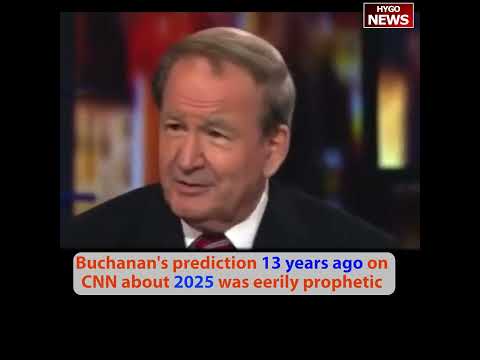
The third strand of the video is a 13-year-old Pat Buchanan CNN interview that has resurfaced with a degree of prescience almost no one has seen from a cable news segment.
Buchanan was predicting the state of the world in 2025. The interviewer asked whether he thought the United States would still exist by then. His reply was careful. “Well, the United States is not dead by 2020. I was worried. But I think in 2025, what concerns me is what’s happening here at home, that we seem to be disintegrating as one nation."
"We Are Very Much At War With Each Other”
Buchanan’s diagnosis of American civic health was precise. “It seems to me we’re losing. We are very much at war with each other. And it’s over ideology, politics, religion, philosophy, everything. And the terms we’re using on each other, I mean, the term, I mean, I’m on cable as you are. And every day somebody’s calling somebody else a racist. We didn’t use those kinds of terms on each other, even during the Civil Rights Era.”
The observation that the civil rights era — an era of genuine racial conflict — featured less casual use of the term “racist” than the contemporary political environment is a striking one. Buchanan is not saying racism has disappeared or that the civil rights era was without genuine racial animosity. He is saying that the specific rhetorical term has been weaponized and overused to a degree that erodes its descriptive power.
”The End Of White America”
The interviewer then pressed Buchanan on his book’s chapter “The End of White America.” “Isn’t the end of white America as we see the rise of Hispanics a good thing? Proof that America is a melting pot, that anybody can succeed here, no matter the color of your skin or your religion or whatever.”
Buchanan’s answer focused on civic cohesion rather than racial identity. “What’s wrong with this is the idea that when whites are a minority in this country in 2041 and Hispanics are 150 million, what is going to hold us together when we don’t have a common religion, we don’t have common beliefs about right and wrong and morality as we used to.”
The question Buchanan raised is not whether America can absorb immigrants. It is whether the country has retained the civic-religious-moral common ground that allows a pluralistic society to function as a single nation. His answer was that America had lost that common ground.
”Equality Of Rights Or Equality Of Rewards”
Buchanan then stated the civic fault line that the current administration continues to navigate. “We are at war over whether or not equality means equality of rights or equality of rewards.”
This is the question that has animated American political philosophy for generations. Equality of rights is the classical liberal project — that every citizen has the same standing before the law, the same freedoms, the same opportunity to pursue happiness. Equality of rewards is the socialist project — that the outputs of society should be distributed more evenly regardless of rights-based arrangements.
Buchanan argued, and the administration continues to argue, that the two projects are not compatible. “The American dream, the freedom, the belief, what will cause the Arab Spring, that’s what holds us together. The idea of socialist equality and freedom are in mortal conflict.”
China As The Cautionary Tale
Buchanan closed with a historical vignette from his own career. “I was in China before you were born with Richard Nixon in 1972. The most equal society you’ve ever seen. Everybody had a blue Mao jacket on and they were the poorest people you’ve ever seen. Now tyranny, the most much of the tyranny has been lifted of Maoism and it’s an unequal society in China. Millionaires and billionaires as Barack Obama would say and poor people. But it is freer. Freedom and absolute equality are in conflict.”
The argument is that China under Mao was equal in outcomes because it was poor in freedoms. As China liberalized, the society became less equal but freer. Americans are being asked, in Buchanan’s framing, to make a similar choice — and he is arguing that choosing equality of outcomes over freedom is a path no society has ever navigated successfully.
Why The 13-Year-Old Clip Landed
The reason Buchanan’s interview is circulating now is that his prediction — that by 2025 the United States would be disintegrating not economically or militarily but internally, over rhetoric and identity — mapped almost exactly onto what subsequent years delivered. The fact that the prediction was made 13 years earlier on a mainstream cable outlet, by a commentator who was then considered a marginal figure, is the part that makes the clip compelling.
Key Takeaways
- Rep. Stephen Lynch compares ICE agents to the Gestapo: “when you compare the old films of the Gestapo grabbing people off the streets of Poland and you compare them to those non-descript thugs…it does look like a Gestapo operation.”
- Mayor Brandon Johnson on ICE raids: “There should be no question to what our country would look like had the Confederacy won. We’re seeing it on full display.”
- Lynch pivots to “terrorism” framing: “I remember a few stand-ups ago when I talked about what terrorism looks like. This is it.”
- Buchanan’s 2012 prediction: “in 2025, what concerns me is what’s happening here at home, that we seem to be disintegrating as one nation…We are very much at war with each other.”
- Buchanan’s thesis: “Freedom and absolute equality are in conflict” — the American project requires choosing between equality of rights and equality of rewards.