 HYGO News
 Leader McCarthy: Xmas Eve? Dems had all year to get funding taken care
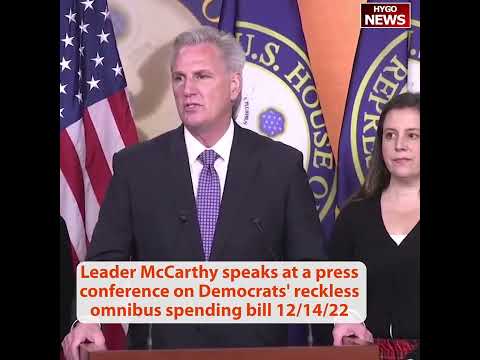
McCarthy on Dec 2022 Omnibus: Two Retiring Senators Writing $100B Baseline Increase for Entire Government — “Cannot Afford to Jam Us Now”
On 12/19/2022, House Republican Leader Kevin McCarthy criticized the December 2022 omnibus appropriations process. “We’ve got two members leading appropriations in the Senate who will no longer be here or be able to be held accountable to the constituents. We’ve got an Omni bill that takes 12 appropriation bills and puts them all together and adds the baseline of somewhere about $100 billion,” McCarthy said. He objected to the timing and process: “We’re Christmas season… a talk of the majority right now who wants to put a small continuing resolution to bump all the members up two days before Christmas to try to vote on a package they cannot read written by two individuals who will not be here on spending for the entire government.” McCarthy concluded: “The Democrats have been in power. They’ve had the House, the Senate, and the presidency. They did not do their work, but they should not jam us now.”
The Two Retiring Senators
McCarthy referenced the Senate Appropriations leadership. “We’ve got two members leading appropriations in the Senate who will no longer be here or be able to be held accountable to the constituents,” McCarthy said.
The two retiring senators were:
Senator Richard Shelby — Republican, Ranking Member, retiring from Senate.
Senator Patrick Leahy — Democrat, Chairman, retiring from Senate.
Both had long Senate careers ending in January 2023:
Shelby — 36 years in Senate.
Leahy — 48 years in Senate (longest-serving senator).
Senior appropriators — Top members of Appropriations Committee.
Retiring — Not running for reelection.
Final bill — Major legislation they would work on.
McCarthy’s complaint was that these retiring senators were writing major appropriations legislation they would never be accountable for. Once they left the Senate, voters couldn’t hold them responsible for the consequences of the bill.
The Accountability Concern
The accountability concern had legitimate foundation:
Retiring officials — Face no electoral consequences.
Major legislation — Affects future voters and taxpayers.
Democratic accountability — Limited by retirement.
Final acts — Can reflect personal priorities over voter priorities.
Lame duck legislation — Historical concerns about accountability.
McCarthy’s framing suggested that retiring senators shouldn’t write final major legislation. But this was a complicated position:
Senators retain authority — Until January.
Leadership responsibilities — Continue through term.
Institutional continuity — Chairs complete work in progress.
Bipartisan negotiation — Required multiple parties.
Alternative would delay — Legislation Congress had to address.
The criticism was more about political timing than governance principles. Retiring senators doing their jobs wasn’t inherently problematic. The substantive issue was what was in the bill, not who was writing it.
The $100 Billion Baseline Increase
McCarthy cited a specific figure. “Adds the baseline of somewhere about $100 billion,” McCarthy said.
The $100 billion figure represented:
Baseline increase — Not total bill cost.
Spending growth — Year over year.
Future year impact — Beyond the current bill.
Budget implications — For fiscal projections.
Republican concern — About spending levels.
The total omnibus was approximately $1.7 trillion. The $100 billion baseline increase would affect spending in subsequent years through the budget baseline mechanism. Once spending levels were raised, future budgets would use the higher levels as starting points.
The baseline concern was technically significant:
Compounds over time — Small increases become large ones.
Difficult to reverse — Once established.
Automatic growth — Through inflation adjustments.
Bipartisan responsibility — Both parties contribute.
Long-term implications — For federal budget.
The 12-Bill Aggregation
McCarthy objected to omnibus structure. “An Omni bill that takes 12 appropriation bills and puts them all together,” McCarthy said.
The omnibus approach was controversial:
Single vote — On entire government funding.
Length and complexity — Thousands of pages.
Limited amendments — Traditional appropriations allowed more.
Minority party leverage — Reduced.
Speed over deliberation — In end-of-year rush.
Traditional appropriations process involved:
12 separate bills — For different government functions.
Committee markup — Detailed review.
Floor debate — On each bill.
Amendment process — Targeted changes.
Senate action — Similar process.
Conference committees — Reconciling differences.
This process had largely broken down in recent decades. Congress had increasingly relied on omnibus packages and continuing resolutions rather than regular appropriations. Both parties had contributed to this pattern when in power.
”Two Days Before Christmas”
McCarthy emphasized timing concerns. “To bump all the members up two days before Christmas to try to vote on a package they cannot read written by two individuals who will not be here on spending for the entire government,” McCarthy said.
The timing concern was specific:
Christmas season — Members wanting to go home.
Two days before Christmas — December 23.
Limited reading time — For thousand-plus-page bill.
Pressure to pass — Before government shutdown.
Final session urgency — End of Congress.
This timing pattern had been criticized for years. Members couldn’t read massive appropriations bills quickly, but votes were scheduled with limited review time. The result was:
Votes on unread bills — Members supporting content they hadn’t reviewed.
Staff analysis only — Not individual member review.
Lobbyist influence — Those with advance access.
Democratic accountability — Reduced.
Public understanding — Severely limited.
”A Package They Cannot Read”
McCarthy’s “cannot read” framing captured the practical reality. Omnibus bills typically:
Ran thousands of pages — Making full reading impractical.
Contained complex provisions — Requiring expertise to understand.
Included policy riders — Beyond appropriations.
Had various carve-outs — Specific interests benefited.
Lacked public scrutiny — Before votes.
The “cannot read” problem affected both parties when each was in minority. But McCarthy’s specific criticism was about current circumstances where Democrats were producing the bill. Republicans would face similar process challenges when they took control.
The Continuing Resolution Reference
McCarthy mentioned a continuing resolution. “A small continuing resolution to bump all the members up two days before Christmas,” McCarthy said.
A continuing resolution (CR) was temporary funding:
Short-term extension — Of existing spending.
Avoids shutdown — When full appropriations aren’t ready.
Deadline extension — For final decisions.
Limited duration — Days or weeks typically.
Emergency mechanism — Not normal process.
McCarthy was describing a process where:
CR extended funding temporarily — Past the deadline.
During the CR period — Omnibus would be finalized.
Members needed to return — To vote on both.
Process complexity — Multiple votes required.
Negotiation pressure — To complete quickly.
”Democrats Have Been in Power”
McCarthy’s political framing was clear. “The Democrats have been in power. They’ve had the House, the Senate, and the presidency. They did not do their work, but they should not jam us now,” McCarthy said.
The “did not do their work” accusation:
Regular appropriations timing — Typically October.
September 30 deadline — For new fiscal year.
Democrats had controlled — Process timing.
Delayed to December — Missed deadline.
Now rushing — To complete before Christmas.
Whether Democrats had uniquely failed at appropriations timing was debatable. Congress regularly missed October 1 deadlines under both parties. The last time all 12 appropriations bills passed on time was 1996 — before many current members had even served.
But McCarthy’s political framing served purposes:
Blamed the majority party — For process failures.
Positioned Republicans — As victims of bad process.
Established expectations — For incoming majority.
Justified opposition — To final product.
”They Should Not Jam Us”
McCarthy’s “jam us” framing suggested:
Forced acceptance — Of Democratic priorities.
Limited review time — For Republican opposition.
Unfair process — In final days.
Legacy spending — That Republicans would inherit.
Democratic advantage — Through timing.
The “jam us” phrasing fit Republican messaging about excluded negotiations. Combined with Stefanik’s “cut out” language from the same day, Republicans were consistently framing the process as exclusionary.
”They Should Not Jam the American Public”
McCarthy extended the framing to voters. “They should not jam the American public. We cannot afford it,” McCarthy said.
The “American public” framing:
Extended beyond Republicans — To all citizens.
Affordability concern — Fiscal responsibility.
Public accountability — For rushed spending.
Democratic representation — Concerns.
Budget pressures — On families.
The “we cannot afford it” message tied the process criticism to substantive concerns about spending levels. Even Republicans who might have accepted rushed process would object to high spending levels that would affect the federal budget.
The Bill’s Eventual Passage
Despite McCarthy’s opposition, the omnibus passed:
Senate approved — December 22, 2022.
House approved — December 23, 2022.
Biden signed — Later that same day.
$1.7 trillion total — As had been predicted.
Ukraine aid — Significant provisions.
Border funding — Some administration requests.
Various policy riders — From both parties.
The passage reflected political reality:
Government shutdown avoided — Through bipartisan action.
Some Republican support — Particularly in Senate.
Must-pass legislation — Hard to block entirely.
Final Democratic majority — Acted before losing House.
Mixed outcomes — Neither side got everything.
The Republican Opposition
McCarthy’s opposition was consistent with Republican positioning:
House Republicans overwhelmingly opposed — Few supporters.
Senate Republicans split — Some supported.
Senator McConnell supported — As Senate leader.
Rank-and-file divided — On specific provisions.
Future consequences — Would affect 2023-2024 fights.
McCarthy’s opposition set up expectations for his speakership. House Republicans who would soon control the House were signaling opposition to Democratic spending priorities. This would shape 2023 appropriations fights.
The Speakership Context
McCarthy’s criticism came as he was preparing for the Speaker election. In January 2023:
Historic 15-ballot election — For Speaker.
Conservative opposition — To McCarthy specifically.
Concessions made — For conservative votes.
Weakened position — As Speaker.
Constraint on leadership — From conservatives.
McCarthy’s strong criticism of the December 2022 omnibus may have been partly aimed at his own caucus. Conservative Republicans who were skeptical of McCarthy’s conservatism needed to see him fighting against Democratic spending. His December 2022 positioning set up his January 2023 speakership election.
The Omnibus Legacy
The December 2022 omnibus had lasting implications:
Spending levels — Established baselines for subsequent years.
Policy provisions — Created ongoing law.
Political precedent — For future end-of-year packages.
Accountability questions — About lame duck legislation.
Republican narrative — Against Democratic fiscal management.
By 2023, Republicans would cite the December 2022 omnibus as example of Democratic overreach requiring correction. This narrative would shape 2023 debt ceiling fights, appropriations battles, and other fiscal disputes. McCarthy’s December 2022 criticism was establishing the framing that would be used throughout his speakership.
Key Takeaways
- House Republican Leader Kevin McCarthy criticized the December 2022 omnibus appropriations process.
- He objected to retiring senators (Shelby and Leahy) writing major spending legislation they wouldn’t be accountable for.
- McCarthy cited a “$100 billion baseline increase” in government spending.
- He criticized the timing — two days before Christmas — and the process of voting on “a package they cannot read.”
- McCarthy accused Democrats of having “all year” while controlling Congress and the White House but failing to do their work on time.
- His framing — “they should not jam us now” and “we cannot afford it” — set the tone for upcoming Republican House opposition.
- The omnibus passed despite his criticism, but the framing would shape 2023 fiscal fights during McCarthy’s speakership.
Transcript Highlights
The following is transcribed from the video audio (unverified — AI-generated from audio).
- We’ve got two members leading appropriations in the Senate who will no longer be here or be able to be held accountable to the constituents.
- We’ve got an Omni bill that takes 12 appropriation bills and puts them all together and adds the baseline of somewhere about $100 billion.
- To bump all the members up two days before Christmas to try to vote on a package they cannot read.
- Written by two individuals who will not be here on spending for the entire government.
- The Democrats have been in power. They’ve had the House, the Senate, and the presidency. They did not do their work.
- They should not jam us now. They should not jam the American public. We cannot afford it.
Full transcript: 141 words transcribed via Whisper AI.