 HYGO News
 LA Mayor Bass: LA riots 'never happened'; Crockett: never concern Biden acuity; Heated Kennedy
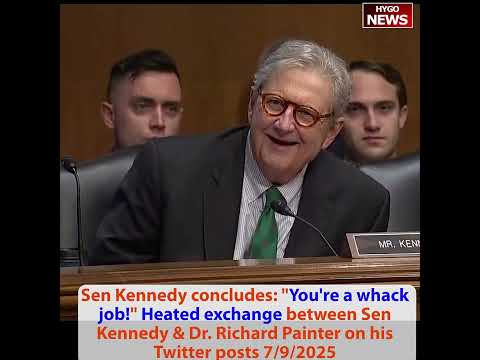
LA Mayor Bass: LA riots “never happened”; Crockett: never concern Biden acuity; Heated Kennedy
The video captured multiple political moments that each drew sharp criticism. LA Mayor Karen Bass claimed the LA riots “never happened” — a claim contradicted by substantial visual evidence of actual rioting, arson, and attacks on federal agents. Rep. Jasmine Crockett claimed she “never had a concern” about Biden’s mental acuity — another claim that stretches credibility given documented evidence that many Biden administration officials had private concerns. Senator John Kennedy called a witness a “whack job” during a heated Senate hearing exchange. Rep. Eric Swalwell argued for continued immigrant labor access for hospitality and agriculture sectors. And the Perris, California mayor issued an unusual advisory telling residents to “stay indoors” because ICE was in the area.
Bass’s “Never Happened”
The reporter asked about LA riots. “Given your strong opposition to federal immigration enforcement actions in Los Angeles, how would you address similar escalations of violence against law enforcement in Texas? And what steps would you propose to prevent such unrest from spreading to Los Angeles while balancing community safety and your sanctuary city policies?”
The question implicitly acknowledges the LA violence that followed federal immigration enforcement operations. The questioner is asking Bass how she would handle similar dynamics elsewhere.
Bass’s response. “Well, let me just say that the quote-unquote riots that were retorted never happened.”
“Never happened” is the specific claim. The LA riots that dominated news coverage in June 2025 — complete with video of burning vehicles, attacks on federal agents, destroyed property, and the deployment of the National Guard — did not, in Bass’s characterization, actually occur.
Why The Bass Claim Is Remarkable
The Bass claim is remarkable because the physical evidence is overwhelming. Video footage from the riots was broadcast globally. Specific vehicles were set on fire. Specific federal agents were attacked. Specific property damage was documented. Specific arrests were made. The riots happened and are documented in multiple forms.
For Bass to claim they “never happened” requires either defining “riot” so narrowly that what occurred doesn’t qualify, or simply denying documented reality. Either approach damages her credibility.
The specific characterization also raises operational questions. If, according to Bass, the riots never happened, why did the National Guard deployment occur? Why were specific arrests made? Why was property damage insurance claimed? The documented response to the events contradicts the claim that the events did not occur.
Why The Bass Claim Matters Politically
Bass’s claim serves a specific political purpose. Democrats have been arguing that federal immigration enforcement is causing community damage. That framing depends on the enforcement being the provocation. If the rioting was a response to legitimate federal action, the framing is weakened. If the rioting did not actually happen, the framing is strengthened.
But denying the rioting also creates specific problems. Mayor Bass’s credibility as a municipal leader requires accurate reporting of conditions in her city. A mayor who denies documented events loses credibility for her assessments of other events.
Crockett On Biden’s Acuity
The video pivoted to Rep. Jasmine Crockett’s response to a question about Biden. “Do you have concerns about the president’s health and his nettle acuity? No. None. None.”
“No. None. None.” is the categorical response. Crockett is denying any concern about Biden’s mental acuity during his presidency. The emphatic repetition captures the specific framing.
”I Had An Opportunity To Interact”
Crockett added the specific claim. “Now, granted, I didn’t see Joe Biden every single day, but I did have an opportunity to interact with the president. I never had a concern.”
The claim requires accepting that Crockett’s interactions with Biden produced no specific observations that raised acuity concerns. Given the documented public evidence — specific moments when Biden appeared confused, lost track of where he was, failed to finish sentences coherently — Crockett’s lack of concern is either a function of not personally observing those moments or a function of interpreting them differently than most observers did.
”The Current Occupant”
Crockett then pivoted to attack Trump. “If there’s anyone that I am concerned about their mental acuity, it is the current occupant.”
The specific claim — that Crockett has concerns about Trump’s mental acuity — is politically convenient. It allows Crockett to redirect from the Biden acuity question to an attack on Trump.
The specific evidence for Trump’s mental acuity concerns is, at most, ambiguous. Trump gives long extemporaneous speeches. He responds to detailed policy questions. He conducts bilateral diplomatic meetings that cover multiple substantive topics. His operational capacity, by the objective measure of work output, substantially exceeds what most presidents have demonstrated.
Whether Trump’s specific style — his stream-of-consciousness speaking pattern, his specific policy priorities, his specific rhetorical choices — represents mental acuity concerns or represents deliberate political style is the question. Crockett’s framing treats the former as obvious. Many observers, including across the political spectrum, would dispute that framing.
The Kennedy-Witness Exchange
The video then captured a heated exchange between Senator John Kennedy and an unnamed witness. “Do you think Senator Gillibrand is a crook?”
The witness (apparently Richard Painter based on the video caption). “No, and I do not think all politicians are crooks.”
“And why did you call her a crook?” Kennedy then pressed on specific social media content.
“I did not call her a crook. Now, Senator, you need to focus on this bill. Here’s what I’m looking right now.”
The Specific Tweet
Kennedy then quoted the specific tweet. “Just again, you did it the last hearing. You need to read the bill. You published a tweet that said Senator Gillibrand’s role in stable corn regulation, $217,000 in crypto donation. You tweeted that. Yes, I do. And then why do you think the crypto industry is buying Senator Gillibrand?”
The specific content of the tweet captures Painter’s framing. By noting that Gillibrand received $217,000 in crypto industry campaign contributions while playing a role in stablecoin regulation, Painter implied a specific corruption allegation. The tweet suggested that Gillibrand’s regulatory positions might be influenced by the campaign contributions.
“I said, look at the campaign contributions from this industry” is Painter’s defense. He is claiming he only invited people to look at the contributions, not that he specifically alleged corruption.
The Distinction That Matters
The distinction Kennedy is probing is important. There is a difference between:
- Observing that a member of Congress receives campaign contributions from an industry she regulates.
- Alleging that those contributions have corrupted her regulatory decisions.
The first observation is factually accurate and politically common. Members of Congress receive donations from industries they oversee. That pattern is widespread and legal.
The second allegation — that specific contributions have purchased specific regulatory positions — is a specific corruption charge that requires specific evidence.
Painter’s tweet can be read either way. Kennedy is pressing him to clarify whether he was making the first observation or the second allegation.
”You’re A Whack Job”
Kennedy’s exasperation escalated. “You are distorting what I said just like you did in the last hearing. You’re wasting everybody’s time, Senator. You’re a whack job. Senator, you are a wasteingly free ones next level whack job.”
“Whack job” from a sitting senator to a hearing witness is unusual. The specific exchange captures Kennedy’s specific frustration with Painter’s evasiveness and the broader political dynamic of witnesses who make specific public statements and then try to soften them under specific Senate questioning.
”Is This Middle School?”
The exchange continued. “Is this middle school, Senator? Senators and witness, thank you for your part. I think you should apologize, Senator. I think, Senator, you’re wasting our time. This is not middle school.”
Both Kennedy and Painter are accusing each other of middle-school-level behavior. The mutual accusation captures the specific dynamic of the hearing — a heated exchange that both parties view as beneath serious political discourse while simultaneously continuing the exchange.
Swalwell On Immigrant Labor
The video then pivoted to Rep. Eric Swalwell. “I would say it doesn’t make economic sense because we have shortages in agriculture, in childcare, in food and beverage, in hospitality. There are work shortages all over our country that Nicaraguans and Hondurans are filling. And if they’re not committing violent crimes in our community, wouldn’t we want them to take those jobs and have all of us pay less?”
The framing is explicit. Swalwell is arguing that mass deportation harms American consumers because it removes workers who are filling specific labor shortages. Americans benefit, in his framing, from continued access to undocumented labor because prices of specific goods and services remain lower.
Why Swalwell’s Framing Is Politically Problematic
The Swalwell framing is politically problematic because it explicitly acknowledges what restrictionists have been arguing for years — that undocumented labor suppresses wages and prices. Restrictionists argue that American workers would benefit from higher wages if undocumented labor supply were reduced. Swalwell’s framing acknowledges that dynamic but treats it as a reason to preserve undocumented labor rather than to reduce it.
The specific argument — that Americans benefit from cheap prices at the cost of American workers’ wages — is the specific trade-off that has defined immigration policy debates for decades. Swalwell’s explicit embrace of that trade-off places him on the side of the trade-off that benefits consumers over workers.
”Pay Less”
The most politically damaging phrase is “have all of us pay less.” Swalwell is telling American voters that undocumented labor keeps prices low, which benefits them. That framing treats American workers’ interest in higher wages as a cost that Americans should accept in exchange for lower consumer prices.
The restrictionist framing inverts this. Higher wages for American workers, even at the cost of slightly higher consumer prices, is the objective. American workers deserve to be paid well. Americans who benefit from low prices at the cost of other Americans’ wages are participating in a specific form of exploitation.
Which framing wins politically depends on which American constituency is larger — consumers who care about prices or workers who care about wages. Given that workers are also consumers, most Americans have mixed interests. The political calculation involves which interest dominates.
The Perris, California Advisory
The video closed with an unusual municipal advisory. “The City of Paris has received reports of ongoing ICE operations within the area. We urge all residents to remain calm, stay indoors when possible, and know your rights. Do not go out unless necessary. Stay at home and do not open the door to strangers.”
The “City of Paris” is almost certainly Perris, California — a city in Riverside County with a substantial Latino population. The advisory tells residents to stay indoors because ICE is in the area.
Why The Advisory Matters
The advisory is extraordinary because it characterizes federal law enforcement as something to hide from. The municipality is advising its residents — presumably including citizens and legal residents — to stay indoors rather than risk encounters with ICE.
The implicit framing is that ICE operations affect the entire community, not just the specific individuals being investigated. That framing is inaccurate. ICE officers conduct specific operations against specific individuals who are subject to specific immigration proceedings. Citizens and legal residents are not subject to ICE enforcement.
A municipal government telling residents to hide from federal law enforcement represents a specific form of obstruction. The municipality is not physically blocking enforcement, but it is creating conditions that make enforcement more difficult. That obstruction can contribute to the specific incidents — arrests of officials, confrontations with agents — that the administration has been documenting.
”Do Not Open The Door To Strangers”
The specific instruction — “do not open the door to strangers” — is even more unusual. Federal law enforcement officers with warrants are entitled to enter homes. Telling residents not to open the door to them is telling residents to obstruct the execution of warrants.
That instruction, if followed, produces specific operational problems for ICE. Officers who cannot access individuals they are seeking must find other ways to execute their orders. Those other ways — public arrests, workplace operations, vehicle stops — create more visible interactions that are more likely to produce conflict.
”Protecting The Dignity And Well-Being”
The advisory closed with a specific framing. “The City is committed to protecting the dignity and well-being of all our residents.”
The framing captures the municipal position. The city is committed to its residents. ICE, from the municipal perspective, is a threat to the residents’ dignity and well-being. Therefore the city is warning residents to protect themselves from ICE.
The administration’s counter-framing is that ICE is doing lawful federal work. Municipalities that characterize federal law enforcement as a threat are, by their framing, rejecting the legitimacy of federal authority. That rejection has specific political and legal consequences that the administration has been calibrating responses to.
The Combined Pattern
The video captures a specific pattern of Democratic and progressive political framings that each serve specific political purposes but each require specific denials of documented reality.
Bass denies that documented LA riots happened. Crockett denies that she observed Biden’s documented acuity problems. Painter denies that his specific tweet alleging corruption alleged corruption. Swalwell explicitly acknowledges the dynamic that undocumented labor suppresses American wages. Perris advises residents to hide from federal law enforcement.
Each specific framing has its own logic. The cumulative pattern reveals specific features of contemporary Democratic political communication — a willingness to make claims that strain credibility, a focus on political framing rather than factual accuracy, and an explicit embrace of positions that implicitly acknowledge the criticisms they publicly reject.
Key Takeaways
- LA Mayor Bass: “The quote-unquote riots that were retorted never happened” — contradicting documented LA rioting.
- Rep. Crockett on Biden’s acuity: “No. None. None. I never had a concern” — while later claiming concern about Trump’s acuity.
- Sen. Kennedy to a hearing witness: “You’re a whack job. You are next level whack job.”
- Rep. Swalwell on undocumented labor: “Wouldn’t we want them to take those jobs and have all of us pay less?”
- Perris, California mayor’s advisory: “Stay indoors when possible…do not go out unless necessary…do not open the door to strangers.”