 HYGO News
 Kwanzaa was created 1966, Harris born in 1964, do Indians & Jamaicans celebrate Kwanzaa?
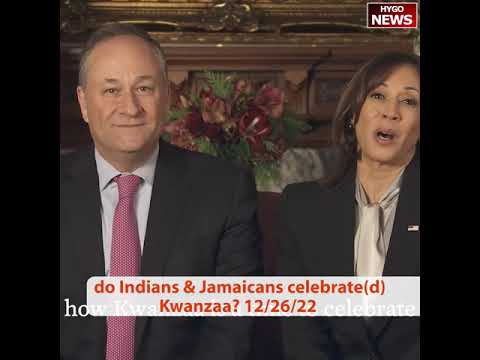
VP Harris’s Kwanzaa Claim Raises Questions: Holiday Created in 1966, Harris Born 1964 — Do Indian and Jamaican Families Celebrate Kwanzaa?
In late December 2022, Vice President Harris’s Kwanzaa message claimed personal family history celebrating the holiday. “Growing up Kwanzaa was always a special time. We came together with generations of friends and family and neighbors,” Harris said. “There were never enough chairs so my sister and I and the other children would often sit on the floor and together we lit the candles of the Canara and then the elders would talk about how Kwanzaa is a time to celebrate culture, community and family.” The claims raised factual questions: Kwanzaa was created in 1966, Harris was born in 1964 (making her 2 when Kwanzaa was created), and Harris’s heritage is Indian (mother Shyamala Gopalan) and Jamaican (father Donald Harris) — neither traditionally associated with Kwanzaa observance.
The Kwanzaa Creation History
Kwanzaa has a specific origin:
Created 1966 — By Maulana Karenga.
Karenga was — California State University professor.
Black nationalism context — Cultural movement.
African American focus — Specifically.
Pan-African elements — Seven principles.
Not ancient — Modern creation.
The specific founding:
December 26-January 1 — Dates set.
Seven principles — From Swahili.
African roots claimed — Though created in America.
Political origins — Black nationalist movement.
Cultural adoption — Gradually.
By 2022, Kwanzaa had:
Been celebrated 56 years — Since creation.
Varied observance — Among African Americans.
Not universal practice — Within Black community.
Some families embraced — Others didn’t.
Cultural visibility — Growing over time.
The Harris Chronology
Harris’s timeline:
Born 1964 — October.
Kwanzaa created 1966 — Late December.
Age 2 when Kwanzaa began — As concept.
Early 1970s — Some adoption began.
By late 1970s — More widespread among some.
Harris’s childhood — When holiday was new.
Harris claiming to have “grown up” celebrating Kwanzaa was:
Chronologically possible — Barely.
Required family adoption — Of new practice.
Would have been early — For Kwanzaa adoption.
Unusual for Indian/Jamaican family — Demographically.
Politically convenient claim — For 2024.
The Indian Heritage
Harris’s mother was Indian:
Shyamala Gopalan — Indian immigrant.
Tamil Brahmin background — Specific South Indian.
Hindu cultural context — Religion.
Indian American community — Growing in 1960s-70s.
Not African heritage — Indian.
Indian American families typically:
Celebrated Indian holidays — Diwali, Holi.
Maintained cultural connections — To India.
Adapted to American context — Over time.
Rarely adopted Kwanzaa — Not culturally relevant.
Identity primarily Indian American — Not African American.
For an Indian-background family to celebrate Kwanzaa would be:
Unusual choice — Culturally.
Not traditional — For Indian Americans.
Possible but atypical — As adopted practice.
Would require explanation — Of adoption.
Not generationally passed — In Indian families.
The Jamaican Heritage
Harris’s father was Jamaican:
Donald Harris — Jamaican economist.
Caribbean background — Specifically.
British colonial culture — Jamaican identity.
Christmas traditions — Strong.
Not African American — Caribbean.
Jamaican cultural context:
Reggae culture — Prominent.
Rastafarianism — Some adherents.
Christianity dominant — For many.
British influence — Historical.
Not Kwanzaa-focused — Generally.
Jamaicans in America often:
Maintained Caribbean identity — Distinct.
Celebrated Jamaican traditions — Carnival, etc.
Differentiated from African Americans — Culturally.
Had separate cultural experiences — Historically.
Integrated variably — With Black American communities.
The Family Practice Question
Whether Harris’s family actually practiced Kwanzaa was:
Not independently verifiable — Without family testimony.
Culturally unlikely — Given heritage.
Possible — Indian-Jamaican family could adopt.
Would require — Specific cultural choice.
Personal to family — Ultimately.
Possible scenarios:
Actually celebrated — As cultural adoption.
Claim is accurate — Personal family history.
Memory is exaggerated — Political purposes.
Adopted later — Not truly “growing up.”
Reframed for political — Effect.
Without family testimony contradicting, Harris’s claim would stand. But the cultural improbability raised questions.
”There Were Never Enough Chairs”
Harris’s specific memory was vivid. “We came together with generations of friends and family and neighbors. There were never enough chairs so my sister and I and the other children would often sit on the floor,” Harris said.
The specific detail:
Multi-generational gathering — Big family events.
Not enough chairs — Classic family memory.
Children on floor — Universal experience.
Vivid personal detail — Credible-sounding.
Political effective — Relatable.
Whether the specific memory was:
Accurate recall — Of actual events.
Composite memory — Of various gatherings.
Reconstructed memory — For narrative.
Political construction — For message.
Aware fabrication — Unlikely but possible.
The specific memory couldn’t be independently verified. It was either genuinely held or constructed for political purposes.
”Lit the Candles of the Canara”
Harris referenced specific Kwanzaa practice. “Together we lit the candles of the Canara,” Harris said.
The kinara (which Harris called “Canara”) is:
Seven-candle holder — Kwanzaa symbol.
One candle per day — Over week.
Each represents principle — Seven total.
Physical artifact — Needed for practice.
Specific to Kwanzaa — Not other holidays.
Harris’s reference suggested:
Familiar with kinara — Knew what it was.
Knew the practice — Of lighting candles.
Specific practice memory — Daily lighting.
Cultural knowledge — About Kwanzaa.
Whether she truly “grew up” with this or learned about it later was unclear.
”The Seven Principles”
Harris mentioned the principles. “They of course taught us about the seven principles,” Harris said.
The seven Nguzo Saba:
Umoja — Unity.
Kujichagulia — Self-determination.
Ujima — Collective work.
Ujamaa — Cooperative economics.
Nia — Purpose.
Kuumba — Creativity.
Imani — Faith.
Harris’s favorite:
Kujichagulia — Self-determination.
“Power to design your own life” — Her framing.
“Determine your own future” — Key concept.
“Deeply American principle” — Her connection.
“Guides me every day” — As VP.
The principles were:
Nationalism-influenced — From creation.
Pan-African themes — Original framing.
Adapted over time — For broader appeal.
Individually meaningful — To celebrants.
Politically flexible — For messaging.
”Deeply American Principle”
Harris reframed Kujichagulia. “It is a deeply American principle, one that guides me every day as vice president,” Harris said.
The “deeply American” framing:
Nationalized African principle — For broader appeal.
Claimed universal value — Beyond Black community.
Connected to American ideals — Self-determination.
Political positioning — As representing Americans.
Broader appeal — Than community-specific.
This reframing served political purposes:
Reached broader audience — Beyond Black voters.
Universalized cultural concept — For messaging.
Claimed American identity — Central to Kwanzaa principle.
Political values connection — To her role.
Aspiration messaging — For all Americans.
The Political Context
Harris’s Kwanzaa message served specific political purposes:
Black voter outreach — Key Democratic constituency.
Cultural positioning — As authentically Black.
2024 positioning — For potential candidacy.
VP visibility — Personal branding.
Identity politics — Strategic engagement.
The Biden-Harris coalition depended heavily on:
Black voters — Particularly women.
Democratic base — Turnout.
Cultural connection — With communities.
Identity reinforcement — Through messaging.
Visible representation — In administration.
Harris’s Kwanzaa message fit all these purposes regardless of precise authenticity.
The Authenticity Concerns
Concerns about Harris’s cultural claims had historical context:
Various cultural claims — During 2020 campaign.
Identity politics — Complex for Harris.
Indian heritage often minimized — Politically.
Black identity emphasized — Strategically.
Mixed receptions — From both communities.
Harris had been criticized:
By some Indian Americans — For minimizing Indian heritage.
By some African Americans — For claiming fuller Black identity.
By Caribbean Americans — For specific positioning.
By identity purists — Various.
By political opponents — Regularly.
The Kwanzaa message was one instance of broader identity questions that had accompanied Harris’s political career.
The Verification Problem
Political identity claims are difficult to verify:
Family practice — Private matter.
Memory reliability — Inherently subjective.
Political incentives — For specific claims.
Fact-checking limitations — For personal history.
Cultural context — For assessment.
The media generally:
Accepted Harris’s claim — At face value.
Didn’t investigate — Family practice.
Allowed political messaging — To stand.
Focused on policy — Rather than identity.
Limited inquiry — Into personal claims.
Alternative media and some observers:
Questioned claims — Based on chronology.
Cited cultural improbability — Of practice.
Highlighted political motivation — For message.
Challenged authenticity — On record.
Faced “attack” framing — For inquiry.
The Political Risk
Harris faced political risk from identity questions:
Authenticity concerns — Cumulative.
Credibility issues — From multiple sources.
2024 implications — For candidacy.
Democratic base — Mixed reception.
Opposition research — Accumulating.
Each questionable identity claim:
Added to pattern — For critics.
Generated skepticism — In media.
Undermined credibility — Gradually.
Affected political positioning — For future.
Created vulnerabilities — For campaign.
The Kwanzaa message was relatively minor individually but part of larger pattern for some observers.
Key Takeaways
- Vice President Harris’s Kwanzaa message claimed she “grew up” celebrating the holiday.
- Factual issues: Kwanzaa was created in 1966; Harris was born in 1964 (age 2 when holiday began); her heritage is Indian and Jamaican.
- Indian and Jamaican families didn’t traditionally celebrate Kwanzaa — it’s specifically an African American cultural creation.
- Harris’s specific memories — “never enough chairs,” lit “candles of the Canara,” taught “seven principles” — were vivid but not independently verifiable.
- Her favorite principle Kujichagulia (self-determination) was reframed as “a deeply American principle” for broader appeal.
- The message served political purposes: Black voter outreach, cultural positioning, 2024 preparation.
- The Kwanzaa claim fit broader patterns of Harris’s identity politics that had attracted scrutiny from various observers.
Transcript Highlights
The following is transcribed from the video audio (unverified — AI-generated from audio).
- Hello everyone and happy Kwanzaa. Doug and I sent our warmest wishes to all of you this holiday season.
- Growing up Kwanzaa was always a special time. We came together with generations of friends and family and neighbors.
- There were never enough chairs so my sister and I and the other children would often sit on the floor.
- Together we lit the candles of the Canara.
- My favorite principle was always the second, Kujichagalia, self-determination.
- It is a deeply American principle, one that guides me every day as Vice President.
Full transcript: 149 words transcribed via Whisper AI.