 HYGO News
 Kroger: 'We do not plan to close stores as part of this merger' Hawley: 'Zero?' A: 'Zero!'
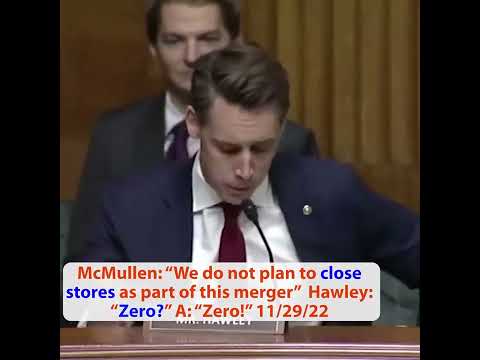
Kroger and Albertsons Executives Tell Hawley: “Zero” Stores Will Close and “No Frontline Layoffs” From Merger — Carefully Worded Promises Leave Non-Frontline Positions Vulnerable
On 12/4/2022, Senator Josh Hawley (R-MO) pressed Kroger and Albertsons executives during a congressional hearing on the specific workforce and store impacts of their proposed merger. Albertsons CEO Vivek Sankaran committed: “We do not plan to close stores as part of this merger — zero, zero.” Hawley pressed for absolute clarity: “You won’t be shuttering them in any form, not spinning them off, not — not getting them away. You’re going to keep everything open in your current footprint?” The executives then pivoted to qualifications — “we will work with the FTC in terms of divesting stores to a viable competitor” and “if that’s not successful using the spin-co structure as well.” On layoffs, the commitment was similarly qualified: “We will not lay off any frontline workers as part of this.” Hawley noticed the qualifier: “What does that mean? No workers — if you look at frontline workers? You’re inserting the word frontline?” The executive confirmed — “frontline” meant warehouses, manufacturing plants, and stores — leaving other positions vulnerable.
”Zero, Zero”
The hearing opened with an apparently absolute commitment. Albertsons CEO Vivek Sankaran said: “We do not plan to close stores as part of this merger — zero, zero.”
The double “zero” emphasis was designed to communicate absolute certainty. No stores would close because of the merger. The executives wanted this claim on the public record because store closures were one of the primary concerns about the proposed merger.
The Kroger-Albertsons merger would create the largest supermarket chain in the United States. The combined company would operate approximately 5,000 stores across nearly every state. Antitrust concerns focused on markets where Kroger and Albertsons stores overlapped — areas where the merger could create local near-monopolies in grocery retail.
Store closures were the direct employment threat to affected communities. A Kroger store closing because the combined company had an Albertsons store nearby meant real job losses for specific workers, real disruption for specific customers, and real reductions in competition in specific markets. The executives’ “zero, zero” commitment was meant to reassure Congress, employees, and communities that this threat was unfounded.
”Zero?” and the Walk-Back
Hawley pressed for absolute clarity. “Zero?” Hawley asked, seeking confirmation. The executive replied: “Zero, Mr. Sankaran — Senator, as the CEO of your company, Mr. McMullen, makes those decisions. But as he said, he plans to — you — and you won’t be — you won’t be shuddering them in any form, not spinning them off, not — not getting them away. You’re — you’re going to keep everything open in your current footprint?”
Hawley’s question was exhaustive. He wanted to rule out every possible form of store closure, including:
Shuttering — traditional closure of stores Spinning off — divesting stores to a separate company “Getting them away” — any other transfer mechanism
These were the major forms of store disposal available in corporate mergers. Spinoffs in particular were common in antitrust merger approvals — the FTC often required merging companies to spin off stores in overlapping markets to preserve competition. If stores were spun off to a new competitor, they might continue operating but would no longer be part of the Kroger-Albertsons system.
The executive’s response confirmed the qualification Hawley had anticipated. “Yes, but we will work with the FTC in terms of divesting stores to a viable competitor, and if that’s not successful, using the spin-co structure as well.”
This was a significant qualification. The executive was essentially saying:
First choice: Keep all stores open (the “zero closures” position) Second choice: Divest some stores to another competitor (selling them to Walmart, Aldi, or another grocery chain) Third choice: Spin off stores into a new company (creating a new entity from the divested stores)
Any of these second or third choices would mean the Kroger-Albertsons combined company wouldn’t keep every store. The “zero closures” commitment was more narrowly focused than it had initially appeared — it meant “we won’t shut stores permanently” but allowed for many stores to leave the combined company.
”What Does That Mean?”
Hawley noticed the qualification. “Well, what does that mean? I mean, how many — how many stores are you going to spin off then?” Hawley asked.
The executive couldn’t answer. “We don’t know,” the executive said.
The “we don’t know” answer was significant. The executives couldn’t commit to zero closures while also acknowledging they didn’t know how many stores would be divested or spun off. The mathematical problem was obvious: if they didn’t know how many stores would be divested, they couldn’t commit to zero stores leaving the combined company.
The “we don’t know” also had legal implications for the hearing. Executives testifying before Congress have obligations to provide truthful information. If they genuinely didn’t know how many stores would be divested, that uncertainty was itself a significant data point for senators evaluating the merger. If they knew but were declining to say, that would be a different kind of problem.
The Layoff Question
Hawley moved to the workforce. “How do you plan to reduce your workforce as an outcome of this merger? How many layoffs are we talking?” Hawley asked.
The executive’s response included another careful qualification. “We will not lay off any frontline workers as part of this,” the executive said.
Hawley caught the qualifier immediately. “What — what does that mean? No workers — if you look at frontline workers? You’re inserting the word frontline?” Hawley asked.
The word “frontline” was the critical qualifier. The executive wasn’t committing to no layoffs overall — he was committing to no layoffs of “frontline” workers specifically. Everyone else — administrative staff, middle management, corporate employees, support functions — was potentially vulnerable to layoffs.
”What’s Frontline?”
Hawley pressed for a definition. The executive clarified: “Frontline would be warehouses, manufacturing plants, stores. There would be no layoffs.”
This definition covered the most visible workforce — the people customers interacted with in stores, the people who moved products through warehouses, the people who made products in manufacturing plants. These were the workers whose jobs most directly touched consumers and whose layoffs would create the most public outcry.
But the definition excluded many categories of Kroger and Albertsons employees:
Corporate headquarters employees — marketing, finance, legal, IT, human resources Middle management — district managers, regional operations staff Support services — call centers, customer service, administrative functions Specialized positions — procurement, real estate, construction, merchandising
All of these positions were vulnerable to layoffs under the “no frontline layoffs” commitment. In typical mergers, these back-office positions see the most significant reductions because the combined company can eliminate duplicative corporate functions.
The careful distinction was important because it meant the “no layoffs” commitment — while technically honored for frontline workers — would almost certainly involve significant layoffs elsewhere in the combined company. Senators and employees who heard “no frontline layoffs” as “no layoffs” would be misled about the likely actual impact.
The Qualification Pattern
The exchange revealed a consistent pattern in the executives’ commitments. Each apparent promise was accompanied by a qualification:
“Zero store closures” — but stores might be divested or spun off “No frontline layoffs” — but non-frontline workers might be laid off “Current footprint preserved” — but through restructuring rather than literal operational continuity
The pattern suggested executives who were willing to make public commitments only when those commitments could be qualified in ways that preserved flexibility. This was typical corporate-legal behavior — technically true statements that created misleading impressions.
Hawley’s role was to expose the qualifications. By asking specific follow-up questions, he forced the executives to acknowledge the limits of their commitments. This gave senators and the public a more accurate understanding of what was actually being promised versus what sounded like it was being promised.
”We’ll Look At”
When asked which positions might be laid off, the executive began a vague response. “Well — together we’ll look at, you know, from an…” the executive said before the transcript cut off.
“We’ll look at” was characteristic corporate non-answering language. It implied process without committing to outcomes. The executive wasn’t saying which positions would be laid off or how many. He was saying the merged company would assess after completion.
But this kind of open-ended assessment was exactly what senators and employees needed to worry about. Mergers typically produced significant consolidation of back-office functions, and “we’ll look at” meant significant numbers of positions were at risk. Without specific commitments, workers in non-frontline positions had no assurance their jobs would survive the merger.
The Antitrust Implications
The store closure and layoff questions were directly relevant to antitrust review of the merger. The Federal Trade Commission and Department of Justice evaluate proposed mergers for competitive impact. Key questions include:
Will the merger reduce competition in specific markets? If Kroger and Albertsons stores overlap in a specific city, closing one might reduce choice for consumers in that market.
Will the merger harm workers? Labor market monopsony — where employers have disproportionate power to set wages — can result when merging companies remove alternative employment options.
Will the merger harm suppliers? Larger combined buyers have more leverage over suppliers, potentially forcing suppliers to accept lower prices or worse terms.
The executives’ commitments were meant to address these concerns. But the qualifications they added undermined the reassurance. “Zero store closures” except for divestments and spinoffs was less reassuring than “zero store closures.” “No frontline layoffs” except for back-office staff was less reassuring than “no layoffs.”
Key Takeaways
- Senator Hawley pressed Kroger and Albertsons executives on store closures and layoffs from their proposed merger.
- Albertsons CEO said “We do not plan to close stores — zero, zero” — but then qualified this to allow FTC-required divestments and spin-offs.
- When asked how many stores would be spun off, the executive said “we don’t know.”
- The layoff commitment was qualified: “no frontline workers” — but “frontline” was defined to exclude corporate, administrative, and management positions.
- The exchange revealed a pattern of carefully qualified commitments that sounded absolute but preserved significant flexibility for the merged company.
Transcript Highlights
The following is transcribed from the video audio (unverified — AI-generated from audio).
- We do not plan to close stores as part of this merger — zero, zero.
- You won’t be shuttering them in any form, not spinning them off, not getting them away?
- We will work with the FTC in terms of divesting stores to a viable competitor, and if that’s not successful using the spin-co structure.
- How many stores are you going to spin off then? — We don’t know.
- We will not lay off any frontline workers as part of this.
- You’re inserting the word frontline? — Frontline would be warehouses, manufacturing plants, stores. There would be no layoffs.
Full transcript: 216 words transcribed via Whisper AI.