 HYGO News
 Sen. Kennedy: '$500 Million a Year' for NPR/PBS -- 'Not a Single Solitary Dime'; 'Without the First Amendment, How Do We Know Who the Idiots Are?'
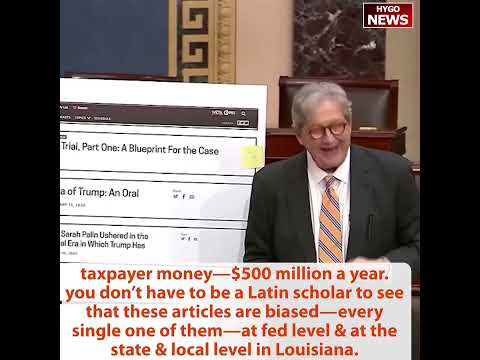
Sen. Kennedy: “$500 Million a Year” for NPR/PBS — “Not a Single Solitary Dime”; “Without the First Amendment, How Do We Know Who the Idiots Are?”
Senator John Kennedy of Louisiana delivered a Senate floor speech in April 2025 calling for the abolition of the Corporation for Public Broadcasting in the reconciliation package. “The United States taxpayers spend $500 million a year subsidizing these media organizations,” Kennedy said. “There was a time when maybe we needed to do that — back in the 40s and 50s, we only had three TV stations. But those days are gone.” He cited specific biased headlines paid for with tax dollars and concluded: “These folks have the right to publish that — I support the First Amendment. Without the First Amendment, how are we supposed to know who the idiots are? But they do not have the right to publish it with taxpayer money. Not a single solitary dime."
"$500 Million a Year”
Kennedy opened by establishing the taxpayer cost.
“The United States taxpayers spend $500 million a year subsidizing these media organizations,” he said.
He provided the historical context: “There was a time when maybe we needed to do that. Back in the 40s and the 50s, we only had three TV stations and a handful of radio stations. It might have been necessary for government to get in the TV and radio business, particularly to help our citizens in rural areas.”
Then the shift: “But those days are gone. Now there are all kinds of forms of media. We’ve got TV, newspapers, radios. We’ve got the internet. We’ve got Facebook. We’ve got blogs. We’ve got podcasts. We’ve got cable TV. We’ve got streaming TV.”
The conclusion: “But yet the government continues to spend $500 million a year to subsidize the Corporation for Public Broadcasting, National Public Radio, and PBS. And it ought to stop.”
Kennedy’s media landscape argument was unanswerable on its merits. The Corporation for Public Broadcasting had been created in 1967, when Americans had access to three broadcast networks, local newspapers, and AM radio. In 2025, Americans had access to hundreds of cable channels, thousands of streaming options, millions of podcasts, and unlimited internet content. The scarcity argument that had justified public broadcasting no longer existed.
”Picking Winners” in Louisiana
Kennedy brought the argument home to his state, demonstrating that the subsidy was inherently discriminatory.
“Louisiana has 318 radio stations,” he said. “Only 10 of them get money from federal taxpayers through the Corporation for Public Broadcasting. So the folks who are publishing the articles I just referenced picked 10 out of 318 and said, ‘We’re going to favor you and give you money.’”
He continued: “My state also has 48 TV stations. Eight of them get federal money — your dollars. I don’t know what the other ones did not to get federal money.”
The conclusion: “Clearly this is a case of the federal government picking winners and losers.”
The Louisiana example made the fairness argument concrete. Of 318 radio stations in the state, only 10 received federal subsidies. Of 48 TV stations, only 8 received federal money. The other 308 radio stations and 40 TV stations operated without taxpayer support. The subsidy was not a universal benefit to the media industry; it was a targeted advantage given to a select few outlets — outlets that, as Kennedy was about to demonstrate, used the money to produce biased content.
The Biased Headlines
Kennedy cited specific headlines from federally funded outlets.
“Democracy on Trial, Part One: A Blueprint for the Case Against Trump,” Kennedy read. “It’s paid for with your tax dollars. This is opinion journalism.”
Another: “These Far-Right Media Figures Are Getting Center Stage Under Trump.”
Kennedy assessed the content: “Now, look, you don’t have to be a Latin scholar to see that these articles are biased. Every single one of them. At the federal level and at the state and local level in Louisiana.”
He acknowledged the right to publish: “And you know what? That’s the right of these state and local television stations. They have the right to say this stuff.”
Then the critical distinction: “But they don’t have the right to say it with your money.”
The argument was not about censorship. Kennedy was not proposing that NPR or PBS be prohibited from publishing biased content. He was arguing that taxpayers should not be forced to fund it. The outlets could say whatever they wanted — but they should fund their own operations, just like the hundreds of other media organizations that operated without government subsidies.
The Debt Argument
Kennedy connected the NPR/PBS funding to the national debt crisis.
“Some of my colleagues are angry at the Corporation for Public Broadcasting and NPR and PBS because of their obviously biased reporting,” he said. “That’s just a fact. No fair-minded American can look at these headlines and say those aren’t biased.”
He then distinguished his concern: “Some of my colleagues are mad about that. That’s not what concerns me the most. I’m sorry they’re mad, but that’s not what concerns me the most.”
Kennedy’s primary objection: “My question is this. What in God’s name, what on God’s green earth are we doing with $36 trillion worth of debt — which is just accumulated deficits — why are we giving certain TV stations and certain radio stations in America, but not others, $500 million a year?”
He posed the equity question: “They don’t need it. Even if they did need it, they shouldn’t get the money to the exclusion of every other media organization. What happened to treating all people and all entities similarly situated similarly?”
The debt framing elevated the NPR/PBS debate from a culture war issue to a fiscal responsibility issue. With $36 trillion in national debt and interest payments consuming an ever-larger share of the federal budget, every expenditure had to be justified. Subsidizing a handful of media outlets that were fully capable of funding themselves — and that were biased in their coverage — was indefensible in an era of fiscal emergency.
”How Are We Supposed to Know Who the Idiots Are?”
Kennedy delivered the line that would be replayed across social media.
“I want to say it again,” he said. “The people who wrote these articles and the people who published these articles have every right to do that. I mean, I’m a firm believer in the First Amendment.”
Then the classic Kennedy zinger: “Without the First Amendment, how are we supposed to know who the idiots are?”
He applied the principle: “I support the First Amendment, and these folks have the right to publish that. But they do not have the right to publish it with taxpayer money. $500 million a year.”
The Reconciliation Call
Kennedy concluded with the legislative action he wanted.
“I think you know how I feel,” he said. “We know how President Trump feels. But I hope the United States Congress, in our reconciliation package, abolishes the Corporation for Public Broadcasting and no longer gives them or any media organization in this country a single solitary dime of taxpayer money.”
He stated the principle: “That’s not the role of the federal government.”
He stated the consequence: “And given these kinds of articles, to do so incites the anger of at least half of our country. And that is not right.”
The reconciliation vehicle was significant because reconciliation bills could not be filibustered in the Senate — meaning they required only 51 votes rather than 60. If the CPB defunding was included in the reconciliation package alongside tax cuts, border security, and energy policy, it would pass with a simple Republican majority.
Key Takeaways
- Kennedy called for abolishing the Corporation for Public Broadcasting: “$500 million a year” to subsidize media “ought to stop.”
- He argued the historical justification expired: “In the 40s and 50s, we had three TV stations. Now we have the internet, podcasts, streaming, cable.”
- Louisiana example: 10 of 318 radio stations and 8 of 48 TV stations receive federal money — “the government is picking winners and losers.”
- Kennedy’s line: “Without the First Amendment, how are we supposed to know who the idiots are?”
- His demand: Include CPB abolition in the reconciliation package — “not a single solitary dime of taxpayer money.”