 HYGO News
Kennedy's 50-Second Quiz for Judge James Simmons: 'Have You Ever Tried a Case in Federal Court?' (November 30, 2022)
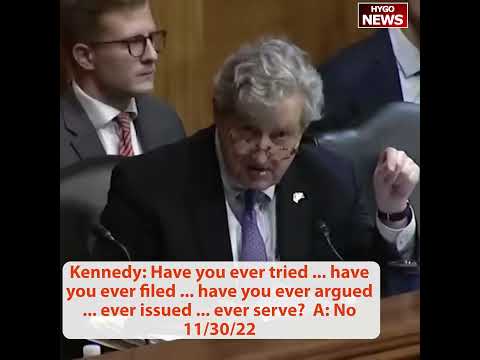
On November 30, 2022, the Senate Judiciary Committee held a confirmation hearing for six of President Biden’s nominees: Judge Jonathan Grey for the Eastern District of Michigan, Julia Kobick for the District of Massachusetts, Judge Rita Lin for the Northern District of California, Judge Ramon Reyes for the Eastern District of New York, Judge James Simmons Jr. for the Southern District of California, and Amy Solomon to lead the Justice Department’s Office of Justice Programs [1]. Sen. John Kennedy of Louisiana opened his turn with a complaint: “I have been given 50 seconds to ask each of you questions and to hear your answers, which, of course, is patently absurd.” This video shows the questions he asked Simmons. All quotes below are from the official hearing record, Senate Hearing 117-971 [1].
Who Simmons Was
Sen. Dianne Feinstein of California introduced Simmons as a graduate of the University of California, Berkeley, and Golden Gate University School of Law who had worked as a deputy city attorney in San Diego and then spent 12 years as a county prosecutor, eight of them in a gang prosecution unit. In 2017, he was appointed to the San Diego Superior Court, where he had become a supervising judge [1].
Key Moments
”Have you ever tried a case in Federal court?”
“Have you ever tried a case in Federal court?” Kennedy asked. “I have not, Senator.” “Have you ever filed a brief in Federal court?” “I have not practiced in Federal court. My entire practice has been in the State court.” “Have you ever argued a motion in Federal court?” “My entire practice of over 12 years as a prosecutor has been in State court, Senator."
"So, the answer’s no?”
Kennedy then asked about Simmons’s five years on the state bench. Had he presided over a jury trial? “As a judge, I have presided over court trials, not jury trials, sir,” Simmons said. “So, the answer’s no?” “I have not presided over a jury trial as a judge.” Had he issued any written opinions? “I’ve been in moving departments in the 5 years that I’ve been a superior court judge. We don’t issue written opinions in moving departments on the superior court.” “So, the answer’s no?” Kennedy asked again, and Simmons repeated his answer.
The quiz
Kennedy then ran through a series of legal questions:
- Standard of review for questions of fact: “For questions of fact by the trial court, it is clear error, sir.”
- For questions of law: “In the trial court level, it’s de novo.”
- The holding of Mapp v. Ohio: “I know what the holding is. It escapes me as I currently sit here.”
- The Chevron doctrine, which Kennedy said “You’ll see that a lot”: “Chevron deference refers to an administrative agency that’s interpreting its own rule. It created a two-part step test. The first step in that test is whether Congress was clear.” “Okay. You know it. I got you,” Kennedy said.
- The political question doctrine: Simmons said he had not practiced in federal court and would “apply the applicable law” if confirmed.
- Plenary or enumerated powers? “Enumerated powers, sir.”
Judge Lin’s college article
Before turning to Simmons, Kennedy read Judge Rita Lin a sentence from an article she wrote in 1998 as a Harvard undergraduate: “The problem with the Christian coalition is not that they are Bible thumpers … but that they are bigots.” “I did write that, when I was … 20 years old,” Lin said. “I do not agree with that today.” “You were a grown woman when you wrote this,” Kennedy replied. “Wow.”
Fact Check
- Clear error and de novo. Right. Under the federal rules, a trial court’s “findings of fact … must not be set aside unless clearly erroneous” [2], and appeals courts review questions of law de novo, without deference. Simmons’s “trial court level” phrasing was loose, but the answers were correct.
- Mapp v. Ohio. Not answered. The 1961 decision held that “all evidence obtained by searches and seizures in violation of the Constitution is, by that same authority, inadmissible in a state court,” applying the exclusionary rule to the states [3].
- Chevron. Partly right. Simmons correctly began describing the two-step test, but Chevron concerned an agency’s interpretation of a statute, not of “its own rule.” The first question was “whether Congress has directly spoken to the precise question at issue,” and, if not, “whether the agency’s answer is based on a permissible construction of the statute” [4]. Deference to an agency’s reading of its own regulations is a separate doctrine, known as Auer deference, which the Supreme Court described in 2019 as deference to “an agency’s reasonable reading of its own genuinely ambiguous regulations” [5].
- Enumerated powers. Right. The Constitution lists Congress’s powers, and the Tenth Amendment provides that “the powers not delegated to the United States by the Constitution, nor prohibited by it to the states, are reserved to the states respectively, or to the people” [6].
What Happened Next
- All five judges were confirmed in 2023, according to the Federal Judicial Center [7]: Grey on March 2 (49–42), Simmons on March 9 (51–43), Lin on September 19 (52–45), Kobick on November 7 (52–46) and Reyes on November 8 (51–48).
- Chevron was overruled. Kennedy told Simmons he would “see that a lot.” On June 28, 2024, in Loper Bright Enterprises v. Raimondo, the Supreme Court wrote: “Chevron is overruled” [8].
Sources
- GovInfo: Senate Hearing 117-971, Confirmation Hearing on Federal Appointments (November 30, 2022)
- Legal Information Institute: Federal Rule of Civil Procedure 52
- Legal Information Institute: Mapp v. Ohio, 367 U.S. 643 (1961)
- Legal Information Institute: Chevron U.S.A. v. Natural Resources Defense Council, 467 U.S. 837 (1984)
- Legal Information Institute: Kisor v. Wilkie (2019)
- Legal Information Institute: Tenth Amendment
- Federal Judicial Center: Biographical Directory of Article III Federal Judges
- Legal Information Institute: Loper Bright Enterprises v. Raimondo (2024)